Co-Marketing Agreement Template: The Clauses That Matter for Partner Webinars and Events

Short answer: A co-marketing agreement is the contract two companies sign before they market together. It sets who does the work, who pays, who owns the leads, how shared registrant data is handled, and how you’ll measure success. You need one for joint webinars, events, content and lead sharing. Most templates cover the legal basics. In practice, the clauses that decide whether the program produces pipeline are lead ownership, data consent and measurement.
What is a co-marketing agreement?
A co-marketing agreement is a written deal between two or more companies that promote something together. Some teams call it a joint marketing agreement. In fact, both names mean the same thing. It covers one campaign or a whole program of them.
In partnerships, the parties are usually a software vendor and one of its B2B partners. That could be a tech alliance partner, a reseller, a distributor, an OEM, an agency or consultancy, an ISV, an implementation partner, and the list goes on. So the agreement sits next to your partner agreement. It doesn’t replace it.
Here’s my view. Co-marketing is the easy part to agree on and the hard part to get value from. Two logos on a webinar page feel like progress. But without clear terms, nobody owns the follow-up, and the registrant list sits in a spreadsheet nobody opens. That’s why the agreement should serve a partner marketing strategy with a pipeline goal.
If you’re still sorting out which motion you’re running, start with our guide to co-sell vs co-marketing. It’s the pillar this post builds on.
When do you need a joint marketing agreement?
You need one any time partners share money, data or brand. In practice, that covers most joint marketing work:
- Joint webinars. Two companies, one registration page, one list of registrants.
- Field events. Happy hours, dinners, roadshows and conference activations where costs and invite lists are split.
- Joint content. Co-authored guides, reports or case studies that carry both brands.
- Lead sharing. Any campaign where one party passes contacts or meetings to the other.
For a one-off blog swap, an email confirming the terms may be enough. However, once registrant data moves between companies, write it down. That’s the moment the legal risk and the pipeline value both show up. That goes double for in-person partner field marketing, where attendee lists move between partners.
What clauses should a co-marketing agreement include?
These are the eight clauses I’d never skip. The first two are standard. The rest are where most partner programs get burned.
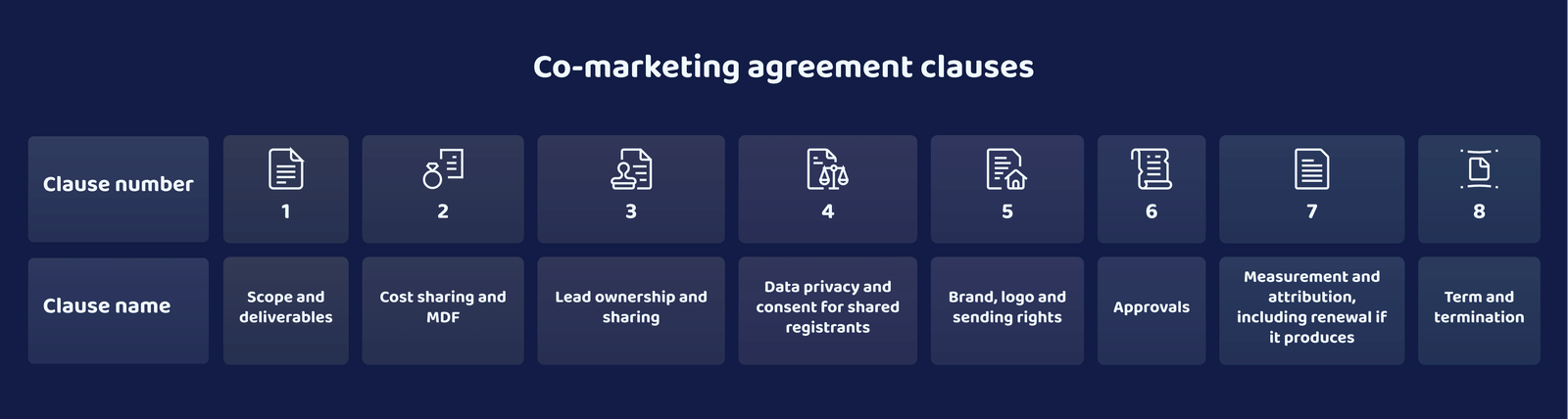
- Scope and deliverables. Name the campaign, the dates and who produces what. List the landing page, the emails, the speakers, the slides and the follow-up. Vague scope is where resentment starts.
- Cost sharing and MDF. State who pays for what, in dollars, and when. If a partner is funding the work with market development funds (MDF), say which costs MDF covers and what proof of performance they need.
- Lead ownership and sharing. Decide who owns each registrant, who follows up and how fast. Also decide what happens when both companies already know the account.
- Data privacy and consent for shared registrants. Spell out what registrants agree to on the form, who sends what, and how opt-outs flow between companies.
- Brand, logo and sending rights. Each side licenses its marks for this campaign only, under its brand guidelines. Also decide who sends: from whose domain, under whose name, and whether a co-branded domain is allowed.
- Approvals. Set who signs off on copy, how long they get, and what happens if they go quiet.
- Measurement and attribution. Agree on the goals before launch and on how credit gets assigned after. Also agree on what happens if it produces. Does the funding renew next quarter? Most teams never write that down.
- Term and termination. Set an end date, how either side exits, and what happens to shared data when it ends.
Why lead ownership is the clause that matters most
Most fights after a joint webinar are about leads. One partner thinks a registrant is theirs. Meanwhile, the other already has an open deal there. Then the registrant gets two follow-up emails and ignores both.
So decide this up front. For example, each party might own registrants from its own customer base. Net-new registrants could go to whoever the partner agreement assigns. Then name the person who does follow-up and set a deadline in business days.
Also, think about credit. In our guide to partner-sourced vs partner-influenced pipeline, we cover a simple rule. If your team books it, it isn’t partner-sourced. If a partner invites its own customers and they show up, that can count as partner-sourced. And if the platform’s own BDRs will do the follow-up, ask the partner team first whether that still counts as partner-sourced. Write down which policy applies before anyone argues about it.
Why data consent can’t be an afterthought
Shared registrant lists are personal data. That means privacy law applies, not just your goodwill.
In the US, the FTC’s CAN-SPAM compliance guide says you must honor an opt-out within 10 business days. It also says that when one email promotes more than one marketer, they can name one of them as the “sender” for compliance. In the EU, Article 26 of the General Data Protection Regulation says companies that jointly decide how data is processed are joint controllers. They must set out their responsibilities in an arrangement.
In short, your registration form should tell people exactly who will contact them. Then your agreement should say who sends, who stores the data and how unsubscribes get shared.
What does a co-marketing agreement template look like?
Here’s a template outline you can copy into your own document. The sample language is a starting point for your lawyer, not finished contract wording.
| Clause | What to decide | Sample language |
|---|---|---|
| Scope and deliverables | Campaign, dates, owner of each asset | “Party A will build the registration page and host the webinar on [date]. Party B will provide one speaker and promote to its customer list.” |
| Cost sharing and MDF | Who pays, how much, when, which costs MDF covers | “Costs will be split [X%/Y%]. Party B will fund [$ amount] from MDF, payable by [date], and will receive the proof of performance listed in Exhibit A.” |
| Lead ownership and sharing | Who owns each registrant, who follows up, how fast | “Registrants from accounts where a party has an open opportunity belong to that party. All other registrants are assigned per Exhibit B. Follow-up begins within [X] business days.” |
| Data privacy and consent | Consent language, sender, storage, opt-out sharing | “The registration form will name both parties. Each party will process registrant data only for this campaign and will share opt-out requests within [X] business days.” |
| Brand, logo and sending rights | Scope of the license, brand guidelines, sender and sending domain | “Each party grants the other a limited license to use its name and logo solely for this campaign, per its brand guidelines. Campaign emails will be sent by [party] from [domain].” |
| Approvals | Who approves, how long, what silence means | “Each party will review materials within [X] business days. Materials not approved in that window may not be published.” |
| Measurement and attribution | Goals, reporting cadence, credit rules, renewal | “The parties will report target accounts attending, meetings held and opportunities created within [X] days of the event. Credit follows each party’s attribution policy. If the campaign meets its goal, the parties will review funding for the next quarter by [date].” |
| Term and termination | End date, exit notice, data handling at the end | “This agreement ends on [date]. Either party may end it with [X] days’ written notice. Shared data will be deleted or returned within [X] days.” |
What about the standard legal clauses?
Your lawyer will add the clauses most commercial contracts carry. Those include ownership of the content you create together, confidentiality, warranties and limits of liability, and governing law and disputes. They matter. They just rarely decide whether the program produces pipeline.
This isn’t legal advice. Every company, partner and jurisdiction is different. Have your own counsel review any co-marketing agreement before you sign it.
What mistakes do teams make with co-marketing agreements?
These are the mistakes I see most often:
- Treating it as a logo swap. Both sides sign, nobody owns the work, and the event runs on hope.
- Leaving lead ownership open. Then both teams chase the same people, or neither does.
- Skipping consent language. A form that names only one company makes sharing the list risky.
- No goals before launch. Teams agree on a date and a topic, then invent the success metric after.
- Ignoring the marketing calendar. Your own marketing team is often the bottleneck. Partners wait in line for a slot that may not come this quarter.
- Letting the partner run it blind. If the partner manages the event, you should still see registrations and activity in real time.
Notice that most of these aren’t legal problems. Instead, they’re operating problems. The agreement is just where you fix them in writing.
How should you measure co-marketing?
Measure target accounts in the room and meetings held. Don’t measure signups.
Here’s the trap. A lot of partner events track registrants and attendees, and stop there. Few set goals up front. So plan the funnel before launch: how many target accounts you’ll invite, how many you expect in the room and how many meetings that should produce. Every co-host signs up to the same numbers.
So put these measures in the agreement:
- Target accounts invited. Build the invite list from accounts both companies care about. Use your partner data in Crossbeam to see which accounts are already your partner’s customers or open opportunities.
- Target accounts in the room. Count accounts, not heads.
- Meetings held. Count meetings that actually happened, not meetings requested.
- Opportunities created. Count sales-qualified opportunities (SQOs) tied back to the campaign.
- Cost per SQO. Divide total spend, including any MDF, by opportunities created.
Then agree on who reports these numbers and when. Ideally, every party sees the same activity as it happens. Nobody should have to wait for a recap deck.
Using MDF to fund the program
Partners fund programs, not tools. A partner is far more likely to commit MDF to a campaign with named target accounts and an SQO goal than to a vague “let’s do a webinar.” Also check the timing rules. Many funders want the work delivered in the same quarter the MDF is spent, so put the delivery dates in the agreement.
Therefore, tie the cost-sharing clause to the measurement clause. Write the plan first, then ask for the funds. Our MDF guide covers the mechanics of requesting and reporting on MDF. And if the partner offers co-op funds instead, here’s how co-op marketing differs from MDF.
Related reading
- Channel Partner Marketing Plan: Build the Template
- Deal Registration Form: What to Include (Template)
- Ecosystem Map Template: How to Build Yours
- Partner Marketing Manager: Role, Skills, and Metrics
- Partner Marketing Software: What It Is, How It Works
Frequently asked questions
Is a co-marketing agreement the same as a joint marketing agreement?
Yes. In practice, the two terms are used for the same contract. Some legal teams also call it a cross-marketing agreement or a marketing partnership agreement.
Do I need a co-marketing agreement for one webinar?
If registrant data, money or logos move between companies, yes. A short agreement for one campaign is fine. It just needs the key clauses in this template.
Who owns the leads from a joint webinar?
Whoever the agreement says. A common approach gives each party registrants from its own accounts, then splits net-new registrants by a rule both sides accept.
Can partners use MDF to pay for co-marketing?
Often, yes. Partners commonly fund joint webinars and events with MDF. Each program sets its own rules, so confirm eligible costs and proof of performance with your partner before you spend.
Does a co-marketing agreement replace my partner agreement?
No. Your partner agreement covers the overall relationship. The co-marketing agreement covers specific campaigns and usually points back to it.
Is this template legal advice?
No. It’s an outline to help you prepare. Have a qualified lawyer review your co-marketing agreement before anyone signs.
What’s the bottom line on co-marketing agreements?
A good co-marketing agreement does more than protect you. It forces both partners to decide who owns the work, the leads and the result before the first invite goes out. Get lead ownership, consent and measurement right, and joint marketing turns into pipeline. Skip them, and you get a nice webinar and a forgotten spreadsheet.
That’s the work we run every day as a B2B partnerships agency. We run partner webinars and events end to end, measured on meetings and pipeline. When you want partners to own the pipeline too, our Partner-Sourced Pipeline program runs GTM motions with your partners every quarter. Or see what’s included when we act as your partner marketing team as a service.
Forecastable is an independent third-party professional services company. Our evaluations of other vendors are based on publicly-available information as of November 2026 and our own client experience.
Want to know which partners would co-fund your next webinar or event, and what it should produce? Book a Program-Fit Analysis
Uncover Your Growth Potential
Schedule a Discovery Call