Square Partner Program: The Three Paths and How Partners Get Noticed

Short answer: The Square partner program gives companies three ways in. Developers publish apps in the Square App Marketplace. Agencies and integrators become solutions partners who build for sellers. And service firms refer businesses to Square for a bonus. Square publishes no tier ladder. Instead, it rewards referral volume and seller success. So the partners who stand out are the ones bringing Square new sellers, often by producing partner-sourced pipeline with other Square partners.
Looking for the Square partner portal login? Go to the Square partner program site.
Already in the program? Here’s how partners turn it into pipeline.
What is the Square partner program?
The Square partner program is how Square works with the companies that build on it, sell it and serve its sellers. Square calls its merchants “sellers,” so you’ll see that word a lot. Per Square’s partnerships page, there are three paths:
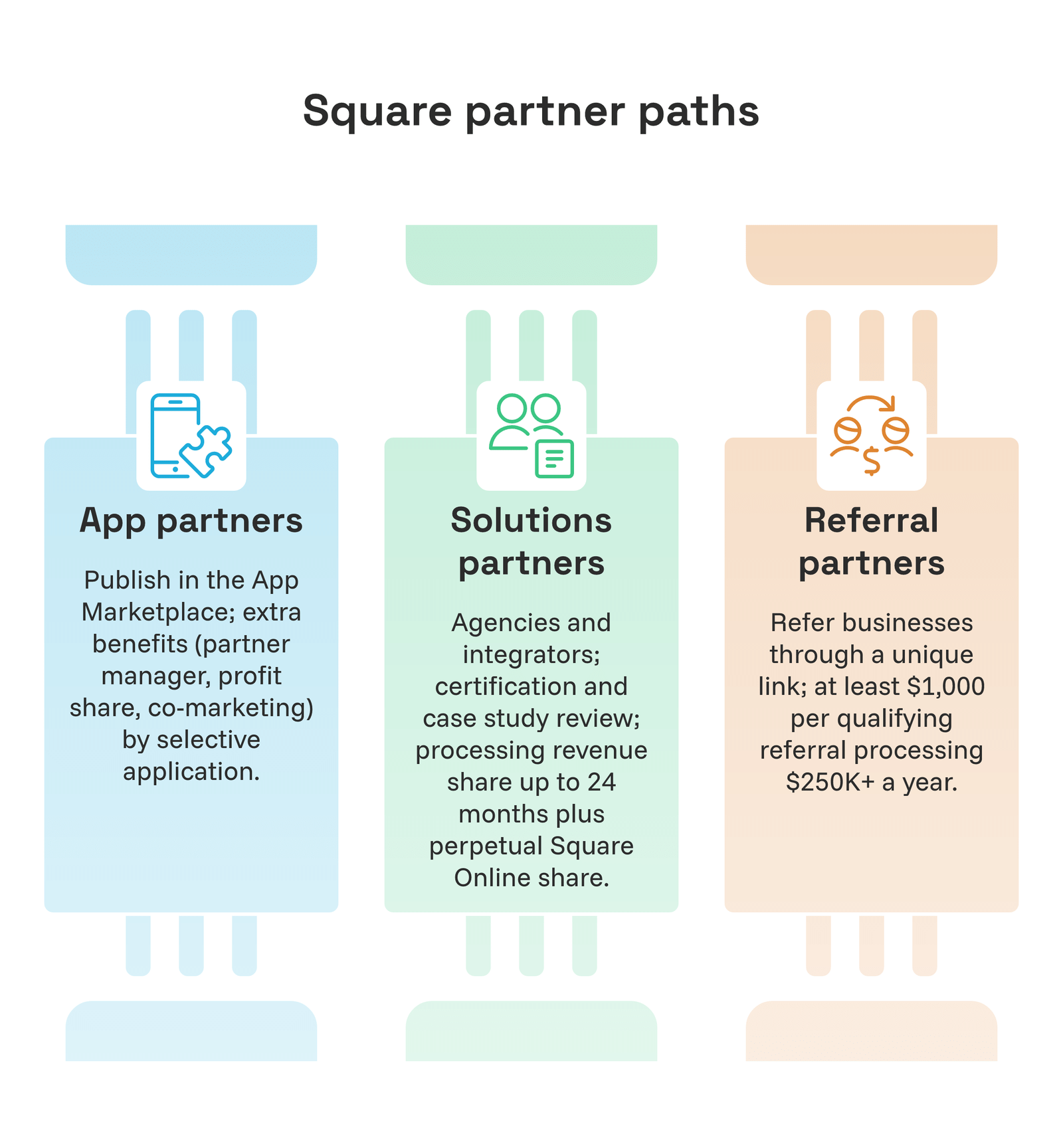
- Publish in the Square App Marketplace, where sellers go to find software.
- Work one-on-one with Square sellers, building websites, custom integrations and marketing.
- Refer businesses to Square, with no development required.
The ecosystem is bigger than most people assume. In a February 19th, 2026 press release, Square said it has nearly 1,000 partners. More than two-thirds of them have built integrations. Square also said 71% of enterprise sellers use at least one of Square’s partner solutions.
That last figure matters. Partner solutions already sit inside most of Square’s enterprise sellers. So partners who help Square win more sellers like them are the ones it wants to hear from.
What types of Square partners are there?
Square doesn’t publish tiers like Bronze or Gold. Instead, it sorts partners by the work they do for sellers. Here’s how the three types compare, as of November 8th, 2026:
| Partner type | Who it fits | How they earn | What Square looks for |
|---|---|---|---|
| App partners | Software companies with a Square integration | Profit share, for partners approved for additional benefits | A live integration; extra benefits go to high-impact opportunities |
| Solutions partners | Agencies, eCommerce partners, systems integrators | A share of processing revenue for up to 24 months, plus perpetual Square Online revenue share | Successful implementations, positive seller feedback, steady lead referrals |
| Referral partners | Accountants, consultants, associations, telecom and legal firms, suppliers | At least $1,000 per qualifying referral | Active promotion and a smooth handoff to sellers |
Those are Square’s program labels. Around any one seller, though, you’ll meet tech alliance partners, resellers, distributors, OEMs, agencies and consultancies, ISVs, implementation partners, and the list goes on.
How do you become a Square app partner?
Square’s app partner page lays out the path:
- Create an app in your Square Developer account.
- Build and test the integration with Square’s APIs.
- Submit your listing with the app for review.
- Pass technical review, content review and QA, and fix anything they find.
Publishing on the Marketplace makes you an app partner. Square says the Marketplace has 3.4 million views.
The bigger benefits sit behind a second application, though. Square lists a dedicated partner manager, profit share eligibility, and enhanced discoverability with co-marketing and sales enablement. It also says it’s selective here. It focuses on “opportunities with the highest impact” and strong seller demand.
So a listing gets you in, but it doesn’t get you a partner manager.
How does the Square solutions partner program work?
Solutions partners are the agencies and integrators who build for sellers. Square lists them in its specialist directory, where sellers go to hire help. Per the solutions partner page, sellers usually want website builds, marketing and SEO, custom integrations, custom apps, and accounting help.
What Square requires
Square spells out what it expects before it approves you:
- Proven work with Square, shown through successful implementations.
- Positive seller feedback.
- A steady volume of lead referrals.
- Fast responses when Square reaches out.
After that, you apply and sign an agreement. On a kickoff call, Square walks through the certification criteria and gives you a case study to review. Pass that review and you’re Square Certified. Finally, an onboarding call gets you partner tools and access. Square says it usually reviews applications weekly.
How solutions partners earn
The economics are published, at least in outline:
- Processing revenue. You earn a percentage of adjusted revenue when you implement Square through point-of-sale or eCommerce APIs. Earnings are capped at 24 months.
- Square Online referrals. You earn a perpetual revenue share on paid Square Online plans.
- Product bonuses. These are tied to point-of-sale implementations, on-demand delivery and referral volume within a 12-month period.
For bonus eligibility, the seller has to create a new Square account. That window runs from 30 days before to 60 days after your referral date. Square doesn’t publish the exact percentages, so check your partner agreement.
How does the Square referral partner program pay?
Referral partners don’t build anything. Instead, they bring Square businesses that need payments and point of sale. Per Square’s referral partner page, new referral partners earn “at least $1000 for every qualifying referral that processes $250K+ annually with Square.”
Square names who fits: consultants, associations, legal and business formation services, telecom providers, finance and accounting firms, and brands and suppliers. The process has four steps:
- Apply. Square reviews the application and follows up.
- Onboard. Square sends a partnership agreement with the terms.
- Refer. Share your unique link. Businesses must sign up through it to count.
- Track. Watch referrals in your account, where bonuses are paid.
Notably, Square expects referral partners to give sellers a Square offer, like free processing or free software, and to offer a product or service that complements Square. It also expects them to promote Square across their own channels. In return, partners may get a listing in the Partner Offers directory, content spots and event invitations.
How does a vendor in the Square ecosystem get Square’s attention?
Look at what Square actually asks for. Solutions partners need “a steady volume of lead referrals.” Referral partners get paid on sellers who process $250,000 or more a year. And extra app partner benefits go to the highest-impact opportunities.
In other words, Square rewards partners who bring it new sellers, especially bigger ones. If you only serve sellers who already run on Square, you’re one of nearly 1,000.
Why partner-sourced pipeline beats going it alone
Think about who already has the seller’s trust. For example, an accounting firm knows a restaurant group’s books. Meanwhile, an agency is rebuilding that group’s website. And an app vendor has the scheduling or inventory product the group needs. Still, none of them gets far calling cold on their own.
As a pair, though, they have a reason to call the same accounts. That’s partner-sourced pipeline: deals that start because a partner opened the door. Here’s how partner-sourced and partner-influenced pipeline differ, if the terms are new.
But there’s a catch. If your own SDR team books the meeting, it most likely won’t count as partner-sourced. Run the outreach as the partner, on the partner’s behalf, and it can. Credit still follows Square’s rules, though. Referrals only count when the seller signs up through the right link. So track every touch.
Start with the accounts, not the pitch
Most partner meetings waste the first ten minutes pulling up lists live. Instead, set an agenda of named accounts before the call. Then sort each account three ways:
- Ask: accounts where you want the partner’s intro.
- Give: accounts where you can hand the partner something.
- Mutual: accounts where you both belong in the room.
If you use Crossbeam, that sorting is where account mapping turns into pipeline. Either way, the list comes first. If your sellers also sell online, here’s how the Shopify partner program is set up.
Bring Square’s team an offer worth passing on
Start with the sellers you already win with. If restaurant groups love your product, lead there, not with a new segment. Square puts its extra app benefits behind high-impact opportunities, so bring proof from day one.
Then give the solutions partners around Square something they can sell. Say an agency is rebuilding a multi-location retailer’s site. Your offer could be a fixed-scope inventory sync for that retailer’s next location launch, priced, limited to a few sellers, and with a clear answer on who pays. Partners rarely respect free, so a free trial alone won’t move them.
Square’s own side has more than one team, too. Partnerships, the app partner managers and the people who run the specialist directory each see different sellers. Ask each one what they think before you launch.
What does a partner GTM motion in the Square ecosystem look like?
A partner go-to-market (GTM) motion is one campaign, run with one partner, into accounts you both care about. Here’s how we run one in the Square ecosystem:
- Pick the partner. Pair an app vendor with a solutions partner, or with an accounting firm that refers sellers.
- Agree on the accounts. Overlap your lists and choose businesses where both of you belong. Multi-location and enterprise sellers are the obvious start.
- Write one joint story. Answer one question: why these two firms, for this business, right now?
- Run the outreach. A human SDR, not AI, cold calls the accounts in the partner’s name, backed by email and LinkedIn. Where it fits, add a field event.
- Hand off the meetings. Booked meetings go to whoever owns the deal, with the partner’s context attached.
- Track every result. Count meetings, new sellers and installs, so you have proof for Square’s partnerships team.
We run these done for you or done with you. Forecastable is a B2B partnerships agency, and we sell partner-sourced pipeline as a service, measured on SQOs, pipeline and revenue. A real campaign operations team and human SDRs do the work. Eva, our AI partner ops agent, tracks every activity, and you get full MCP access to it. You don’t buy seats or a PRM.
One-off motions are quoted individually. Roughly $15K tends to be the average for a one-off motion with one partner, with a part-time SDR making a limited number of calls. That’s a way to prove the model before you scale it. For planning, one SDR makes about 1,000 cold calls a month. A program running three to five motions either prioritizes which motions get SDR calling or adds a second SDR. Our Produce My Pipeline program is the version that runs every quarter.
Partners often fund these motions, too. Big partners rarely pay for your tools, but they will fund a program that produces pipeline. Any GTM motion could cost you $0 if partners pay for it. Before you fund one alone, read how market development funds work.
Frequently asked questions
Is the Square partner program free?
Square doesn’t list a fee to publish an app, apply as a solutions partner or join as a referral partner. Each path does carry its own agreement and review, so check the terms before you sign.
Does the Square partner program have tiers?
Not publicly, as of November 8th, 2026. Square sorts partners into app, solutions and referral partners. App partners can apply for extra benefits, and Square says it’s selective about who gets them.
How much do Square referral partners make?
Square says new referral partners earn at least $1,000 for every qualifying referral that processes $250,000 or more a year with Square. Other terms live in the partnership agreement.
How do Square solutions partners get paid?
They earn a share of adjusted processing revenue for up to 24 months on API implementations. They also earn perpetual revenue share on paid Square Online plans, plus product bonuses.
How do I get listed in the Square specialist directory?
Become a certified solutions partner. That means a signed agreement, a case study review, certification and onboarding calls.
Does Square offer co-marketing for app partners?
Yes, for selected partners. Enhanced discoverability with co-marketing and sales enablement is part of the additional benefits app partners apply for.
What’s the bottom line on the Square partner program?
The Square partner program doesn’t hand out status for showing up. Instead, it rewards referral volume and sellers who grow on Square. Square says 71% of enterprise sellers already use at least one of its partner solutions. So don’t wait for Square to send you deals. Instead, go build pipeline with the partners who serve the same sellers. That’s what gets a platform’s attention. The same small businesses run payroll too, so here’s how the Gusto partner program is set up. Our partner programs hub lists every platform we cover.
Forecastable is an independent third-party B2B partnerships agency. We are not affiliated with or endorsed by Square. Program details are drawn from Square’s public pages and are current as of November 8th, 2026.
Are you an app vendor or solutions partner serving Square sellers? Find out which GTM motion to run first. Book a Program-Fit Analysis
Uncover Your Growth Potential
Schedule a Discovery Call