Gusto Partner Program: The Tracks, the Tiers and How Software Vendors Get Noticed

Short answer: The Gusto partner program comes in three main parts. Accountants and bookkeepers earn up to 20% through four client-based tiers. Next, platforms that serve small businesses join the Channel Partner Program, which is tiered by projected revenue to Gusto. Then software vendors build app integrations or embed Gusto payroll. If you sell software that connects to Gusto, an integration gets you listed. But pipeline built with Gusto’s accountant partners gets you noticed.
Looking for the Gusto partner portal login? Go to the Gusto partner program site.
Already in the program? Here’s how partners turn it into pipeline.
What is the Gusto partner program?
Gusto is payroll, benefits and HR software for small businesses. Search “Gusto partner program” and the top result is Gusto’s support article for accounting firms. That’s the one Gusto calls the Gusto Partner Program. However, Gusto runs several partner tracks, and each one answers a different question.
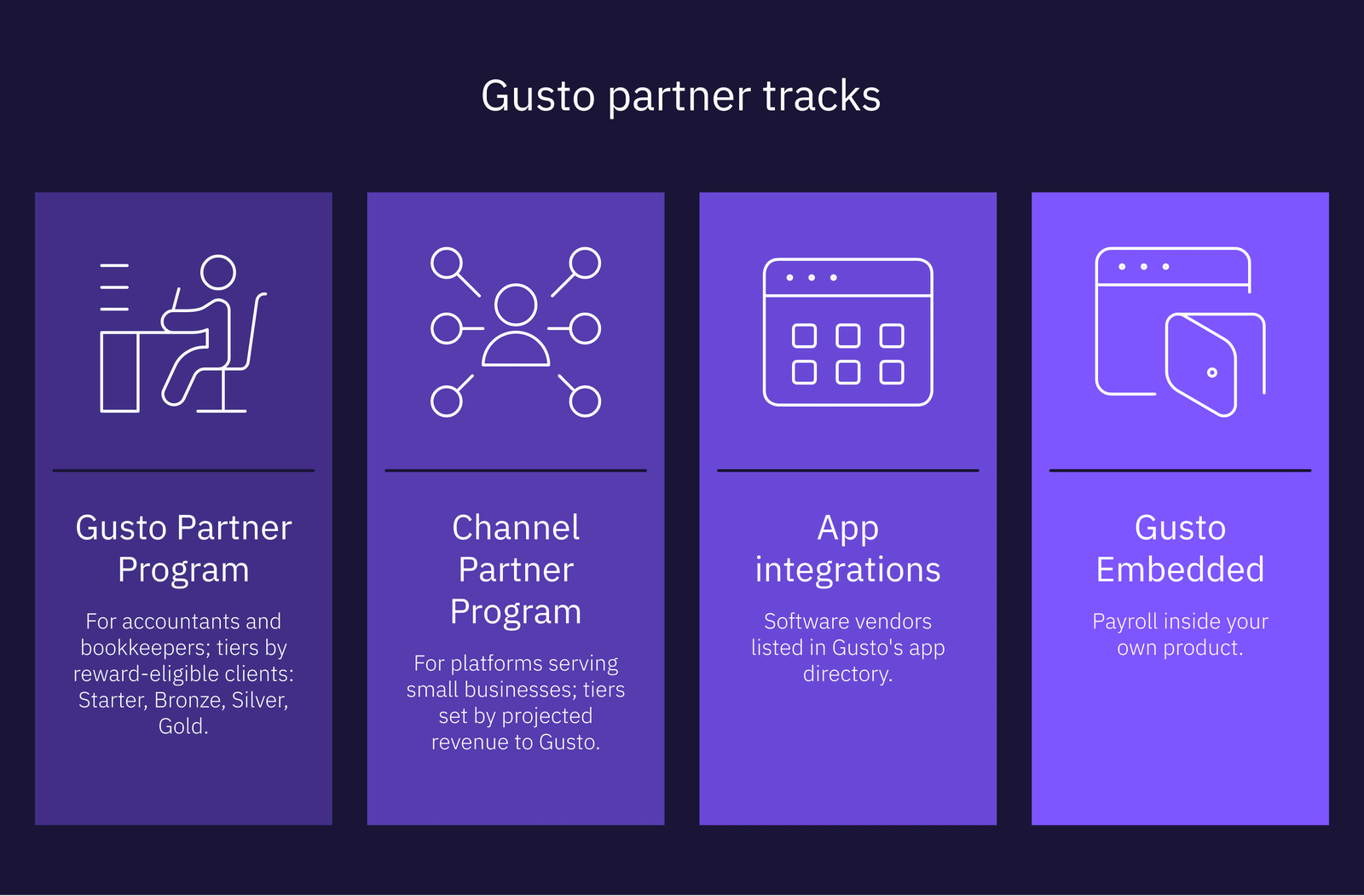
Here’s the map, as of November 8th, 2026:
| Partner track | Who it’s for | How you earn or grow | What it costs |
|---|---|---|---|
| Gusto Partner Program | Accountants and bookkeepers who run payroll for clients | Discount or revenue share of up to 20%, by client count | Free, no minimum |
| Channel Partner Program | Platforms that serve small businesses | Recurring revenue share on referred customers, tiered by projected revenue to Gusto | Free at all tiers |
| App integrations | Software vendors that push or pull data with Gusto | A listing in Gusto’s in-app directory and website | Gusto doesn’t publish a fee |
| Gusto Embedded | Software companies that want payroll inside their own product | Payroll as a feature you sell | Gusto doesn’t publish pricing |
| Affiliate program | Creators with small business audiences | $200 or more per valid business customer | Gusto doesn’t publish a fee |
The affiliate program is the simple one. It pays per sale, per Gusto’s affiliate page. It’s a different model from the rest, and it’s outside the work we do, so I’ll leave it there.
How do the Gusto Partner Program tiers work for accountants?
The accountant program is free to join, with no minimum client count. Your tier depends on how many reward-eligible clients you manage. According to Gusto’s support article on the program, here’s the ladder:
| Tier | Reward-eligible clients | Discount or revenue share |
|---|---|---|
| Starter | 1 to 2 | 0% |
| Bronze | 3 to 14 | 10% |
| Silver | 15 to 49 | 15% |
| Gold | 50 or more | 20% |
One caution: Gusto’s own pages don’t fully agree. Its accountant marketing page uses Silver, Gold and Platinum names without client counts. So confirm your tier with your Gusto Partner Advisor before you plan around it.
For each client, the firm picks one of two paths. It can pass the discount on to the client. Or it can keep it as revenue share. Also, Gusto says firms can update a client’s billing at any time.
Which clients count toward a tier?
This is where firms trip. Only clients added through the Partner Dashboard count. If a business signs up on its own and later adds the firm as an accountant admin, that client isn’t reward eligible. Also, referral-only clients don’t count, because the firm doesn’t manage their payroll.
What accountant partners get
Gusto lists these benefits by tier:
- Every tier: a Partner Advisor for sales needs, co-branded dashboards, referral tools, flexible payment options, free marketing collateral, and free firm payroll and Complete HR tools.
- Starter, Bronze and Silver: priority support from Gusto’s Accountant Care team.
- Bronze and up: a Gusto Partner badge and a listing in the Partner Directory.
- Silver and Gold: a featured profile in the Partner Directory.
- Gold: a Premium account partner, who is a single, exclusive point of contact for support.
On top of that, Gusto’s accountant page lists free certification courses and CPE credits. Firms manage clients from a Gusto Pro dashboard. One catch on the free firm payroll: Gusto says it’s “contingent upon adding at least one reward-eligible client every year.”
What is the Gusto Channel Partner Program?
The Channel Partner Program is for platforms already built into how small businesses run. Gusto names fintech solutions, vertical SaaS, incorporation platforms, franchise networks, VCs and PEs, integration partners and accounting technology. So if your product sits next to payroll, this is probably your track.
But the tiers work differently here. Gusto sets them at enrollment, based on projected annual revenue contribution to Gusto. Then it reviews them every year. Here’s what each tier adds:
- Every partner: recurring revenue share on eligible referred customers, a co-branded referral landing page, and rewards for referring accounting firms.
- Bronze: self-guided enablement and onboarding, plus marketing toolkits.
- Silver: a designated partner manager, guided enablement and onboarding, and co-marketing activities by plan.
- Gold: a dedicated partner Slack channel, a joint go-to-market plan with QBRs, featuring by Gusto and executive alignment.
- Platinum: development funds, full co-marketing and planning support, and priority featuring with executive alignment.
Read one line on that page twice. Gusto says “integration and referral are separate,” and an existing integration doesn’t generate revenue share automatically. In other words, building the integration doesn’t make you a revenue partner. Bringing Gusto customers does.
How do Gusto app integrations and Gusto Embedded differ?
These are the two technology paths. Gusto’s developer docs draw the line clearly.
App integrations
App integrations complement Gusto’s own web app. They push data to Gusto, pull data from it, or update it. For example, an app might push hours to payroll, send new hires from an applicant tracking system, or pull payroll data into an analytics tool.
To start, Gusto’s developer FAQ says you fill out a Production Pre-Approval form, sign up for a Developer Portal account and onboard to the sandbox. The developer docs also cover a security review. Once you launch, “every integrated partner will be featured in our in-app directory and website.”
Gusto Embedded
But Gusto Embedded is different. You build payroll into your own product, on Gusto’s backend. Meanwhile, your users never have to visit Gusto.com. Gusto handles the payroll math, tax filing and paying people on time. Per Gusto Embedded’s site, it’s built for accounting tech, vertical SaaS, HRIS, time and team management, banking and fintech, and point of sale. The same site says embedded partners serve more than 1 million small businesses.
How does a software vendor get Gusto’s attention?
Here’s the honest version. An app directory listing makes you findable. But it doesn’t make you a priority. Every integrated partner gets that listing.
What does Gusto reward? Look at how it built its programs:
- Channel tiers are set by projected revenue contribution to Gusto.
- Revenue share is paid on referred customers, not on integrations.
- Every channel partner gets rewards for referring accounting firms.
So Gusto pays attention to whoever brings it new customers and new accounting firms. That’s the whole game. And the fastest path there runs through partners who already have the trust of small business owners.
Why accountants are the door
My rule is simple. Don’t build distribution. Find who already has it. Accountants are a clear case. Someone else already built that reach.
Look at the numbers Gusto publishes. A Gold firm manages 50 or more reward-eligible clients on Gusto. When a firm like that recommends your time tracking, benefits or finance tool, it’s recommending you to people who already trust it on payroll.
That’s trust from a third party. You can’t buy it with ads. It also produces partner-sourced pipeline: deals that start because a partner opened the door. If the terms are new, here’s how partner-sourced and partner-influenced pipeline differ.
One rule matters here. If your SDR team books it, it isn’t partner-sourced. Run with the partner, in the partner’s name, and it counts.
Give the firm a reason to pick up the phone
An accounting firm won’t introduce you because your app is good. It introduces you when the intro makes it look smart to a client. So hand the firm something specific to offer: say, a payroll and time tracking cleanup for clients with hourly staff, scoped to a few clients, with a stated value. Partners rarely respect free, so don’t lead with a free trial. Then ask the firm’s partners which three clients feel that pain most this quarter.
Who else is in the ecosystem
Accountants aren’t the only door. Other software vendors in Gusto’s app directory sell to the same small businesses. So a time tracking app and a benefits tool can share customers without ever comparing lists. Together, they have a reason to call the same accounts. If you sell into HR platforms, we break down the Rippling partner program the same way.
What does a partner GTM motion with Gusto partners look like?
A partner go-to-market (GTM) motion is one campaign, run with one partner, into accounts you both care about. Here’s how we’d run one in the Gusto ecosystem:
- Pick the partner. Choose an accounting firm, a bookkeeper, another Gusto app whose buyers overlap with yours, and the list goes on.
- Agree on the accounts. Set the target list before anyone meets. Then sort each account as an ask, a give or mutual. Give first.
- Write one joint story. Answer one question: why should this business owner care, from this firm, right now?
- Run the outreach. A human SDR, not AI, cold calls the accounts in the partner’s name, backed by email and LinkedIn. Where it fits, add a field event.
- Hand off the meetings. Booked meetings go to whoever owns the deal, with the partner’s context attached.
- Track every result. Count meetings held, deals and new Gusto customers, so you have proof to show Gusto.
That’s the work we do. Forecastable is a B2B partnerships agency that sells outcomes: partner-sourced pipeline, measured on SQOs, pipeline and revenue. Our campaign operations team and human SDRs run the motion with your partner, or as your partner team. Eva, our AI partner ops agent, logs every touch, and you get full MCP access to all of it. No seats, and no PRM required.
One-off motions are quoted individually. Roughly $15K tends to be the average for a one-off motion with one partner, with a part-time SDR making a limited number of calls. That’s a way to prove the model before you scale it. For planning, one SDR makes about 1,000 cold calls a month. A program running three to five motions either prioritizes which motions get SDR calling or adds a second SDR. Our Produce My Pipeline program is the version that runs every quarter.
Partners often fund these motions, too. Big partners rarely pay for your tools, but they will fund a program that produces pipeline. Gusto’s Platinum channel tier lists development funds. Any GTM motion could cost you $0 if partners pay for it. Before you fund one alone, read how market development funds work.
Why the partner manager shouldn’t run it
Partner managers are in the relationship business. Building lists and calling into accounts aren’t their job, and they shouldn’t be. Partners are typically bad at outbound, too. That’s why a third party in between works. Your partner manager picks the firm and owns the relationship. Meanwhile, we run the motion and track every touch.
Related reading
- Partner Execution Software: The Layer Above PRM in 2026
- Partner Portal Software: What It Is and How to Pick
- Partner Relationship Management Software: A Buyer’s Guide
- Partner Training Software: A 2026 Buyer’s Guide
- Partnership Management Software: A Buyer’s Guide
Frequently asked questions
Is the Gusto partner program free?
Yes. The accountant program is free with no minimum client count. And Gusto says the Channel Partner Program is free at all tiers.
How much do Gusto accountant partners earn?
Up to 20% at Gold, which takes 50 or more reward-eligible clients. Bronze earns 10% and Silver earns 15%. Firms can keep it as revenue share or pass it to clients as a discount.
Does building a Gusto integration earn revenue share?
No. Gusto says an existing integration doesn’t generate revenue share automatically. To earn it, you join the Channel Partner Program and refer customers.
Do I get listed in the Gusto app directory?
Yes, once your integration launches. Gusto’s developer FAQ says every integrated partner is featured in its in-app directory and website.
What is the Gusto Partner Directory?
It’s where small businesses find accounting firms that work with Gusto. Firms at Bronze and up get a listing. Silver and Gold firms get a featured profile.
What’s the difference between Gusto Embedded and an app integration?
An app integration connects your product to Gusto’s own app. Gusto Embedded puts payroll inside your product, so your users never have to leave it.
What’s the bottom line on the Gusto partner program?
Gusto built its partner program to reward one thing: new customers. Accountants climb tiers by adding clients. Channel partners earn on referrals. An integration gets you listed, but referrals and pipeline get you noticed. So don’t wait for the directory to send you deals. Instead, go build pipeline with the accountants and apps that already sell to your buyers. ADP runs a similar mix. Compare it with the ADP Marketplace and Accountant Connect. Our partner programs hub covers the rest.
Forecastable is an independent third-party B2B partnerships agency. We are not affiliated with or endorsed by Gusto. Program details are drawn from Gusto’s public pages and are current as of November 8th, 2026.
Are you a software vendor or partner selling to Gusto’s small business customers? Find out which GTM motion to run first. Book a Program-Fit Analysis
Uncover Your Growth Potential
Schedule a Discovery Call