Skip to content
Logo โ€” Itโ€™s All AboutThe Team
  • Home
  • Who We Serve
    • By Category
      • SaaS
      • Professional Services
      • Platforms (Large Ecosystems)
      • Private Equity
    • By Role
      • Chief Revenue Officers (CRO)
      • Chief Financial Officers (CFO)
      • Chief Marketing Officers (CMO)
      • Chief Executive Officers (CEO)
      • Sales Leaders
      • Partnership Professionals
  • Solutions
    • By Partner Program Maturity
      • Partnerships Foundation
      • Partnerships Acceleration
      • Ecosystem-Wide Orchestration
    • Specialized Solutions
      • Net-New Named Account Development
      • Large Ecosystems
      • M&A: Post-Acquisition Internal Cross-Selling
  • Pricing
  • Education
  • Company
    • Our History
    • Security
  • Login
Logo โ€” Itโ€™s All AboutThe Team
  • Home
  • Who We Serve
    • By Category
      • SaaS
      • Professional Services
      • Platforms (Large Ecosystems)
      • Private Equity
    • By Role
      • Chief Revenue Officers (CRO)
      • Chief Financial Officers (CFO)
      • Chief Marketing Officers (CMO)
      • Chief Executive Officers (CEO)
      • Sales Leaders
      • Partnership Professionals
  • Solutions
    • By Partner Program Maturity
      • Partnerships Foundation
      • Partnerships Acceleration
      • Ecosystem-Wide Orchestration
    • Specialized Solutions
      • Net-New Named Account Development
      • Large Ecosystems
      • M&A: Post-Acquisition Internal Cross-Selling
  • Pricing
  • Education
  • Company
    • Our History
    • Security
  • Login
  • Home
  • Who We Serve
    • By Category
      • SaaS
      • Professional Services
      • Platforms (Large Ecosystems)
      • Private Equity
    • By Role
      • Chief Revenue Officers (CRO)
      • Chief Financial Officers (CFO)
      • Chief Marketing Officers (CMO)
      • Chief Executive Officers (CEO)
      • Sales Leaders
      • Partnership Professionals
  • Solutions
    • By Partner Program Maturity
      • Partnerships Foundation
      • Partnerships Acceleration
      • Ecosystem-Wide Orchestration
    • Specialized Solutions
      • Net-New Named Account Development
      • Large Ecosystems
      • M&A: Post-Acquisition Internal Cross-Selling
  • Pricing
  • Education
  • Company
    • Our History
    • Security
  • Login
Back to all blogs
  • Account Mapping
Alex Buckles

Partner Discovery Data: Building a Working Signal Layer

A revenue operations leader and a partner manager at a desk reviewing a partner discovery data signal taxonomy on a wall monitor with overlap accounts tiered by signal strength alongside a printed partner-side context cheat sheet, deep navy and warm amber palette

What is partner discovery data?

Short answer: Partner discovery data is the structured intelligence layer that converts raw partner-side signal (account overlap, customer status, buying-committee relationships, deal-in-progress flags) into AE-ready signal with named tiers, partner-side context, and a defined next move per signal. It exists because raw overlap data is not signal, and AEs working raw overlap produce roughly the same conversion as cold outbound. The discovery data layer is what turns overlap into a pipeline source.

The shortcut is to treat partner discovery data as a product, not a query. The product has a defined input (the overlap and signal sources), a defined output (the tiered, contextualized AE-ready signal), and a defined consumer (the AE workspace in the CRM). Until it is built as a product, the partner-side signal stays raw and stays unused.

Why partner discovery data matters in 2026

Three forces have made partner discovery data the linchpin of the partner-sourced GTM motion. First, the overlap and signal platforms (Crossbeam, Pocus, Common Room) now produce more data than AEs can consume without structure, and the unstructured stream is being treated as noise. Second, AE leadership will not invest workflow time in partner-sourced signals that do not have a defined tier and a defined next move; the signal has to look the same as the rest of the AE workflow. Third, the partner-side counterparts can now feed structured context (customer status, buying-committee relationships, active deals) on a recurring cadence, but only if the discovery data product captures and surfaces it.

A working partner discovery data layer is structured, tiered, and consumed in the AE workspace. The teams that produce results have built it as a product with a named owner (usually partnerships RevOps or a partner-data analyst) and a recurring refresh cadence.

The shortcut is to start with a four-tier signal taxonomy and a partner-side context capture cadence. The taxonomy is the schema; the cadence is the data quality.

How partner discovery data actually works

A working layer runs on five components. Each component is built by a named owner (partnerships RevOps, partner manager, or a partner-data analyst) with a defined refresh cadence.
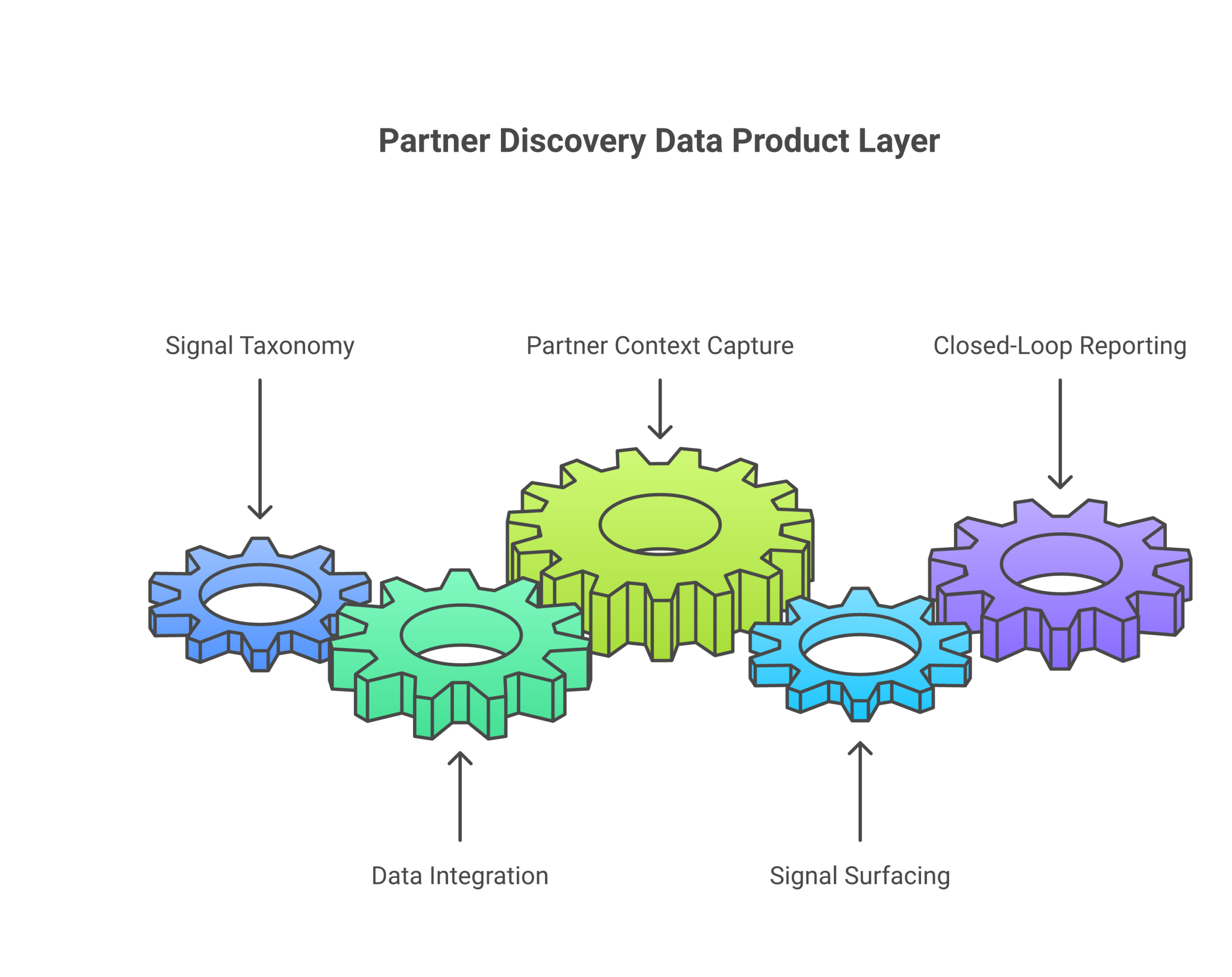
Five-component partner discovery data product layer turning overlap into AE-ready signal.

  1. Signal taxonomy with four tiers: Tier 1 (partner has an active customer at the target account with a named champion), Tier 2 (partner has a deal in progress at the target account), Tier 3 (partner has a named buyer relationship at the target account), Tier 4 (generic overlap, no signal yet). AEs work Tiers 1 through 3; Tier 4 goes back to the partner side for context capture.
  2. Overlap and signal source integration: Crossbeam for account overlap, Pocus for intent and buying signal, Common Room for community and engagement signal. The three sources feed the same signal record per account.
  3. Partner-side context capture cadence: A monthly thirty-minute working session with each Tier 1 partner manager-side counterpart to validate the top fifty signal-tier candidates and add the partner-side context (champion name, deal status, relationship strength). The context is the data quality.
  4. CRM and PRM signal surfacing: The signal-tier record opens in the AE workspace from the account or opportunity, with the partner-side context, the named partner-side counterpart, and the defined next move (intro request, joint discovery, joint pitch). The signal lives where the AE works (CRM, Introw, Euler, Impartner, PartnerStack, or Channelscaler).
  5. Closed-loop reporting to the partner side: Within seven business days of the AE action, the partner-side counterpart sees what happened (meeting booked, opportunity created, opportunity closed, no contact). The closed-loop report is what makes the partner side keep feeding context.

The layer compounds when the refresh cadence and the closed-loop report stay tight.

Common pitfalls in building a partner discovery data layer

  • Treating overlap as signal: Account overlap is the prerequisite for signal, not the signal. The partner-side context (active customer, deal in progress, named buyer relationship) is what makes the overlap actionable. Without context, AEs work overlap like cold outbound.
  • No named owner for the discovery data product: The layer falls apart when nobody owns the schema, the refresh, or the surfacing. Partnerships RevOps or a dedicated partner-data analyst has to own it; otherwise the signal goes stale.
  • No partner-side context capture cadence: The signal-tier candidates without partner-side context are Tier 4 by default. The monthly working session with each Tier 1 partner manager-side counterpart is what produces the context; without it, the layer is overlap with a label.
  • Surfacing signal outside the AE workspace: Signal in a separate tool, a dashboard, or an email AEs do not open is not consumed. The signal has to live in the CRM, the PRM, or wherever the AE already works.
  • No closed-loop report: The partner side stops feeding context when the host side does not report back. The closed-loop report is what keeps the data layer alive past the first quarter.

What this looks like in practice

A mid-market B2B SaaS team had Crossbeam producing five thousand monthly overlap records and AEs ignoring all of them. The head of partnerships hired a partner-data analyst and built a discovery data product: a four-tier signal taxonomy, a monthly thirty-minute working session with each of the top six partner-side counterparts to validate the top fifty Tier 1 and Tier 2 candidates per partner, and a signal-tier record surfaced in Salesforce on the account record with the partner-side context, the named counterpart, and the defined next move. Within two quarters, the team had created two hundred and eighty Tier 1 and Tier 2 signals, AEs were working roughly seventy-five percent of them, and partner-sourced pipeline had moved from anecdotal to a forecasted line on the QBR. The compounding gain was in the partner-side context; the same overlap data without the context had produced nothing.

Forecastable’s POV on partner discovery data

Partner discovery data is the difference between a partner program that reports activity and one that produces pipeline. The teams that build the layer as a product (with a named owner, a refresh cadence, and a CRM-resident surfacing) produce a forecasted partner-sourced pipeline line; the teams that leave the overlap raw never get past activity reporting.

The deeper read is that the partner-side context is the data quality, and the context only comes from a recurring working session with the partner-side counterpart. A team that buys Crossbeam and never runs the working session produces noise; a team that runs the working session and validates the top fifty signals per partner per month produces a working pipeline source.

The candor on the AE workflow question is that the signal has to live in the AE workspace, not in a dashboard the AE does not open. The most common failure is to build the discovery data layer in a separate tool and ask AEs to check it; AEs do not check separate tools. The signal has to open from the account or the opportunity record.

The candor on the data-product analogy is that the partner discovery data layer should be treated like an internal data product, with a service-level agreement on refresh, a defined schema, and a named consumer. Without the data-product discipline, the layer goes stale in two quarters and the AE workflow drops the motion.

Forecastable is a partnerships operating platform; the tools above (Crossbeam, Pocus, Common Room, Tackle, Labra, Suger, Clazar, Introw, Euler, Impartner, PartnerStack, Channelscaler) are independent third-party platforms, and naming them is not an endorsement of any specific deployment over another. Evaluate each on your own motion.

Frequently asked questions

What is the difference between overlap and partner discovery data?
Overlap is the raw fact that the host and the partner share an account. Partner discovery data is the structured signal layer that adds tier, partner-side context, and a defined next move on top of overlap.

Who owns the partner discovery data layer?
Partnerships RevOps or a dedicated partner-data analyst. The owner runs the schema, the refresh cadence, and the closed-loop report to the partner side.

How often should partner discovery data be refreshed?
Monthly working session with each Tier 1 partner manager-side counterpart to validate the top fifty signal-tier candidates. Overlap data refreshes more often (daily or weekly through Crossbeam, Pocus, Common Room); the context layer refreshes monthly.

Where should partner discovery data live?
In the AE workspace. The CRM (Salesforce, HubSpot) is the default home; the PRM (Introw, Euler, Impartner, PartnerStack, or Channelscaler) mirrors the signal-tier record on the partner profile. Signal outside the AE workspace is not consumed.

How is partner discovery data measured?
Signal-tier volume per partner, signal-to-meeting conversion rate, signal-to-opportunity rate, and closed-loop completion rate. The leading indicator is closed-loop completion; the lagging indicator is partner-sourced pipeline.

Does partner discovery data require Crossbeam?
No. Crossbeam is the most common overlap source; Pocus and Common Room cover signal and engagement. The discovery data layer can be built on any of the three or in combination, with a defined data model.

How does partner discovery data tie into partner attribution?
The signal record feeds the partner role table at deal registration. A deal sourced from a Tier 1 signal carries a “Sourcer” role for the named partner; the attribution model translates the role into sourced or influenced credit.

Next step

If a partner discovery data layer is open this quarter, the move this week is to draft the four-tier signal taxonomy, name the data product owner, and schedule the first monthly working session with the top three Tier 1 partner-side counterparts.

Start your growth journey now to install a working partner discovery data layer in your specific environment, or read the orientation on account mapping for the broader data layer that feeds it.

Uncover Your Growth Potential

Whether starting with a single sales team or a single partner, any co-sell motion can be live within 30 days.

Schedule a Discovery Call
Latest Insights
A partner manager and a sales rep reviewing a partner overlap map on a wall monitor showing shared and net-new accounts highlighted between two company logos, a printed shared-account list on the table, deep navy and warm amber palette
  • Account Mapping
Alex Buckles

Partner Overlap: Finding the Accounts You Share

What is partner overlap? Short answer: Partner overlap is the set of accounts that both you and a partner are working, have closed, or are prospecting at the same time, surfaced by comparing the two companies’ account lists. It is the raw material of co-sell, because the accounts you share are the ones where a […]

Read Article
A head of partnerships and a CRO at a small conference table reviewing a printed partner ecosystem map with tier classifications and joint motion labels alongside a wall monitor showing partner overlap density by segment, deep navy and warm amber palette
  • Account Mapping
Alex Buckles

Partner Ecosystem Map: Building One That Drives GTM

What is a partner ecosystem map? Short answer: A partner ecosystem map is the structured visualization and classification of every partner in a company’s go-to-market ecosystem, with named tiers, partner-type categories (SI, ISV, reseller, marketplace, agency, alliance), joint motion labels, and overlap density per partner per segment. It exists because a company cannot make sound […]

Read Article
Partner ops analyst and a sales operations leader at twin monitors reviewing a shared customer overlap report with named accounts and partner-warm tags highlighted, deep navy and amber palette
  • Account Mapping
Alex Buckles

Overlap Data: What It Is and How to Use It in 2026

What is overlap data? Short answer: overlap data is the structured comparison of two partners’ account lists, typically customers, prospects, and open opportunities, that produces a list of shared accounts and the metadata attached to each. It is the input to account mapping motions, ecosystem-data platforms, and modern co-sell programs. In 2026, most partnerships teams […]

Read Article
Partner manager and an AE in a Monday deal review with a printed prioritized account list and CRM screen showing partner-warm tags, deep navy and amber palette
  • Account Mapping
Alex Buckles

Partner Account Mapping: A 2026 Operating Guide

What is partner account mapping? Short answer: partner account mapping is the operating practice of comparing your account list to a partner’s account list, segmenting the results, prioritizing the segments by relationship depth and in-market signal, and routing the prioritized accounts into the seller’s weekly workflow. It is the operating motion that turns overlap data […]

Read Article
Logo โ€” Itโ€™s All AboutThe Team

Quick Links

  • Who We Serve
  • Solutions
  • Resources
  • Pricing
  • Our History

Social Media

  • Linkedin

Legal

  • Privacy Policy
  • Terms of Service
Quick Links
  • Who We Serve
  • Solutions
  • Resources
  • Pricing
  • Our History
Social Media
  • Linkedin
Legal
  • Privacy Policy
  • Terms of Service

Stay ahead on ecosystem-led growth

Logo โ€” Itโ€™s All AboutThe Team
ยฉ 2025 Forecastable. All rights reserved.
Book Your Strategy Call
Request Enrollment Details

[contact-form-7 id=”dfbeed3″ title=”Request Enrollment Details”]

Mollie Bodensteiner

Revops Advisory
  Mollie Bodensteiner is an experienced operations professional with a demonstrated track record of utilizing technology to support operational processes that drive performance and innovation. She currently is the Vice President of Operations at Sound and owns go-to-market agency, MB Solutions. Mollie has previously held operations leadership roles at Deel, Syncari, Corteva and Marketo. She has over 14 years of experience in both B2C and B2B operations and technology. When she is not working, Mollie enjoys spending time with her husband, three small children, and two large dogs. Childhood Career/Dream: Growing up in the age of Disney and Nick@Nite I always wanted to be a child actor (good thing that never was actually pursued ๐Ÿ™‚ Favorite Win: I am not sure I have a specific โ€œwinโ€ but I think I get the most joy and excitement from coaching others and watching them hit major milestones in their career. The first time you get to promote someone on your team or watch them lead a major project – are always career highlights! Personal Fun Facts: Favorite Song: If itโ€™s love, Train Favorite Movie: Good Will Hunting Favorite Meme: Disaster Girl
Forecastable resources: Co-Sell Orchestration Platform · All Use Cases · Live in 30 Days · Co-Sell Playbook

Kelsey Buckles

Director of Operations


My journey from Education to Operations has equipped me with a unique perspective and skill set that perfectly aligns with Forecastable’s mission to help businesses improve sales collaboration through partner co-selling strategies.

At Forecastable, I am passionate about empowering teams and organizations to unlock the full potential of strategic partnerships. By leveraging my expertise in communication, leadership, and operational efficiency, I contribute to creating seamless co-selling processes that align with business goals and deliver exceptional results.

The intersection of my educational foundation and operational experience fuels my dedication to fostering alignment, building trust, and enhancing collaboration between partners. I am driven by the opportunity to contribute to a platform that not only optimizes sales strategies but also strengthens relationships that lead to long-term growth.

Paul Jonhson

Chief Technology Officer (Co-founder)


Paul Johnson has 20+ years of software development and consulting experience for a variety of organizations, ranging from startups to large-enterprise organization with highly-complex needs.

Mr. Johnson has a long track record of successful technology deployments.
This, combined with his deep passion for machine learning and exceptional user experience design, allows him to lead our technical direction from the front with confidence.

Alex Buckles

Product, Partnerships, and Value Engineering (Co-founder)


After serving in The United States Marine Corps, Alex Buckles spent the next two decades as a student of revenue production and an advocate for innovation.

Along the way, he has helped numerous companies achieve double and triple-digit growth by crafting and executing high-performing go-to-market strategies, with co-selling at the center of each.

As a once-advanced technical marketer, an expert sales & partner professional, and a strong customer success advocate, Mr. Buckles understands the impact of these functions aligning not only on revenue production, but on the day-to-day execution of the go-to-market strategy. This concept of revenue-team alignment is what quickly became the foundation of Forecastable back in January of 2018.

In his free time, youโ€™ll find him spending quality time with his children, one of whom is on the autism spectrum. 1 in 36 children in the U.S. are on the spectrum and boys are four times more likely to be diagnosed than girls.

With that in mind, Mr. Buckles plans on dedicating the rest of his life serving those living with autism, through his organization Pathways for Autism. From his perspective, there must be a scalable and financially self-sustaining infrastructure established to put as many individuals with autism as possible on a path towards complete independence as adults.