Alex Buckles
Co-Sell Automation Is Only the Start: Why Overlap Alerts Alone Underuse Your Partner Data

Short answer: Co-sell automation means overlap alerts, intro requests, rep nudges and attribution. Every partner program should have it, and we’ve included it in every program for years. But if your team only acts on alerts, you’re underusing your partner data. Crossbeam’s MCP changed the game. AI can now work with partner data directly, so an overlap becomes a specific action for a specific person, not one more notification.
What co-sell automation includes
Co-sell is when your sellers and a partner’s sellers work the same account together. Co-sell automation is the software layer that keeps that work moving without a person pushing every step.
In practice, it covers four jobs:
- Overlap alerts: A signal that a partner shares a customer or open opportunity with you.
- Intro requests: A structured ask for a warm introduction through the partner.
- Rep nudges: Reminders that push a seller to act on an overlap.
- Attribution: A record of which partner touched which deal.
These matter. But they’re the floor. Any serious program should have them, and buying a separate tool just to get them is paying twice. Crossbeam’s own co-selling automation is a solid baseline.
Why overlap alerts alone don’t produce pipeline
Partner data rarely fails. What fails is that people don’t know what to do with the data they have, and they don’t activate it.
Most overlaps just sit there. Nobody owns turning them into a GTM motion, and nobody watches the data week after week. So the alert fires, and nothing happens.
Reps ignore notifications, in every tool
This isn’t a problem with any one product. Reps ignore email notifications because the last thing they need is another email. A Slack message is just another channel. Eventually, every automated notification gets tuned out like the rest.
But reps do pay attention when a real person sends them something specific. That’s the difference between an alert and an action.
An alert isn’t an action
Compare two messages a rep could get.
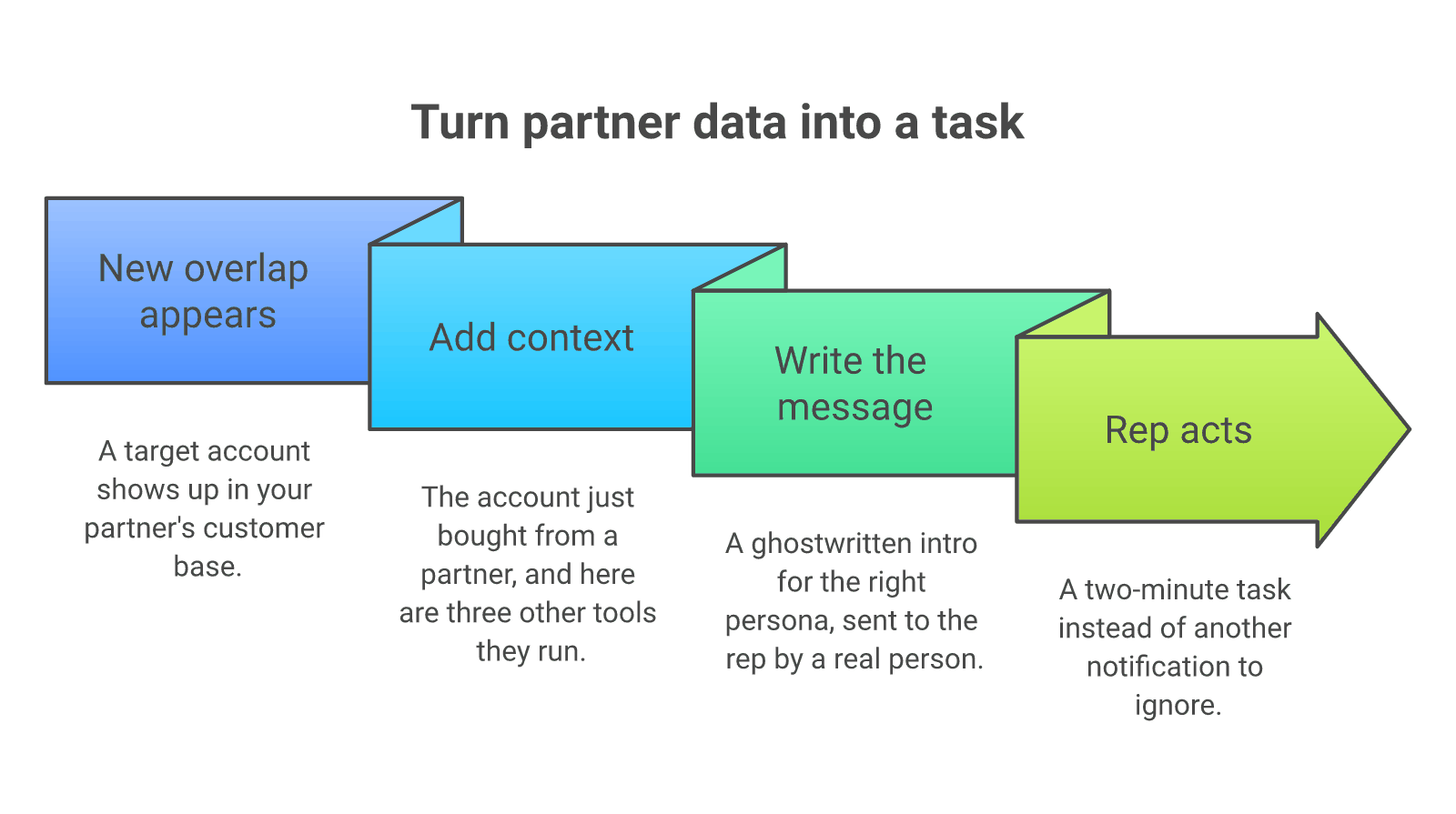
The first says a partner also has this account as a customer. The second says the account just bought from a partner, here are three other tools they run, and here’s a ghostwritten message to send the right persona today.
One is information. The other is a task the rep can finish in two minutes. You have to hand it to a rep on a silver platter, because they won’t do this work on their own.
How Crossbeam’s MCP changed co-sell automation
MCP stands for Model Context Protocol. It’s an open standard that lets AI assistants connect to other systems and use their data. Crossbeam launched its MCP in beta in March 2026. It works with AI assistants like Claude, ChatGPT, Copilot Studio, Gemini and Glean.
That shift matters more than any alert setting. Before, partner data reached reps as fields in a CRM or messages in Slack. Now an AI assistant can ask Crossbeam questions directly and act on the answers. Crossbeam’s CEO described both paths, CRM sync and direct AI access through MCP, in an AI go-to-market playbook fueled by ecosystem data.
Two moments where partner data is worth the most
In our work, two moments stand out:
- Right after a discovery call: A rep can see the prospect’s footprint across every technology partner in seconds, while the call is fresh.
- When scoping a co-sell with a services partner: Both sides see which accounts they share before they commit to a GTM motion.
Neither moment needs an alert. Both need a fast, specific answer, and that’s what MCP access gives you.
Agents talking to agents
Here’s where this goes. Your AI agent asks Crossbeam’s MCP which partners overlap an account. Then it asks Forecastable’s MCP which GTM motion fits that overlap and who owns it. And it drafts the message, queues it for the right person and logs the touch.
That’s agents talking to agents, each one working from its own system of record. The human still decides. Every send is approved by a person before it goes out. But the hours of pulling lists and writing intros disappear.
Co-sell automation should run on tools you already own
You don’t need another platform for this. Most mid-market and enterprise companies already run AI tools that security has approved and that already connect to their CRM.
So we start there. When you already have Claude connected to your CRM, we deploy a plugin into it. If it adds value, great. If it doesn’t, we drop it. You already own the tool. The same goes for Dust, Glean, Copilot or any AI tool that can connect to MCP servers.
Our AI partner manager assistant, Eva, runs this way. Eva is an AI agent that runs inside your own Claude environment on a schedule or on demand. It watches for new overlaps that qualify for a stored GTM motion, drafts the next step and routes it to a person for approval. Eva never auto-sends.
What partners leaders say when the data finally gets used
The goal isn’t more alerts. It’s partners and reps who know what to do with the data. Here’s how one partner leader described working with us on exactly this problem:
“We came to Alex and the Forecastable team as we were struggling to operationalize and enable partners on a true co-sell motion using Crossbeam. By working with the Forecastable team, we’ve developed a great framework and playbooks, content and education to enable our partners, and the foundation for reps and partners to effectively co-sell.”
Christi Williams, Lead Marketing Manager, Partner Enablement, HubSpot
How Forecastable includes co-sell automation
At Forecastable, we deliver partner-sourced pipeline as a service. We build your partner program and run it with you or for you, and we’re measured on pipeline and revenue.
Co-sell automation is a given, so it’s included in every program. Overlap alerts, intros, nudges and attribution are handled by Eva and our team, running on your Crossbeam data and the AI tools you already own. There are no seats to buy and no PRM required. Partners can fund or co-fund the program through MDF, so it can cost you $0.
The real work sits above the alerts: GTM motions built with your partners, run in market, with every touch tracked. Learn more about our co-sell orchestration platform and how Crossbeam account mapping works.
FAQ
What is co-sell automation?
Co-sell automation is software that handles the repeatable parts of co-selling with partners: overlap alerts, intro requests, rep nudges and attribution.
Why do sellers ignore overlap alerts?
Because every tool sends notifications, and reps tune them out. Sellers act when they get a specific task, with context and a ready-to-send message, from a real person.
What is the Crossbeam MCP?
It’s Crossbeam’s Model Context Protocol server. It lets AI assistants like Claude, ChatGPT and Copilot Studio query Crossbeam partner data directly and act on it.
Do I need a separate co-sell automation tool?
Not with Forecastable. Co-sell automation is included in every program, and it runs on Crossbeam data and the AI tools you already own.
Does AI send messages to partners or prospects on its own?
No. In our programs, AI drafts and queues. A person approves every send.
The bottom line
Alerts tell you something happened. Pipeline comes from what someone does next. Keep co-sell automation, because it’s the floor. Then put your partner data to work through AI that turns every overlap into a task a real person can finish today.
Forecastable is an independent third-party professional services company. Our evaluations of other vendors are based on publicly-available information as of October 2026 and our own client experience.
Book a Program Fit Analysis to see how much more your partner data could produce →
Related reading:
Uncover Your Growth Potential
Schedule a Discovery Call