Crossbeam Account Mapping: What It Is, How It Works

What is Crossbeam account mapping?
Short answer: Crossbeam account mapping is the process of using Crossbeam to compare your customer and prospect lists with a partner’s, securely, to find the accounts you share, the ones only they have, and the ones only you have. It turns the old spreadsheet swap into a live, permissioned overlap view, and its value is that both sides can see where their books intersect without exposing their whole customer list to each other.
Account mapping is the input to a co-sell motion, not the motion itself. It shows where two companies could work together; it does not run the introductions or the joint deals that follow.
The useful question is not whether the overlap exists, it is what you do with it once you can see it.
Why Crossbeam account mapping matters in 2026
The reason account mapping matters in 2026 is that co-sell is now a measured revenue channel, and it starts with knowing where the overlap is. You cannot introduce a partner into a deal, or ask for an introduction into one, if you do not know that the partner has a relationship with the account. Mapping surfaces that at scale, across many partners and thousands of accounts, which no one can hold in their head or reconcile by hand.
That matters more now because the manual version does not just take time, it leaks trust. Trading raw customer lists over email exposes data both sides would rather protect, so partners hesitate and mapping stalls. A permissioned platform lets each side control what is shared, which is what makes partners willing to map in the first place. When the overlap is easy and safe to see, more of it gets acted on.
The reframe is that account mapping is a means, not an end. The overlap view is only worth the effort if it feeds a habit of introductions and deal reviews. A beautiful map that nobody acts on sources zero revenue.
How Crossbeam account mapping actually works
Crossbeam account mapping works by connecting each company’s CRM data, comparing the lists securely, and returning a permissioned view of the overlap that both sides can act on. The mechanics matter because the trust and the follow-through both depend on them. The parts below are how the overlap gets created and turned into activity.
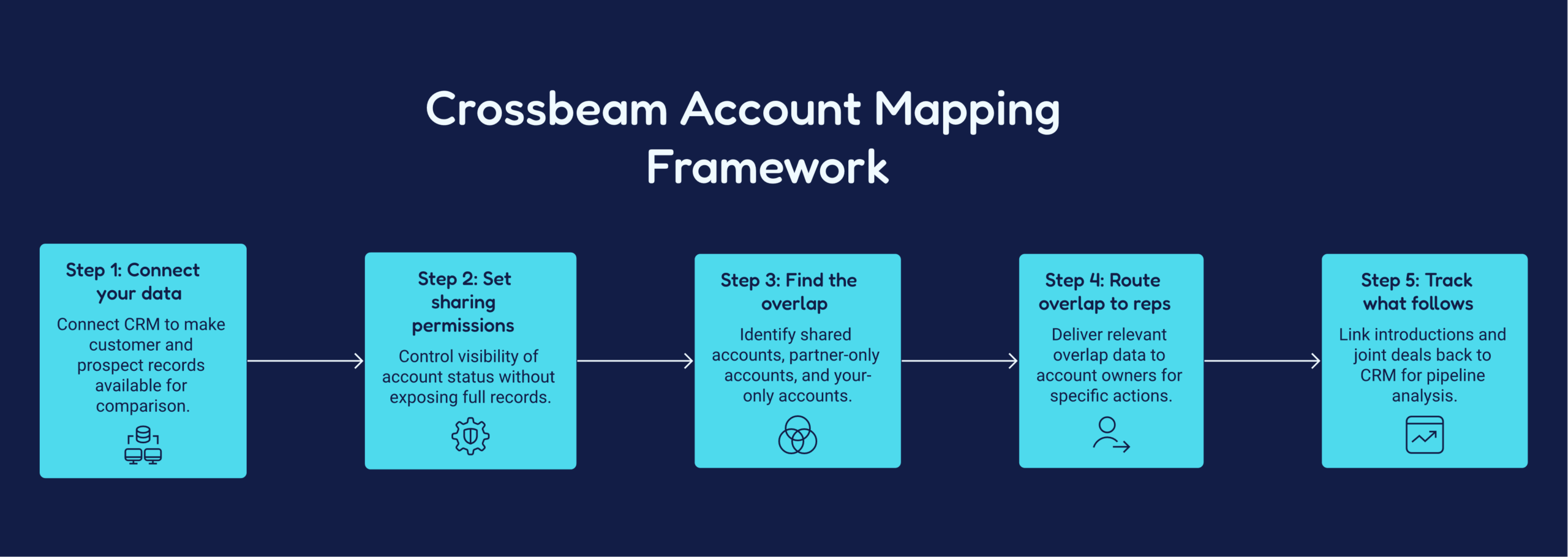
- Connect your data: Each company connects its CRM so its customer and prospect records are available for comparison. The comparison happens on the platform, so neither side hands the other a raw export.
- Set sharing permissions: Each side controls what the other can see, such as whether an account is a customer, an opportunity, or a prospect, without exposing the full record. Permissioning is what makes partners comfortable mapping at all.
- Find the overlap: The platform returns the shared accounts, the accounts only the partner has, and the accounts only you have. Each segment implies a different play, from co-selling a mutual customer to asking for an introduction into a partner’s account.
- Route overlap to reps: Get the relevant overlap in front of the reps who own those accounts, so a match becomes a specific action rather than a report nobody opens. This is the step where mapping becomes selling.
- Track what follows: Tie the introductions and joint deals back to the CRM so the overlap connects to partner-sourced and partner-influenced pipeline. Without this, mapping produces activity you cannot measure or defend.
Common pitfalls when using Crossbeam account mapping
- Mapping and then stopping: The most common failure is treating the overlap view as the finish line. Teams connect data, admire the shared accounts, and never build the introduction rhythm, so the map sources nothing. Mapping only pays when a motion runs on it.
- No rep-level routing: Overlap that sits in a dashboard nobody checks is wasted. If the shared accounts do not reach the reps who own them with a clear next action, the data never turns into deals.
- Weak partner adoption: Mapping needs both sides connected. If your partner will not connect their data or set permissions, you see half the picture, so partner willingness is a precondition to plan for, not assume.
- Ignoring the CRM tie-back: If joint deals do not connect to CRM opportunities, you generate partner activity you cannot attribute. Unattributed co-sell gets cut, so insist the follow-through lands in the CRM.
- Treating the map as static: Customer bases change. A one-time map goes stale, so refresh the overlap on a cadence and keep the reviews recurring rather than one-off.
Tools and examples
Crossbeam is one of several platforms in the ecosystem and overlap data category. The table below places account mapping among the tooling worth weighing.
| Platform | Category | What to know |
|---|---|---|
| Crossbeam | Ecosystem and overlap data | Permissioned account mapping across many partners; widely adopted for co-sell overlap |
| Pocus | Signal and overlap data | Blends account signals with overlap to prioritize which shared accounts to work |
| Common Room | Signal and ecosystem data | Surfaces ecosystem and community signals alongside account overlap |
A worked example: a software team had ten partners and no idea where their books overlapped, so co-sell only happened where two reps already knew each other. It set up account mapping with its top partners, permissioned the sharing so each side exposed only account status, and surfaced several hundred shared and adjacent accounts. It then routed each partner’s overlap to the owning reps and ran a biweekly review to request and track introductions. The overlap that had been invisible became a working pipeline of plays, and the joint deals landed in the CRM as measurable partner-influenced revenue. The map did not do the selling; it told everyone where selling together would pay off.
Forecastable’s POV on Crossbeam account mapping
Our position is that account mapping is the right first step and a common last step, and that is the problem. Seeing the overlap is genuinely valuable, and a permissioned platform like Crossbeam makes it safe and scalable in a way spreadsheets never could. But the map is an input. It sources revenue only when it feeds a durable habit of routing overlap to reps, requesting introductions, and reviewing joint deals, and most programs stop at the map because the map is the easy part.
That is the frame we would apply to any account mapping tool. Map with the partners that matter, permission it so both sides trust it, and then spend the real effort on the motion the map is supposed to feed. Route every overlap to an owner, put a recurring review on top, and tie the results back to the CRM so the pipeline is provable. The tool shows you where to work; the work is still yours.
Forecastable is a partnerships operating platform that connects partner conversations and actions to CRM pipeline and revenue, the flywheel of Conversations to Actions to Pipeline to Revenue. We are a category authority on running partner-led growth, so we sit complementary to the overlap data you get from a platform like Crossbeam, turning the mapped overlap into tracked action and making it visible which partners and which joint deals actually produce.
Any third-party tools or firms referenced here are independent third-party products, and mentioning them is not an endorsement. Evaluate Crossbeam or any account mapping platform against your own CRM, partner base, and motion before committing to it.
Frequently asked questions
What is Crossbeam account mapping? Crossbeam account mapping is using Crossbeam to securely compare your customer and prospect lists with a partner’s to find shared accounts, accounts only they have, and accounts only you have. It creates a permissioned overlap view that feeds a co-sell motion; it does not run the introductions or deals itself.
How does account mapping stay secure? Each side connects its CRM and sets permissions controlling what the other can see, such as account status rather than full records. Because neither company exports a raw list to the other, partners are more willing to map, which is the whole reason a permissioned platform beats trading spreadsheets.
What do you do with the overlap once you have it? Route each partner’s overlap to the reps who own those accounts, request and track warm introductions, run recurring deal reviews, and tie the results back to CRM opportunities. The overlap is the input; the introductions and joint deals are where the revenue comes from.
How is Crossbeam different from Pocus or Common Room? Crossbeam is widely used for permissioned overlap and account mapping across many partners. Pocus and Common Room bring account and ecosystem signals alongside overlap to help prioritize which shared accounts to work. The right mix depends on whether you need pure overlap or overlap plus prioritization signal.
Does account mapping replace a co-sell motion? No. Mapping surfaces where two companies could sell together; it does not build trust, request introductions, or close deals. The map is worthwhile only when a real introduction-and-review rhythm runs on top of it.
How often should you refresh the map? On a regular cadence, because customer bases change and a one-time map goes stale. Keep the overlap current and the reviews recurring so the co-sell motion works from live data rather than a snapshot.
Next step
If you can see where you and your partners overlap but the map is not producing deals, the missing piece is the motion, routing overlap to reps and running the introductions and reviews on a cadence. Map with the partners that matter, then build the habit on top. Start your growth journey now to turn account overlap into a co-sell motion that produces. The account mapping hub frames how overlap fits the broader program.
Uncover Your Growth Potential
Schedule a Discovery Call