Ecosystem-Led Pipeline: The Warmest Channel You Own

Short answer
Short answer: Ecosystem-led pipeline is new opportunity created by working the overlap between your accounts and your partners’ accounts, turning shared customers and prospects into warm introductions instead of cold outreach. It is the channel where the first touch already carries trust, which is why it converts higher than anything you can buy.
Here is the position. Every company already sits inside an ecosystem of partners who touch the same buyers. The pipeline is there whether you build the motion or not, and most teams leave it uncounted and unworked.
What is ecosystem-led pipeline?
Ecosystem-led pipeline is the output of ecosystem-led growth, a go-to-market approach that uses partner relationships and shared account data to source and advance deals. The raw material is overlap: the accounts where you and a partner both have a presence, a customer, or an active deal. That overlap is mapped, and the strongest intersections become warm introductions, co-sell plays, and referrals.
The plain-language version: instead of starting cold, you start from a relationship that already exists. A partner who sells to your target account can introduce you to a buyer who trusts them. The lead that results is an ecosystem qualified lead, an EQL, and it behaves nothing like a cold lead because it arrives pre-trusted.
Why ecosystem-led pipeline matters in 2026
Ecosystem-led pipeline matters because the cold channels that carried B2B got expensive and tired at the same time. Buyers screen out cold outreach, ad costs rose, and the warm introduction became the scarce, valuable thing. Companies that built an ecosystem motion have a channel that gets cheaper and better as partnerships deepen, while cold channels get worse as they scale.
The second reason is data. Partner overlap data, which once required manual spreadsheets, is now routine to map, so the barrier to running the motion dropped. The work that remains is organizational: routing the introductions, crediting the partner, and measuring what the channel produces in the same system as everything else.
In my work with revenue teams, the companies that already run an ecosystem motion treat it as their most defensible channel, because a cold playbook can be copied overnight and a set of partner relationships that reliably produce warm pipeline cannot.
How ecosystem-led pipeline actually works
Ecosystem-led pipeline works as a repeatable loop that turns relationships into measured revenue, where each step depends on the one before it.
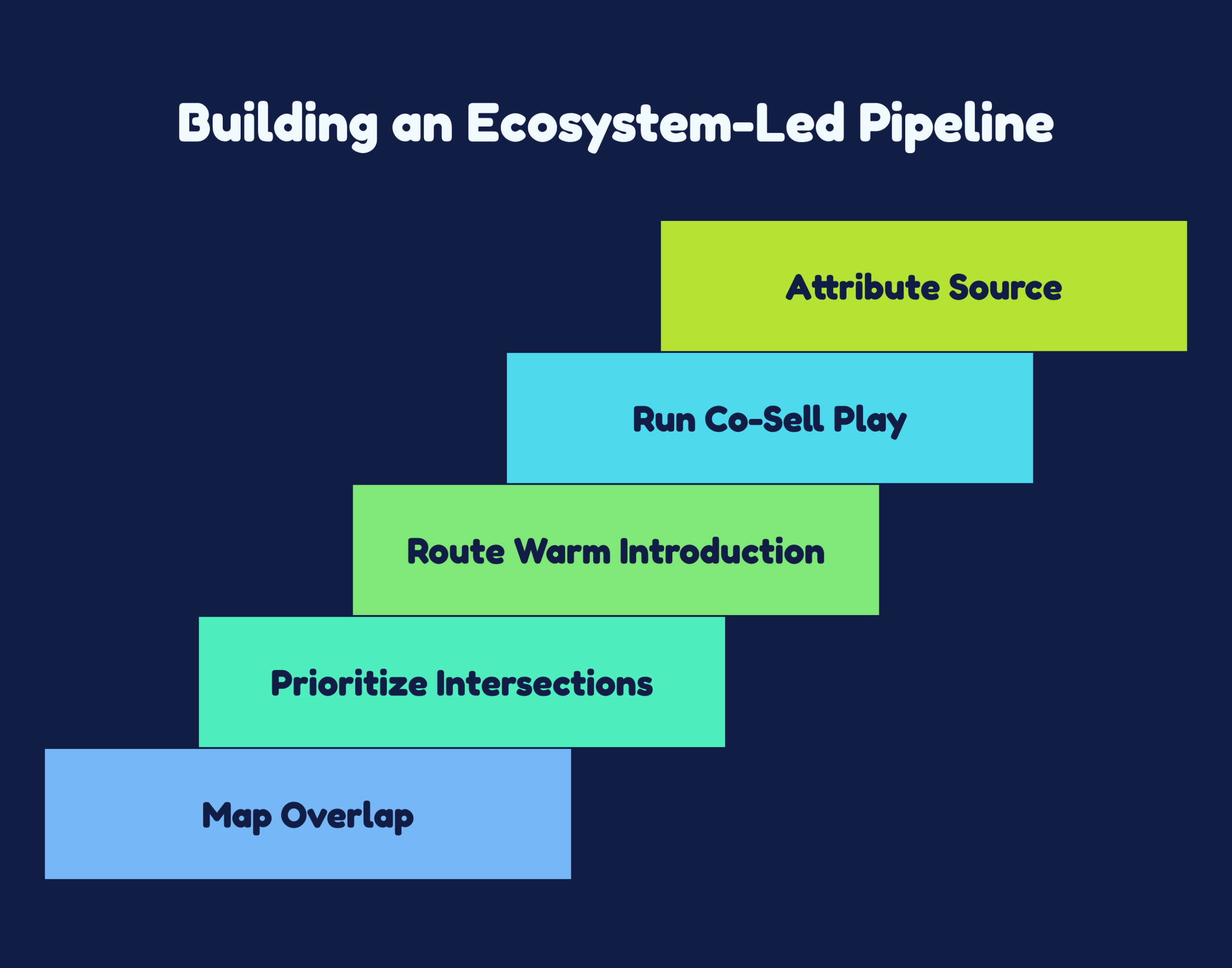
- Map the overlap: compare your accounts against each partner’s to find shared customers and shared prospects, because the overlap is the whole supply of ecosystem pipeline and you cannot work intersections you have not surfaced.
- Prioritize the intersections: rank the overlap by account value and the strength of the partner’s relationship, since a warm introduction into a high-fit account is worth far more than a long list of weak ones.
- Route the warm introduction: ask the partner for a specific introduction into a specific account, because a vague request for help produces nothing and a precise ask into a named buyer produces a meeting.
- Run the co-sell play: align both sellers on who does what in the deal, as the introduction only becomes pipeline when the two companies actually work the account together rather than hand it off and hope.
- Attribute the source: tag the opportunity to the partner origin and keep it tagged, because if the next rep activity overwrites the source, the channel becomes invisible and the loop cannot be measured or scaled.
The through-line is that ecosystem pipeline is a system, not a favor. The overlap supplies it, the prioritization focuses it, the introduction opens it, the co-sell converts it, and the attribution is what lets you prove it works and justify building more.
Common pitfalls
- Treating it as networking: relying on ad hoc partner favors instead of a mapped, prioritized motion, so the channel produces the occasional lucky deal and never compounds.
- Vague introduction asks: asking partners to help generally rather than for a named introduction into a named account, which produces goodwill and no pipeline.
- No co-sell alignment: getting the introduction and then handing the deal to a rep with no plan, so the trust the partner lent evaporates in the first meeting.
- Losing the source tag: letting the CRM credit the rep who logged the next activity, which erases the partner origin and makes the whole channel disappear from reporting.
- Measuring it differently: tracking ecosystem pipeline in a separate spreadsheet instead of the same system as other channels, so it never gets compared fairly and never gets funded like a real channel.
What this looks like in practice
A partnerships lead and an AE sit down with the overlap between their accounts and three technology partners. The map shows forty shared accounts, eight of them high-value targets the AE had been cold-prospecting without reply. For each of the eight, the partner who holds the relationship makes a specific introduction. Six meetings result within two weeks, meetings the cold sequence had failed to produce over a quarter. The two companies align on each deal, and the opportunities are tagged to the partner source so the channel shows up in the pipeline report.
The contrast with the cold motion is stark. The same eight accounts produced nothing cold and six warm meetings through the ecosystem. The difference was not effort or messaging. It was starting from a relationship that already existed instead of manufacturing one from scratch.
Forecastable’s POV
Ecosystem-led pipeline is the warmest, highest-converting channel most companies own and the one they are least equipped to measure. The relationships exist, the overlap is mappable, and the conversion advantage is real, but the pipeline evaporates in the CRM the moment a rep’s activity overwrites the partner as the source. A channel you cannot see is a channel you cannot grow.
The fix is to run the ecosystem motion as a measured system rather than a set of relationships, with the partner origin preserved from introduction to closed revenue. Mapping overlap is the easy part now; the hard part is the operating discipline that routes the introductions, aligns the co-sell, and keeps the attribution honest. At Forecastable we are a partnerships operating platform that connects partner conversations and actions to CRM pipeline and revenue, so ecosystem-led pipeline is instrumented end to end and sits in the same report as outbound and inbound. Category peers like Crossbeam have done real work to make overlap mapping routine, and the point of this piece is what you do with that overlap once you have it.
My bet: the companies that treat ecosystem-led pipeline as a measured channel, not a networking habit, build the one source of warm deals their competitors cannot copy.
Forecastable is an independent third-party. Any tools, vendors, or third-party figures referenced here are described from public information for the reader’s own evaluation, not as paid placements.
Frequently asked questions
What is ecosystem-led pipeline? It is new opportunity created from partner overlap, where shared accounts and relationships become warm introductions, co-sell plays, and referrals. It is the pipeline output of ecosystem-led growth, and its defining trait is that the first touch already carries trust.
How is ecosystem-led pipeline different from outbound? Outbound starts cold and manufactures a relationship through volume. Ecosystem-led pipeline starts from a relationship a partner already has, so the first meeting is warm. That difference shows up as a conversion rate several times higher at a fraction of the cost.
What is an ecosystem qualified lead? An EQL is a lead that comes through the partner ecosystem, typically a buyer introduced by a partner who already holds the relationship. It is warmer than a marketing qualified lead because it arrives with borrowed trust rather than expressed interest alone.
How do you measure ecosystem-led pipeline? By tagging each opportunity to its partner origin and tracking its cost to produce and its conversion in the same system as other channels. The measurement only holds if the source tag survives later rep activity, which is where most programs lose the data.
Do I need overlap data to run an ecosystem motion? Overlap mapping makes it far more efficient, since it shows exactly where you and a partner share accounts. The motion can start with known relationships, but at any scale you want mapped overlap so you prioritize the intersections worth working.
Why does ecosystem-led pipeline convert so well? Because the introduction carries trust that a cold touch cannot manufacture. A buyer who hears about you from a partner they already rely on starts the conversation disposed to listen, which compresses the cycle and lifts the win rate.
Next step
Map your overlap with your top three partners this week and pick eight high-value shared accounts for specific, named introductions. Tag whatever results to the partner source so you can measure the channel.
If the introductions convert and your CRM keeps erasing where they came from, that is the gap we close. Start your growth journey with Forecastable and we will instrument ecosystem-led pipeline next to your other channels. Our partner influenced pipeline guide covers how warm pipeline compounds, and the partner attribution guide covers keeping the source honest.
Uncover Your Growth Potential
Schedule a Discovery Call