Nearbound Pipeline: Selling Through Trusted Partners

Short answer
Short answer: Nearbound pipeline is opportunity created by reaching buyers through the partners and people they already trust, instead of going directly at them with inbound or outbound. It puts a trusted third party between you and the buyer, so the first conversation starts with credibility you did not have to earn from zero.
Here is the position. Inbound waits for the buyer to come to you and outbound goes straight at them. Nearbound goes around, through someone the buyer already listens to, and that detour is the shortest path to a warm deal.
What is nearbound pipeline?
Nearbound pipeline is the set of opportunities that originate from the space around your buyer, the partners, advisors, and communities they already rely on. The term describes a motion that is neither inbound nor outbound: rather than owning the whole relationship yourself, you borrow proximity from someone who already has it. A partner who serves your target account vouches for you, and that vouching becomes a meeting.
The core idea is trust transfer. A buyer discounts what a vendor says about itself and weights heavily what a trusted partner says about that vendor. Nearbound pipeline is built by organizing that trust transfer on purpose, at the accounts where a partner’s relationship can open a door your own outreach cannot.
Why nearbound pipeline matters in 2026
Nearbound pipeline matters because buyers got harder to reach directly and better at ignoring vendors. Cold outreach reply rates fell, content saturated every channel, and the signal that still cuts through is a recommendation from someone the buyer already trusts. The partner relationship became the scarce asset, and nearbound is the motion that turns it into pipeline.
The second reason is durability. A nearbound motion rests on relationships that compound over time, so it gets stronger as partnerships mature, while cold channels degrade as more companies crowd the same inboxes and auctions. In a tight market, the companies with a working nearbound motion have a channel competitors cannot quickly replicate.
In my work with revenue teams, the clearest pattern is that nearbound deals close faster and at higher win rates than anything cold, because the partner’s endorsement does the work that a cold seller spends months trying and usually failing to do, which is earning the buyer’s trust.
How nearbound pipeline actually works
Nearbound pipeline works by organizing trust transfer into a repeatable motion, where each step moves a buyer from a partner’s relationship into your own.
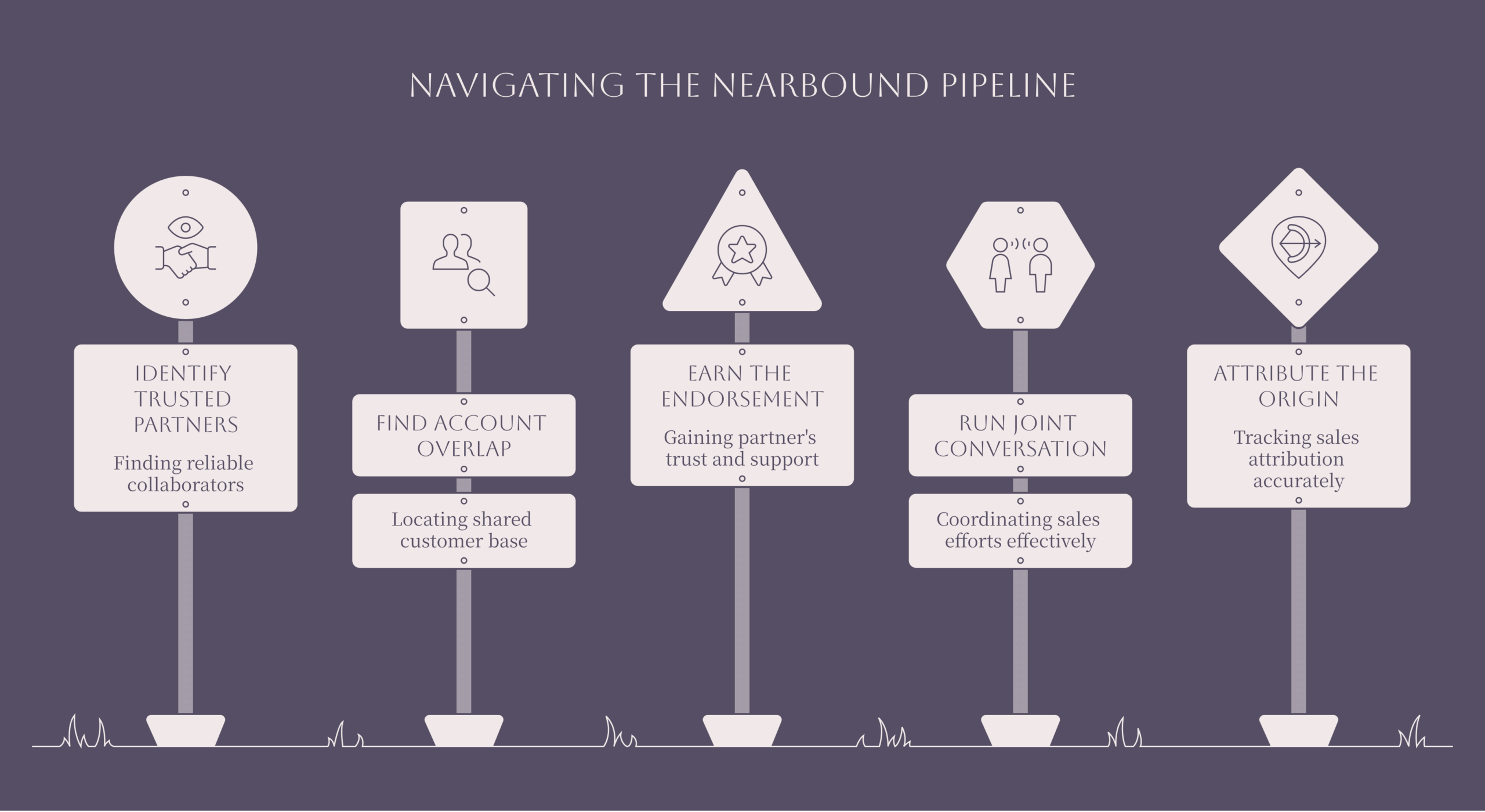
- Identify trusted partners: find the partners, advisors, and communities your buyers already rely on, because the motion depends entirely on borrowing a relationship that exists, and the wrong partner has no trust to transfer.
- Find the account overlap: locate the accounts where a trusted partner has a relationship you want, since this intersection is where a nearbound play can actually open a door that your direct outreach cannot.
- Earn the endorsement: give the partner a reason to vouch for you, usually by being genuinely useful to their customer, because an endorsement a partner does not believe is worse than none and will not be repeated.
- Run the joint conversation: enter the account with the partner rather than being handed off, so the trust the partner lent carries into the first meeting instead of evaporating when a cold seller takes over.
- Attribute the origin: tag the opportunity to the partner and the nearbound motion, because without the source preserved the channel looks like ordinary outbound and gets neither credit nor investment.
The through-line is that nearbound is trust transferred on purpose. Each step either builds the trust, finds where to apply it, or preserves the evidence that it worked, and skipping any of them collapses the motion back into cold outreach with extra steps.
Common pitfalls
- Partner with no real trust: running the motion through a partner the buyer does not actually rely on, so there is no credibility to borrow and the introduction lands as cold.
- Taking the endorsement for granted: expecting partners to vouch without being useful to their customers first, which burns the relationship and ends the referrals.
- Handing off instead of co-selling: getting the warm introduction and then dropping the partner, so the buyer feels the switch from trusted advisor to vendor pitch and closes up.
- Treating nearbound as a campaign: running it as a one-time push rather than an ongoing motion, so it never builds the compounding relationships that make it work.
- No attribution: failing to tag the partner origin, which makes nearbound indistinguishable from outbound in the data and starves it of the investment its results would justify.
What this looks like in practice
An AE has been chasing a strategic account cold for two quarters with nothing to show. The partner manager checks the account against the company’s partners and finds that one of them is the account’s trusted implementation partner. Rather than send another cold sequence, they ask that partner to mention the company in a conversation the partner is already having with the buyer. The partner does, the buyer agrees to a joint call, and the AE enters the account alongside the partner who vouched for them. The deal that cold outreach could not start opens in a single warm meeting.
The lesson is not that cold outreach is useless; it is that the same account behaves completely differently depending on who makes the first touch. Direct, it was a closed door. Nearbound, through a partner the buyer trusted, it was a conversation.
Forecastable’s POV
Nearbound is the motion that matches how B2B buyers actually decide, which is by asking people they trust before they listen to a vendor. The reason it is underused is not that teams doubt it works; it is that it sits between the partnerships team that owns the relationships and the sales team that owns the quota, and neither side measures it, so it never gets run as a real channel.
The missing piece is instrumentation. Nearbound pipeline has to be visible as its own source, with the partner origin preserved, or it dissolves into outbound numbers and loses its claim on budget and attention. The relationships that power it are the hard part to build and the easy part to waste. At Forecastable we are a partnerships operating platform that connects partner conversations and actions to CRM pipeline and revenue, so nearbound deals are tracked from the partner endorsement through to closed revenue and compared fairly with every other channel. The nearbound idea has been pushed hard by the team behind Crossbeam, and the operating question this piece answers is how you turn that idea into measured pipeline.
My bet: the companies that run nearbound as a measured channel, owned jointly by partnerships and sales, out-convert the ones still pouring budget into cold outreach at the same accounts.
Forecastable is an independent third-party. Any tools, vendors, or third-party figures referenced here are described from public information for the reader’s own evaluation, not as paid placements.
Frequently asked questions
What is nearbound pipeline? It is opportunity created by reaching buyers through the partners and communities they already trust, rather than directly through inbound or outbound. The defining trait is trust transfer: a partner’s credibility opens the conversation before you have earned it yourself.
How is nearbound different from inbound and outbound? Inbound waits for the buyer to arrive, outbound goes straight at the buyer, and nearbound goes through a trusted third party who already has the relationship. Nearbound starts warm because the partner’s endorsement carries into the first touch.
Does nearbound replace outbound? No; it changes which accounts you work cold and which you work through a partner. The best motions reserve cold outreach for accounts with no partner path and run nearbound wherever a trusted partner relationship exists, because that path converts far higher.
What makes a good nearbound partner? One the buyer genuinely trusts and relies on, with a relationship into the accounts you want. Trust is the asset being borrowed, so a partner with a strong but irrelevant relationship, or a weak but well-placed one, will not produce nearbound pipeline.
How do you measure nearbound pipeline? Tag each opportunity to the partner and the nearbound motion, then track its conversion and cost in the same system as other channels. Without that source tag, nearbound is invisible and gets neither credit nor investment.
Why does nearbound convert better than cold channels? Because the partner’s endorsement transfers trust the buyer already holds, so the conversation starts from credibility rather than suspicion. That shortens the cycle and raises the win rate compared with any touch the buyer experiences as coming from a stranger.
Next step
Take your five most-wanted cold accounts and check each one against your partners. Where a trusted partner holds the relationship, run a nearbound play instead of another sequence, and tag what results to the partner.
If nearbound starts producing meetings your cold motion could not, instrument it so it keeps earning budget. Start your growth journey with Forecastable and we will track nearbound from endorsement to revenue. Our nearbound guide covers the motion in depth, and the partner influenced pipeline guide covers how warm pipeline compounds.
Uncover Your Growth Potential
Schedule a Discovery Call