Partner-Influenced Pipeline: Define and Report It

What is partner-influenced pipeline?
Short answer: Partner influenced pipeline is the set of open opportunities a partner touched or advanced without originating, measured against a signed definition agreed by partnerships, sales, and finance. It sits alongside partner sourced pipeline, which a partner originated, and the two together describe the partner motion’s contribution to the funnel.
The mistake most teams make is to claim influence loosely, tagging any deal a partner ever appeared near as partner influenced. That inflates the number, finance stops trusting it, and the whole partner attribution story collapses. The teams that get credit define influence narrowly and consistently, with a rule for what counts and evidence behind every tagged opportunity.
Partner influenced pipeline is only worth reporting if the definition is signed before the reporting starts.
Why partner-influenced pipeline matters in 2026
Most partner contribution is influence, not source. A partner rarely originates the majority of the deals they touch; far more often they shape an active opportunity through a warm introduction, a reference, a co-sell conversation, or a competitive unseat. If a program only counts sourced pipeline, it undercounts the partner motion badly and loses the budget argument it should win.
The second force is that finance now audits partner numbers. As partnerships budgets have come under the same scrutiny as sales budgets, the influenced number gets challenged line by line, and a loose definition does not survive the audit. The programs that keep their budget are the ones whose influenced pipeline is defined tightly enough that a finance partner can check it.
The third force is that influence is where the co-sell motion actually lives. The day-to-day work of a partner manager is advancing active deals, bringing partners into live opportunities, setting references, and unblocking stalls, and almost all of that shows up as influence, not source. A program that cannot report influenced pipeline cannot describe its own core motion. In 2026 the influenced number is how partnerships proves the work it does every day.
How partner-influenced pipeline actually works
A credible influenced-pipeline report runs on a four-part model. Each part has a named owner and a named artifact, and each part is what gets skipped when influence is claimed loosely.
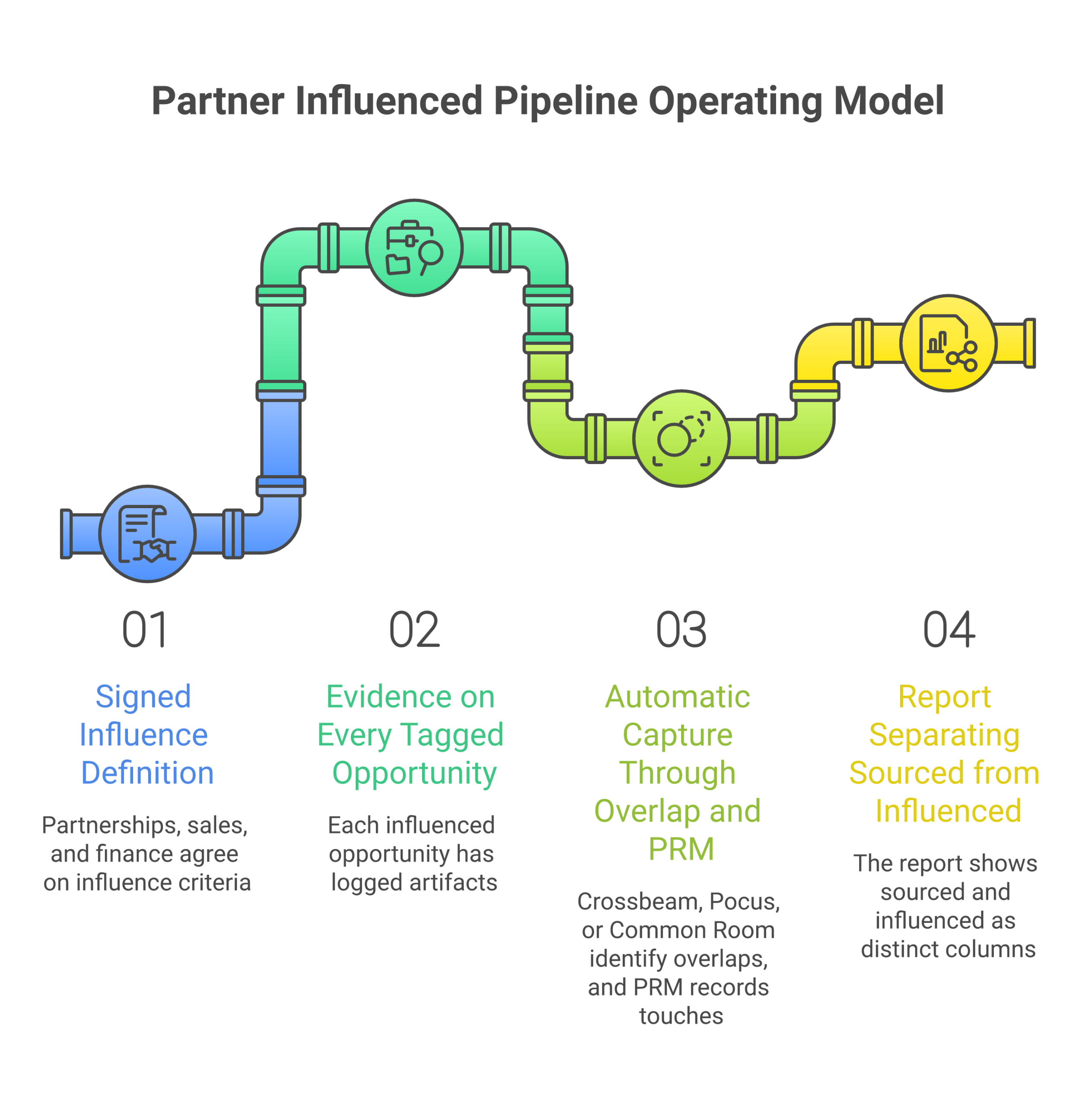
- A signed influence definition: Partnerships, sales, and finance agree in writing what counts as influence: a logged partner touch (introduction, reference, co-sell meeting, competitive assist) on an open opportunity within a defined window. The signed definition is the foundation of everything downstream.
- Evidence on every tagged opportunity: Each influenced opportunity carries a logged artifact, the introduction email, the co-sell meeting, the reference call, so the tag is auditable. An influenced tag with no evidence is a claim, not a number.
- Automatic capture through overlap and the PRM: Crossbeam, Pocus, or Common Room surface which open opportunities a partner overlaps, and the PRM (Introw, Euler, Impartner, PartnerStack, or Channelscaler) records the partner touch against the opportunity. Capture is automatic so the influence tag does not depend on memory.
- A report that separates sourced from influenced: The rollup shows sourced and influenced as distinct columns by stage, never blended into one inflated figure. Keeping them separate is what makes finance trust both.
The model reruns every reporting cycle, and the definition is revisited only by joint agreement, never quietly widened to make a quarter look better.
Common pitfalls in partner influenced pipeline
- Claiming influence without a signed definition: An influenced number built on an unsigned definition gets argued every quarter and trusted by no one. Sign the definition with sales and finance before the first report.
- Blending sourced and influenced into one figure: Merging the two produces a big number that finance discounts entirely. Report them as separate columns so each one stands on its own.
- Tagging influence with no evidence: An influenced opportunity with no logged artifact is a guess. Require a logged touch on every tagged opportunity, or the report fails the first audit.
- Widening the definition to hit a target: Quietly expanding what counts as influence to make a quarter look better destroys the credibility of every future number. The definition changes only by joint agreement, in the open.
- Double-counting across partners: When two partners both touch an opportunity, a loose model counts it twice and inflates the total. Define how shared influence is attributed before it happens.
What this looks like in practice
A B2B program had been reporting a single blended partner pipeline number, and finance had quietly stopped trusting it. They rebuilt the model by signing an influence definition with sales and finance: a logged partner touch (introduction, co-sell meeting, or reference) on an open opportunity within ninety days. Every influenced opportunity required a logged artifact, captured automatically through Introw with the overlap surfaced in Crossbeam. The next report split the partner contribution into a sourced column of about three hundred thousand dollars and an influenced column of about nine hundred thousand dollars, each by stage, each auditable. Finance audited a sample of the influenced opportunities, found a logged touch on every one, and accepted the number. The influenced figure, which the old blended report had been burying, turned out to be the largest part of the partner motion’s contribution.
Forecastable’s POV on partner influenced pipeline
The influenced number is where partnerships wins or loses the budget argument, and most programs lose it by claiming too much. The instinct is to maximize the influenced figure, but a big number that finance discounts is worth less than a smaller number finance trusts. The whole game is credibility, and credibility comes from a tight definition and an audit trail, not from the size of the figure.
The deeper read is that influence is the honest description of what a partner motion mostly does. Partners advance active deals far more often than they originate new ones, and a program that only reports sourced pipeline is hiding the majority of its own contribution. The influenced number, defined narrowly and evidenced fully, is the truest picture of the work, and it is usually larger than the sourced number once it is captured properly.
The candor on the definition is that it must be co-owned by finance, not handed to finance. A definition partnerships writes alone and asks finance to accept will be challenged forever; a definition the two sign together is durable. Spend the political capital to get the signature up front, and the reporting runs clean for years. Skip it, and every quarter becomes a negotiation.
Forecastable is a partnerships operating platform; the tools above (Crossbeam, Pocus, Common Room, Introw, Euler, Impartner, PartnerStack, Channelscaler) are independent third-party platforms, and naming them is not an endorsement of any specific deployment over another. Evaluate each against your own motion.
Frequently asked questions
What is the difference between partner sourced and partner influenced pipeline?
Sourced pipeline is opportunities a partner originated; influenced pipeline is open opportunities a partner touched or advanced without originating. Report them as separate columns, never blended.
How do you define partner influence so finance trusts it?
Sign a written definition with sales and finance: a logged partner touch (introduction, co-sell meeting, reference, or competitive assist) on an open opportunity within a defined window, with evidence on every tagged opportunity.
Why not just report one combined partner pipeline number?
Because finance discounts a blended figure entirely. Separating sourced from influenced lets each number stand on its own and survive an audit.
What evidence should an influenced opportunity carry?
A logged artifact of the touch: the introduction email, the co-sell meeting, or the reference call. An influenced tag with no evidence fails the first audit.
How do you handle a deal two partners both influenced?
Define shared-influence attribution before it happens. Decide whether the touch is split, credited to both, or assigned to the primary partner, and apply the rule consistently.
Which tools capture partner influence?
Overlap tools (Crossbeam, Pocus, Common Room) surface which open opportunities a partner touches, and the PRM (Introw, Euler, Impartner, PartnerStack, or Channelscaler) logs the touch against the opportunity for reporting.
Next step
If your partner pipeline is one blended number today, the move this week is to draft an influence definition, walk it to sales and finance for a signature, and split your next report into separate sourced and influenced columns by stage.
Start your growth journey now to build the attribution model for your specific motion, or read the orientation on the partner program for the broader operating model.
Uncover Your Growth Potential
Schedule a Discovery Call