Partner Enablement Best Practices That Drive Revenue

What are partner enablement best practices?
Short answer: Partner enablement best practices are the methods that get a partner ready to sell a real deal, not just to pass a course. They tie every asset, session, and certification to a named opportunity and measure success by partner-sourced pipeline rather than completion rates. The test is simple: did the enablement move a deal.
Most programs enable to a curriculum. They build a learning path, track who finished it, and report the completion number to leadership. The number goes up and the pipeline stays flat.
The better instinct treats enablement as deal preparation. You enable a partner because there is revenue to win, and you measure whether the revenue showed up. Everything else is a proxy that can lie to you.
Why partner enablement best practices matter in 2026
Partner enablement best practices matter because enablement is where most programs spend real money and get almost nothing back. Teams pour budget into portals, courses, and certification tracks, then wonder why partner-sourced pipeline never moves. The spend is real and the return is invisible.
In 2026, more revenue moves through partners, and the gap between programs that enable to a deal and programs that enable to a curriculum is widening. A partner who completes your certification but never touches an opportunity produced nothing, and the completion metric hid that from you for a quarter. The programs pulling ahead measure enablement against pipeline, so they catch the gap in weeks, not quarters.
There is a cost discipline point too. Enablement attention is finite, and every hour spent building a course nobody applies to a live deal is an hour not spent helping a partner close one. Partners that co-sell can see 3x the pipeline and a 40% higher win rate (Crossbeam / HubSpot), but only when enablement is pointed at an actual opportunity rather than a content library.
How partner enablement best practices actually work
Partner enablement best practices work by anchoring everything to a deal. You start from a named opportunity, build the partner’s readiness against that specific sale, give them assets they can put in front of a customer, and measure the whole effort by what reaches your CRM as pipeline. Each practice below is a way to keep enablement pointed at revenue instead of at content.
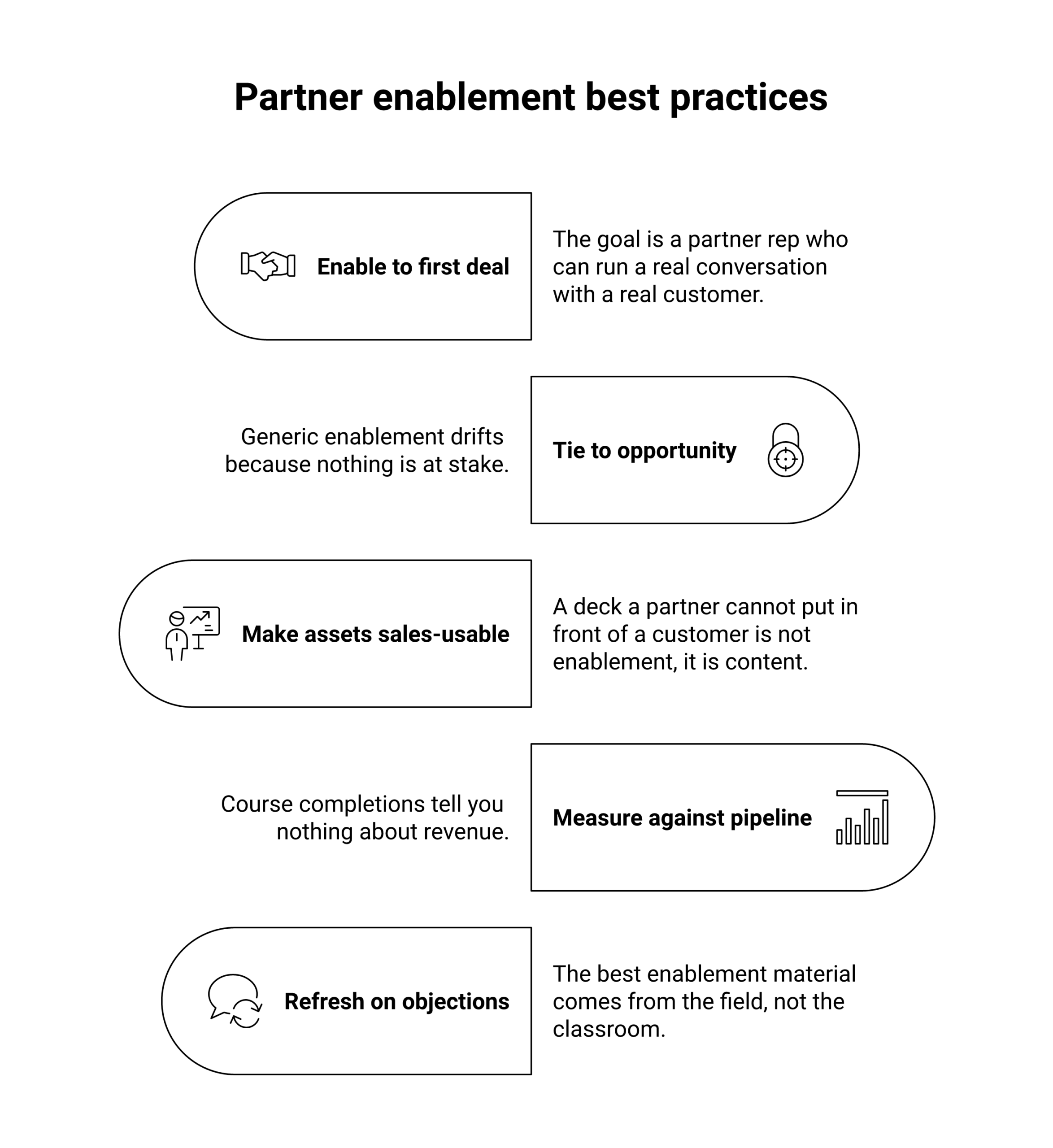
- Enable to a first deal, not a curriculum: The goal is a partner rep who can run a real conversation with a real customer, not a rep who finished a learning path. Build the shortest path to a first co-sell win and treat the curriculum as support for that, not the destination.
- Tie enablement to a named opportunity: Generic enablement drifts because nothing is at stake. Attach each partner’s enablement to a specific account or deal they are working, so the training has a target and you can tell whether it helped.
- Make assets sales-usable: A deck a partner cannot put in front of a customer is not enablement, it is content. Build assets the partner rep can actually use in a live conversation, the pitch, the objection responses, the one-pager, and test them on a real call before you call them done.
- Measure enablement against partner-sourced pipeline: Course completions tell you nothing about revenue. Track enablement against partner-sourced pipeline and influenced deals in the CRM, so you are measuring the outcome you care about instead of a proxy that always looks green.
- Refresh on real objections: The best enablement material comes from the field, not the classroom. Pull the objections and questions partners actually hit on live deals and feed them back into the next round of enablement, so the material sharpens against reality instead of aging on a portal.
Common pitfalls in partner enablement
- Enabling to completion, not competence: A finished course proves attendance, not ability. When completion is the metric, you get partners who watched the videos and still cannot run a customer conversation.
- Building a library nobody uses: Teams produce dozens of assets and assume production equals enablement. If a partner rep cannot use the asset on a live deal, it is shelfware, and the effort is spent.
- No named opportunity behind the training: Enablement with nothing at stake drifts into generic product education. Without a real deal attached, there is no way to tell whether any of it worked.
- Measuring the wrong thing: Reporting certifications and completion rates to leadership hides the truth that pipeline is flat. The metric looks healthy while the program produces nothing.
- Enablement that never refreshes: Material built once and left on the portal ages against a market that keeps moving. Objections change, competitors change, and static enablement stops matching the deals partners actually face.
What this looks like in practice
A B2B software vendor had a certification program with an 80% completion rate and a wall of enablement assets, yet partner-sourced pipeline had not moved in three quarters. When they looked closely, the certification tested product knowledge and nothing else, and most certified partners had never worked a co-sell deal. The completion number was high and the revenue number was flat, and the two had never been connected. They rebuilt enablement around a first deal: every partner rep entering the program picked a real target account, and the enablement walked them to a customer conversation on that account, with the assets and objection handling they needed for that specific sale. They swapped the completion dashboard for a partner-sourced pipeline view and refreshed the material every month from the objections partners hit in the field. Within two quarters, certified partners were producing pipeline for the first time, and the program could finally point to deals it had moved rather than courses it had delivered.
Forecastable’s POV on partner enablement best practices
Our position is that enablement should be measured by whether it moves a real deal, not by course completions. A partner who finishes your curriculum and never touches an opportunity produced nothing, and any metric that calls that a success is lying to you. The right question is never how many partners completed enablement, it is how much pipeline the enablement produced.
That means anchoring enablement to a named opportunity and building the shortest path to a first co-sell win, then tracking that partner forward into the CRM. Completion is a starting line, not a finish line. If a certified partner has not touched a live deal, the enablement has not done its job yet, however good the completion rate looks.
Forecastable is a partnerships operating platform that connects partner conversations and actions to CRM pipeline and revenue, the flow from Conversations to Actions to Pipeline to Revenue. We do not run your enablement curriculum. We make it visible which enabled partners actually produce pipeline, so enablement can be judged by the deals it moves rather than the courses it delivers, and so the next round is built on what worked in the field.
Forecastable is a partnerships operating platform and a category authority, complementary to PRM administration rather than a replacement, and not a PRM vendor. Any third-party tools or firms referenced in this space are independent third-party products, and mentioning them is not an endorsement. Evaluate any enablement approach against your own partner mix, motion, and CRM.
Frequently asked questions
What is the difference between partner enablement and partner training?
Training teaches a partner about your product. Enablement gets a partner ready to sell a specific deal, with the assets, positioning, and objection handling for a real customer conversation. Training can be a part of enablement, but enablement is judged by whether a deal moved, not by whether a course finished.
How do you measure partner enablement?
Measure it against partner-sourced and partner-influenced pipeline in your CRM, not against course completions or certification counts. The question is whether enabled partners produced revenue, and completion rates cannot answer that.
What makes a partner enablement asset actually useful?
It can be put in front of a customer on a live deal. If a partner rep cannot use the pitch, one-pager, or objection response in a real conversation, it is content sitting on a portal, not enablement.
Should enablement be tied to a specific deal?
Yes. Enablement with a named opportunity behind it has a target and a way to prove it worked. Generic enablement with nothing at stake drifts into product education that never shows up as pipeline.
How often should partner enablement be refreshed?
Refresh it from the field on a regular cadence, pulling the objections and questions partners actually hit on live deals. Material built once and left static ages against a market that keeps moving.
Why do certified partners still fail to sell?
Usually because certification tested product knowledge and never touched a real deal. A partner can pass every course and still be unable to run a customer conversation, which is why enablement should be measured by pipeline, not completion.
Where does enablement fit against recruitment and onboarding?
Recruitment decides who you enable, onboarding gets them set up, and enablement gets them ready to sell. All three feed the same outcome, so measure each by what reaches the forecast, not by its own internal activity number.
Next step
If your certification numbers are high but your partner-sourced pipeline is flat, the problem is that enablement is pointed at completion, not at a deal. Attach each partner’s enablement to a named opportunity, build the shortest path to a first co-sell win, and measure the whole effort against CRM pipeline. Start your growth journey now to measure enablement by the deals it moves, not the courses it delivers. The partner program hub frames how partner enablement best practices connect to recruitment, onboarding, and co-selling.
Uncover Your Growth Potential
Schedule a Discovery Call