Channel Sales Enablement: What It Is and How to Do It

What is channel sales enablement?
Short answer: Channel sales enablement is the work of equipping a vendor’s partners to sell its product accurately and confidently, through training, certification, sales tools, and ongoing support. It is the difference between a partner who signed an agreement and a partner who can actually win a deal. Without it, a signed partner is a logo, not a seller.
The word enablement points to capability. A partner does not sell your product because they signed a contract; they sell it because someone taught them what it does, who it is for, and how to handle the objections they will hear.
Why channel sales enablement matters in 2026
Channel sales enablement matters because a partner’s attention is scarce, and an unenabled partner spends it on someone else’s product. A reseller carries many vendors and sells the ones they understand and trust. If your product is the one they cannot confidently pitch, it sits at the bottom of the bag no matter how good the margin.
In 2026, with buyers better informed and less patient, a partner who half-understands your product loses the deal in the first meeting. The vendors winning through the channel are the ones whose partners can speak to the product as fluently as a direct rep. Channel sales enablement is what closes that gap, and it is why enablement, not recruitment, is usually the real constraint on channel revenue.
There is also a mindshare argument. Partners invest where they see themselves succeeding, so the vendor who makes a partner’s first few deals easy earns a disproportionate share of that partner’s future effort. Enablement is how you buy mindshare, and mindshare is what compounds.
How channel sales enablement actually works
Channel sales enablement works through a repeatable set of moves that take a partner from signed to selling. The components below are what a working program assembles.
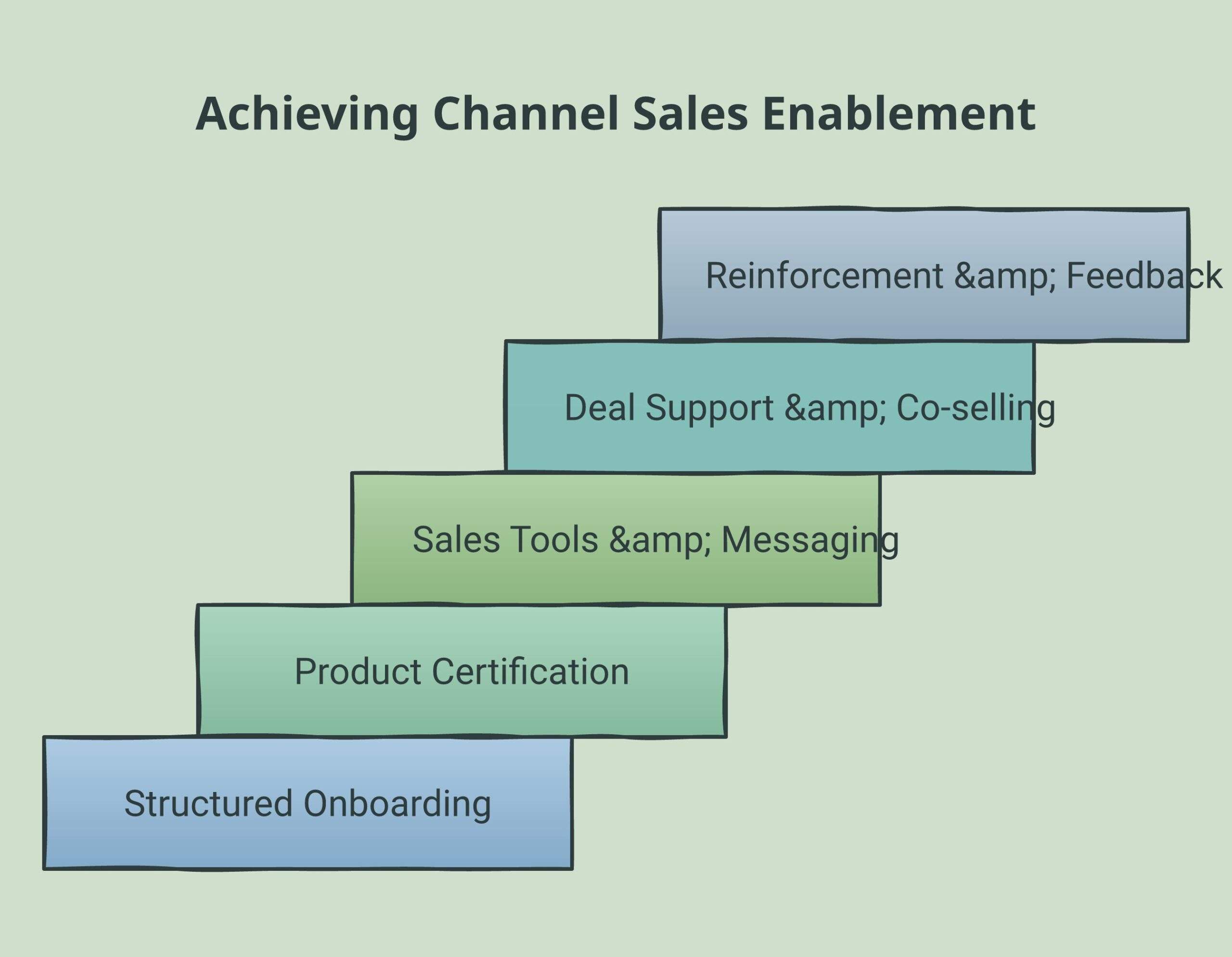
- Structured onboarding: A defined path from signature to first pitch, so a new partner knows exactly what to learn and in what order rather than guessing.
- Product and sales certification: Training that proves a partner can explain the product and qualify a buyer, tied to a real check rather than a slide they clicked through.
- Sales tools and messaging: The decks, one-pagers, objection guides, and demo scripts a partner needs to run a deal without inventing your pitch themselves.
- Deal support and co-selling: A path for a partner to pull in a vendor specialist on a live opportunity, so the partner is not alone when a deal gets technical.
- Reinforcement and feedback: Ongoing coaching and a loop that surfaces where partners lose deals, so enablement improves against reality instead of guesses.
Common pitfalls in channel sales enablement
- Confusing content with capability: A portal full of decks is not enablement if no partner can pitch from them. Capability is proven in a deal, not measured in downloads.
- Certifying once and walking away: Products change and reps turn over, so a one-time certification decays. Enablement that does not refresh leaves partners selling last year’s product.
- Enabling every partner the same: A partner closing six figures and a partner who has never sold a deal need different support. One curriculum for all of them wastes effort on both ends.
- No deal support when it counts: Training a partner and then abandoning them when a live deal gets hard teaches them to stop bringing you deals. The co-sell path has to be real.
- Measuring activity, not outcomes: Tracking courses completed tells you nothing about whether partners win. Tie enablement to deals sourced and closed, or you are measuring motion.
What this looks like in practice
A worked example: a vendor recruited thirty resellers and watched most of them never close a deal. The problem was not the partners; it was that onboarding ended at contract signature. They rebuilt enablement around a defined path, a real product certification, an objection guide drawn from actual lost deals, and a named specialist a partner could pull into any live opportunity. Within two quarters, the share of partners who had closed at least one deal roughly doubled. The recruitment number never changed; the enablement behind it did, and that is what moved revenue.
Forecastable’s POV on channel sales enablement
Our position is that enablement, not recruitment, is where most channel programs actually leak. It is easy to sign partners and report the count; it is harder to get those partners to their first win, and the gap between signed and selling is where the revenue quietly disappears. A program that celebrates partner signatures while ignoring partner enablement is measuring the wrong number.
We also think enablement has to be measured against deals, not activity. Courses completed and assets downloaded feel like progress, but they do not tell you whether a partner can win. The signal that matters is the share of partners who have closed, and the time it takes a new partner to reach a first deal. Enablement that moves those numbers is working; enablement that only moves download counts is theater.
Forecastable is a partnerships operating platform focused on connecting partner activity to CRM pipeline and revenue. That lens makes channel sales enablement accountable: instead of reporting training completion, a team can see whether enabled partners actually source and close deals, and where in the path partners stall. Enablement stops being a cost center and becomes a lever you can point at the forecast.
Forecastable is a partnerships operating platform. Any tools or approaches named here are independent third-party products, and naming them is not an endorsement. Design channel sales enablement around your own product, partner types, and sales motion.
Frequently asked questions
What is channel sales enablement?
It is the work of equipping a vendor’s partners to sell its product accurately, through onboarding, certification, sales tools, deal support, and ongoing coaching, so a signed partner becomes a capable seller.
How is channel sales enablement different from direct sales enablement?
Direct enablement trains a vendor’s own reps, who sell only that product. Channel enablement trains partners who carry many vendors, so it competes for attention and has to make the product easy to prioritize.
Who owns channel sales enablement?
Usually a channel or partner enablement function inside the vendor, working with the partner managers who own relationships and the product and sales teams who supply the substance.
How do you measure channel sales enablement?
By outcomes: the share of partners who have closed a deal, time from signature to first win, and pipeline sourced by enabled partners, rather than courses completed.
What should channel sales enablement include at a minimum?
Structured onboarding, a real product and sales certification, current sales tools and objection guidance, and a co-sell path for live deals.
Why do partners ignore vendor enablement?
Usually because it is generic, one-time, or disconnected from deals. Partners engage with enablement that visibly makes their next deal easier to win.
Next step
If you recruit partners but most never close, the constraint is enablement, not the pipeline of new logos. The fix is getting partners to a first win faster and measuring enablement against deals, not downloads. Forecastable helps partnerships teams connect partner activity to CRM pipeline, so you can see which partners are actually selling and where enablement stalls. Start your growth journey now to make channel enablement something you can measure. The partner program hub frames how channel sales enablement fits onboarding and co-sell.
Uncover Your Growth Potential
Schedule a Discovery Call