OEM Partnerships: How They Work and When to Use Them in 2026

Short answer: OEM partnerships are commercial agreements where a hardware manufacturer lets another company’s product become part of what it ships, and lets a wider channel sell the result. Picture a server builder or a commercial mobile device maker. Around its OEM program sits a crowd. Software vendors want their product certified and embedded so the hardware has something to differentiate on. Distributors want the volume. Resellers want to carry the combined offer to end customers. Everyone wants a part of that program, because the program is the channel. So the deal you sign with the manufacturer is the easy part. The work is earning a defensible place in the channel that hangs off it, and most companies underprice that work because they score an OEM partnership like a logo grab.
What an OEM partnership actually is
An OEM partnership is a commercial agreement in which one company, the OEM, makes another company’s product or technology part of what it builds and ships under its own name. The term comes from hardware. OEM stands for “original equipment manufacturer,” and for decades it meant the company that actually made the device. When a software vendor’s product gets embedded, certified, or rebranded inside that device, the software vendor becomes an OEM partner of the manufacturer.
So the structure is different from a reseller deal in three ways. First, the embedded company’s brand usually disappears, and the manufacturer’s brand is what the customer sees. Second, the customer relationship and the support burden sit with the manufacturer and its channel, not with the embedded vendor. Third, the money moves as a royalty or a license fee, not as margin on resale.
If you want to see what a real program you need hardware certifications, sales enablement, joint marketing funding, a dedicated partner team, joint reference architectures, and a roadmap-alignment cadence. That is the shape of the thing. It is not a contract. It is a program with its own operating rhythm, and getting in is the start of the work, not the end of it. This is why an OEM motion behaves more like a channel sales strategy anchored in partner economics than like a one-time integration deal.
Why software vendors, resellers, and distributors all want into the program
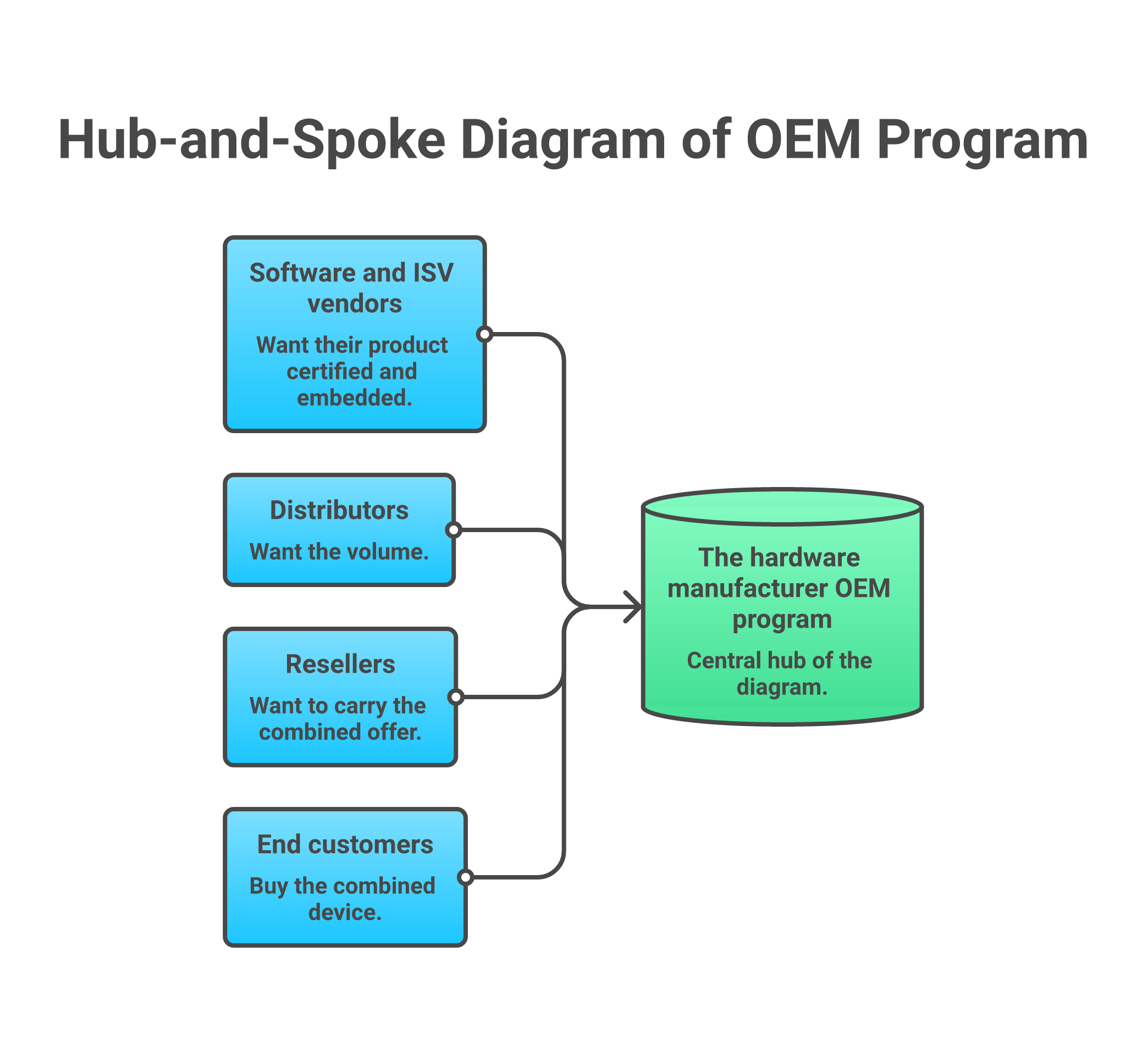
Start with the manufacturer’s problem. Hardware drifts toward commodity. Two rugged tablets or two POS terminals with similar specs compete mostly on price, and price competition is miserable. So the manufacturer needs something to differentiate on, and embedded or certified software is one of the few things that works.
Now look at it from the software vendor’s side. The manufacturer already has a channel. It has distributors buying in volume and resellers carrying devices to end customers in markets the software vendor could not reach alone. Building that distribution directly would cost years and a lot of money. Getting certified into the manufacturer’s program rents it instead. That is the real prize, and it explains why the program is crowded.
The scale of the prize is easy to miss. By one Canalys estimate, over 70% of global IT and telecom spend flows to, through, or with the channel. When you join a hardware manufacturer’s OEM program, you are not joining a partnership. You are plugging into the part of the market where most of the money already moves.
But here is the catch. The manufacturer’s sales reps are paid to move hardware. They will not naturally surface the value of your software, because to them it is a feature that helps close a box. If you treat the signed agreement as the finish line, your product sits in a price list nobody references. In my work with partnerships teams, the vendors that win treat the program as a channel they have to activate, one rep and one reseller at a time.
The four structures an OEM partnership takes
OEM partnerships take four common shapes. Each one ships differently, pays differently, and is hard to leave for different reasons.
Full embedded. Your product becomes an invisible component of the device. The end customer does not know you exist. The money is usually a per-unit royalty or a revenue share, often with a minimum-volume commitment.
White-label. Your product ships rebranded as the manufacturer’s product. Customers see the manufacturer’s name on something you built. The money is typically a per-unit royalty plus a setup fee, with named support terms and an SLA.
Certified or validated component. Your product is tested, certified, and sold as a named, supported add-on, often as a joint SKU the manufacturer’s reps can quote. The money is a license fee plus a usage-based or per-unit royalty. This is where most pilots start, because the operating discipline is lighter and the exit path is cleaner.
Strategic co-developed program tier. This is the manufacturer’s top OEM tier. You get deeper integration access, a joint roadmap, co-funded go-to-market, and a named partner team on the manufacturer’s side. In return the manufacturer expects real commitment: validated devices, registered pipeline, and co-marketing activity. This tier replaces what people often mislabel as a “platform tier.” It is not a cloud marketplace listing. It is a hardware manufacturer treating you as a co-development partner.
How the four structures differ on exit risk
Exit risk rises as you move down that list. A certified component can be swapped or rebuilt without the customer noticing. A white-label arrangement is harder, because customers will see the change. Full embedded is harder still, since pulling your component out is a multi-quarter engineering project for the manufacturer. The strategic tier is hardest of all, because both sides have built customer-facing investment on top of the relationship. That difficulty is not a bug. Designed well, it becomes the moat.
When an OEM partnership makes strategic sense
An OEM partnership earns its operating cost in four conditions. If fewer than three hold, the motion is usually a distraction.
First, the manufacturer needs a complete offer faster than it can build one. Embedding your capability shortens its time to ship by months. The partnership is effectively an “instead of build” decision for the manufacturer, and that is the strongest version of the motion.
Second, you have a real technical lead that is hard to copy. If the manufacturer could rebuild your capability in a quarter, the embedding is not durable. A strong OEM partnership is anchored on a genuine lead. A weak one is anchored on a lead that erodes over the term of the contract.
Third, the combined offer reaches a customer segment neither side reaches alone. The device plus your software becomes a different product, not just a bundle, and that new product opens a market.
Fourth, the economics leave defendable margin for both sides and for the channel underneath them. If the royalty only works at pilot volume, the partnership breaks the moment it scales.
The mechanics that decide whether it produces durable revenue
Signing the agreement is the easy part. In the OEM motions I have watched produce revenue you can actually forecast, four mechanics did the deciding.
Price the royalty for scale, not for the pilot
The most common economic mistake is agreeing to royalty terms that work at pilot volume and break at scale. Model the volume curve before you sign. Lock in escalators, volume tiers, and minimum floors. Build the exit path into the first contract, because renegotiating it later, when the manufacturer depends on you, is a far weaker position than negotiating it up front.
Diversify the manufacturers you work with, and never sign exclusivity
Exclusivity feels like commitment. It is actually existential risk. If your one manufacturer stumbles, gets acquired, or simply deprioritizes the category, your revenue goes with it. So work with multiple manufacturers unless one of them guarantees revenue large enough to offset the risk, which almost none can. Be the best partner each manufacturer has, not the exclusive one. Respect each manufacturer’s customer lists and never proactively rip and replace. When a competing manufacturer’s customer comes to you directly, you take the deal, because that is fair business and every manufacturer in your portfolio understands it.
Enable the manufacturer’s sales motion, then activate its channel
Your buyer here is not the end customer first. It is the manufacturer’s sales team, and then its distributors and resellers. They need to understand the problem your software solves before they can sell it, and they will not get there on their own. So teach them the customer pain in plain language, give them the deployment stories, and give them collateral they can carry into a discovery call. Then push the same enablement down to the resellers. If you skip the manufacturer and go straight to the resellers, the resellers will not believe the message. This is the same discipline as turning signed partners into sellers anywhere else in the partner program. The OEM relationship is upstream of the reseller motion, not parallel to it.
Score the partnership on a scoreboard, not on SQOs
Most teams measure an OEM partnership by deals closed this quarter. That number misses almost everything that predicts next year. A better scoreboard tracks integrations validated, devices validated, co-marketing activity, the current device count in the field, and the count of devices shipping with your software pre-loaded. Those last two are the forward-revenue signal. When you score the partnership on ecosystem health instead of transactional wins, you make decisions that compound.
Where OEM partnerships fail
Most OEM underperformance traces to a short list of design and operating mistakes. All of them are fixable, and all of them are cheaper to prevent than to repair.
The royalty is underpriced, so the economics break at scale. There is no exit path, so the partnership becomes a contract that is easy to underprice and hard to leave. Brand and support ownership are fuzzy, so the end customer does not know who to call. The two roadmaps drift apart, and technical debt piles up at the integration layer. There is no customer-success layer, so churn happens where the embedded vendor cannot see it and the manufacturer cannot fix it. And then there is the exclusivity trap: signing exclusivity to win one manufacturer and forfeiting the rest of the channel to do it.
How OEM partnerships fit the partner ecosystem
OEM is one of seven partner types, and it is easy to confuse with its neighbors. The full set is tech alliance partners, reseller partners, distributor partners, OEM partners, agency and consulting partners, ISV partners, and service-delivery partners. For a clean reference on where OEM sits among the other partner types, the distinctions are worth getting right, because each type runs on different economics.
The thing to hold onto is that an OEM partnership is not a side deal. It sits at the top of a layered channel. The manufacturer feeds national distributors. Those distributors feed regional and transactional resellers. After that, the resellers reach the end customer. So when you embed into a manufacturer, you are buying a position at the head of that whole structure, which is exactly why the activation work runs downstream and never stops. If you want the wider operating picture, our 2026 operating guide for revenue leaders and our breakdown of the structural patterns behind partner programs that scale both put the OEM motion in context.
The same logic travels to software
The hardware framing is the clearest version of this, but the logic is not limited to hardware. When one software company embeds another company’s technology and ships it under its own brand, the same rules apply. The program is the channel. The contract is the easy part. And the work is activating the partner’s go-to-market and earning a defensible spot in it. If you take one idea from this piece, take that one. An OEM partnership is a channel you operate, not a contract you sign.
Frequently asked questions
What is an OEM partnership?
An OEM partnership is a commercial agreement in which a manufacturer makes another company’s product part of what it builds and ships under its own brand. The embedded company earns a royalty or license fee. It usually does not own the brand-facing experience or the customer relationship.
How do OEM partnerships differ from reseller partnerships?
A reseller buys your product and resells it under your brand, earning margin on the resale. An OEM embeds or rebrands your product and sells it under the manufacturer’s brand, paying you a royalty or license fee. The brand, the customer relationship, and the economics all work differently.
What are the four common OEM partnership structures?
Full embedded, white-label, certified or validated component, and strategic co-developed program tier. They differ on how the product ships, how the money moves, and how hard the arrangement is to exit.
When do OEM partnerships make strategic sense?
When the manufacturer needs a complete offer faster than it can build one, when you hold a technical lead that is hard to copy, when the combined offer reaches a segment neither side reaches alone, and when the royalty leaves defendable margin for both sides and the channel.
How is OEM revenue typically structured?
As a per-unit royalty, a revenue share, a fixed license fee, or a hybrid. Strong agreements add volume tiers, escalators, and minimum commitments so the economics hold as the partnership scales.
What is the most common OEM partnership pitfall?
Underpricing the royalty at pilot volume so the economics break at scale. The close runner-up is signing exclusivity, which trades the rest of the channel for one manufacturer relationship.
Who owns customer support in an OEM partnership?
Usually the manufacturer and its channel, with a defined escalation path back to the embedded vendor for technical issues. The failure mode is leaving that boundary undefined, which leaves the end customer unsure who to call.
Talk to our team about structuring an OEM motion that holds up downstream →
Uncover Your Growth Potential
Schedule a Discovery Call