Short answer: partner activation is the structured process of turning a newly signed partner from “logo on a slide” into “selling, registering deals, and producing pipeline.” In 2026, it is where most programs leak the most revenue. Partners sign at 100% and activate closer to 20% to 30%, because nobody owns the runway. So the fix is to run activation with the same rigor as a sales pipeline.
What is partner activation?
Partner activation is the program that moves a signed partner through the steps to become productive. Those steps are onboarding, certification, joint go-to-market planning, the first registered deal, and the first closed-won.
A working definition has three traits:
Time-bound. It runs on a 90 to 120 day clock. Partners who have not moved by the deadline get help or get dropped down the list.
Milestone-based. Use hard milestones. Not “the partner is engaged” but “the partner registered a deal” or “the partner certified two AEs.”
Owned. A named partner manager owns it for each partner. A job that is everyone’s job is no one’s job.
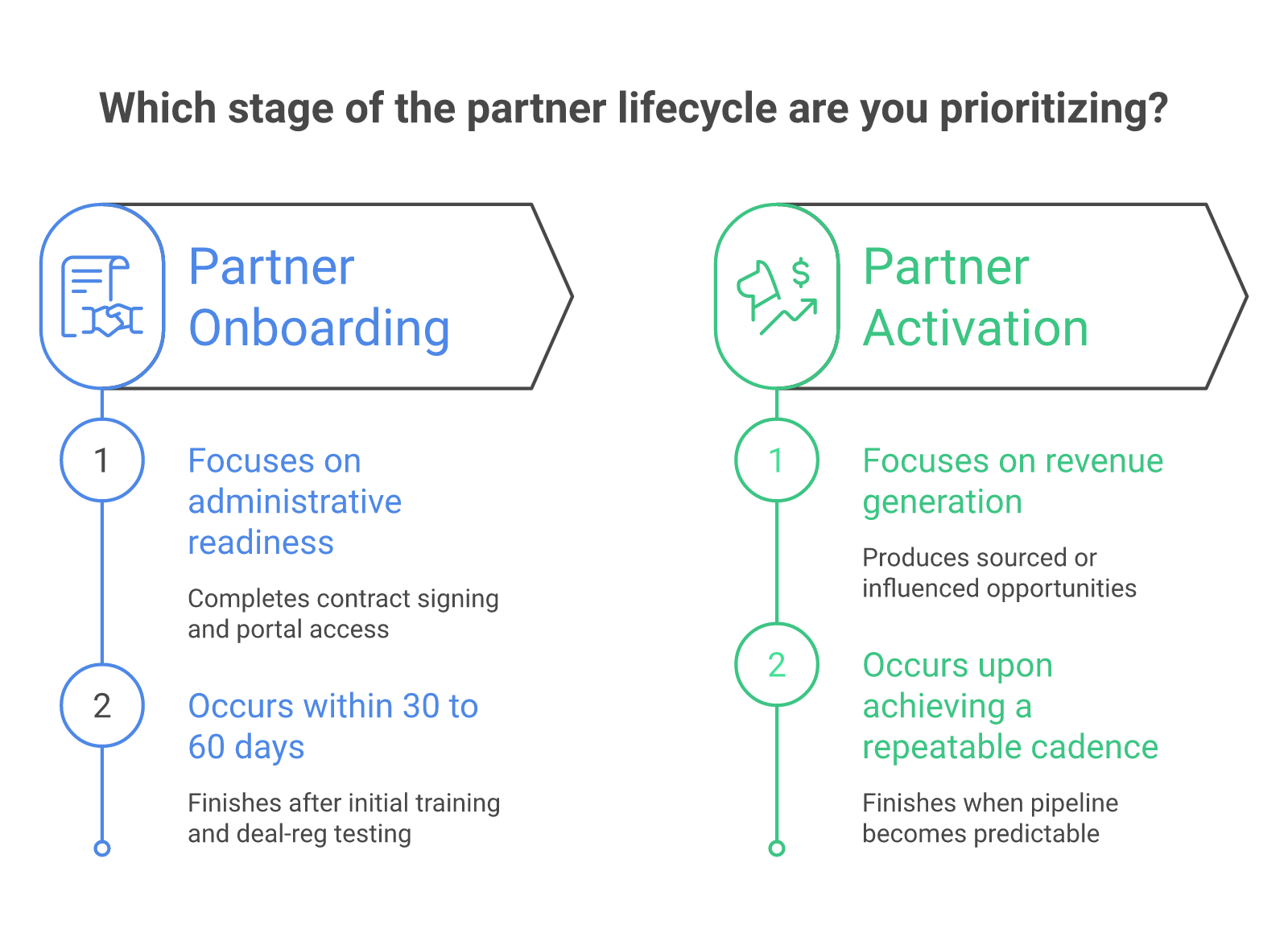
People often confuse this with partner onboarding. Onboarding is the contract and access part: paperwork, portal access, kickoff. By contrast, activation is the productivity part: first deal, first pipeline, first revenue.
Why partner activation matters in 2026
Programs lose more revenue here than at recruitment. Most signed partners never produce anything. So the fix is to own the runway from signed to first closed-won.
Three things make the topic matter more in 2026 than five years ago. First, the partner-sourced revenue numbers got serious. CFOs now look at the gap between “partners signed” and “partners producing” and ask hard questions. Second, partner-rep certs and PRM tooling matured to the point where the runway can be tracked. Third, the cost to acquire partners is now visible enough that wasting it stands out. Forrester’s channel research has tracked this shift toward partner productivity as a board-level metric (Forrester channels research).
Consider the math. A 200-partner roster at 25% activation produces less pipeline than a 50-partner roster at 90% active. So a focus on the runway, not on recruiting, is almost always the higher-leverage move. The Harvard Business Review has made the broader point that channel programs win on partner productivity, not partner count (Harvard Business Review on sales and marketing).
How partner activation actually works
Six milestones run across 90 to 120 days. They are agreement signed, portal access and certification done, joint GTM plan signed, first registered deal, first opportunity progression, and first closed-won. Skip any one and the runway breaks.
Here is the standard flow.
Milestone 1, agreement signed (week 0). Contract executed. Portal access set up.
Milestone 2, onboarding done (week 1 to 2). Partner reps have portal logins. The partner-manager kickoff is held. The first content path is assigned.
Milestone 3, certification done (week 3 to 6). A minimum number of reps certified per role, often 2 sales reps and 1 SE. Partner certification gated to selling rights.
Milestone 4, joint GTM plan signed (week 4 to 6). A one-page joint plan: target accounts, a working joint value proposition, deal-reg process, attribution rules, cadence. Signed by both sides.
Milestone 5, first registered deal (week 6 to 10). A partner rep registers the first deal through the PRM. The deal can be early-stage. Registration itself is the milestone.
Milestone 6, first closed-won (week 12 to 26). The first deal closed and revenue booked. This closes the loop.
Programs that hit all six within 120 days run activation rates in the 70% to 90% range. By contrast, programs that skip milestone 3 or 4, the cert and joint plan steps, see those rates fall to 20% to 30%.
However, you can still reach first pipeline within 6 weeks if the value story is strong and the partner’s customer base is ready for it. Partners do not have to be certified to refer, as long as the referral runs in a controlled way.
Partner activation versus partner onboarding
Onboarding is the admin process: contract, portal, kickoff. Activation is the productivity process: cert, joint plan, first deal. So many programs run onboarding well and skip activation entirely.
Dimension
Onboarding
Activation
Owner
Partner ops or operations
Partner manager
Duration
1 to 2 weeks
90 to 120 days
Output
Portal access, paperwork complete
First registered deal, first closed-won
Failure mode
Slow legal, missing access
No certification, no joint plan, no first deal
Common confusion
“Onboarding is complete” treated as “partner is active”
Activation treated as a status, not a runway
The most common failure is to treat a partner as active the moment onboarding ends. Onboarding done means the partner can log into the portal. Activation done means the partner is producing revenue. The gap between the two is exactly where most programs leak.
Common pitfalls
Five failures repeat. They are a recruitment-over-activation focus, a missing milestone owner, a missing time-bound deadline, no certification gating, and no first-deal target.
Pitfall 1: recruitment over activation. Programs that brag about “200 signed partners” with no activation rate are usually hiding it because it is bad. So fix the metric: activation rate, not partners signed.
Pitfall 2: no milestone owner. Work that is “the partner manager’s job in general” does not get done. Instead, name a milestone owner for each partner. Then hold them to the 120-day clock.
Pitfall 3: no deadline. A runway with no deadline drags on forever. So partners who have not become active in 120 days get help or get dropped, not endless patience.
Pitfall 4: no certification gating. When partners can sell without a cert, the cert does not happen. The fix is to gate selling rights to the cert. Then enforce it.
Pitfall 5: no first-deal target. Programs that skip a target of “first registered deal within X weeks” miss the key signal. So set the target. Then track the misses.
How to instrument partner activation
Track six metrics. Milestone hit rate. Time-in-stage. The active-vs-signed ratio. First-deal-cycle time. Cohort progress. And the firm-level spread.
Here are the six metrics that make the runway real:
Milestone hit rate. What share of signed partners hit each of the six milestones?
Time-in-stage. Average days from signed to onboarded, onboarded to certified, and so on. Use this to find the bottleneck.
Active-vs-signed ratio. What share of partners signed in the last 6 months have hit milestone 5, the first registered deal? This is your headline number.
Time to first pipeline. Median days from signed to first registered deal.
Cohort progress. Group partners by signing month. Then track how each cohort moves.
Firm-level spread. Are 80% of activated partners producing 80% of partner-sourced pipeline? Or is the spread flatter? The shape tells you about partner-tier strategy.
Programs that report all six find their bottleneck within a quarter. By contrast, programs that report only “partners signed” never find it.
Forecastable’s POV on partner activation
Most partnerships teams optimize partner recruitment and ignore partner activation. The activation rate is the metric that predicts partner-sourced revenue. And it almost always sits below where the team thinks it does.
Nobody owns the 120-day clock
Here is the note I repeat most across the programs I have reviewed. Nobody owns the 120-day clock. The partner gets handed off from BDR to ops to a partner manager who is also running 25 other partners. That manager has no specific target for this one. So the runway falls between the seams. The fix is mechanical: name an owner per partner, set the 120-day clock, and run weekly stand-ups against milestone progress.
Report the activation rate at the all-hands
The second move is to report the activation rate at the all-hands. The metric “200 partners signed this quarter” hides everything that matters. By contrast, “200 signed, 47 activated, 153 idle and aging” forces the conversation about the runway. The first time a team reports this honestly, the room reacts. The reaction is the point.
Frequently asked questions
What is the difference between partner activation and partner onboarding?
Onboarding is the admin work: contract, portal access, kickoff. It runs 1 to 2 weeks. Activation is the productivity work: cert, joint plan, first registered deal, first closed-won. It runs 90 to 120 days. Different owners. Different metrics.
What activation rate should we be targeting?
70% to 90% within 120 days is the bar for a mature program. Below 30% says the activation runway is not owned. Between 30% and 70% says it is owned but lacks discipline.
Who owns partner activation?
A named partner manager owns the activation for each partner. Partner operations can support. But the partner manager has to own the 120-day clock and the milestone progression.
How does partner activation relate to partner certification?
The cert is a milestone inside activation. It is often milestone 3, in week 3 to 6. Programs that gate selling rights to the cert move faster, because they force the milestone.
Can partner activation be automated?
Partially. Milestone tracking, certification gating, and deal-reg can be automated in the PRM. The joint GTM plan and the first-deal conversations cannot. Those are partner-manager work.
What if a partner fails to activate within 120 days?
Help them first. Pair them with an AE and add enablement. Move them down a tier second. End the partnership third. If you carry idle partners forever, you just pad the signed-partner count and book no revenue.
Does partner activation work for SI and consulting partners?
Yes, with milestone tweaks. For an SI, the runway often swaps “first registered deal” for “first paid pilot” or “first scoped project.” Same discipline. Different exit gate.
How does PRM tooling support partner activation?
The PRM tracks milestone status. It gates selling rights to the cert. It automates deal-reg. And it reports the rate by cohort. Without a PRM, this tracking lives in a spreadsheet. That works for small programs and gets fragile at scale.
Next step
Pull your last two cohorts of signed partners this week. Then count how many hit milestone 5, the first registered deal, inside 120 days. That single number is your real activation rate, and it is usually lower than the team expects. If it sits below 50%, do not recruit another partner until you have named an activation owner per partner and set the 120-day clock. The runway, not the roster, is what produces revenue.
Talk to our team about standing up partner activation tracking that produces pipeline →
Uncover Your Growth Potential
Whether starting with a single sales team or a single partner, any co-sell motion can be live within 30 days.
What is a HubSpot deal stages co-sell setup? Short answer: A HubSpot deal stages co-sell setup is the way you configure your pipeline so a deal worked with a partner is tracked as one, from the stage where the partner enters to the credit captured at close. It uses your existing pipeline plus a few […]
What is the difference: close plan vs mutual action plan? Short answer: The difference in close plan vs mutual action plan is scope: a mutual action plan maps the whole pursuit from evaluation to a decision, while a close plan maps the final segment of dated steps that get an agreed deal to signature. They […]
What is a mutual action plan template? Short answer: A mutual action plan template is a reusable structure, a set of fields for milestones, owners, dates, and dependencies, that a buyer and seller fill in to produce the joint roadmap for a specific deal, so they are not designing the format from scratch each time. […]
What is a mutual action plan? Short answer: A mutual action plan is the joint, dated roadmap that a buyer and a seller agree to follow to move a deal from evaluation to a decision and beyond, listing the milestones, the owner on each side, and the dates, across the whole pursuit rather than only […]
Mollie Bodensteiner is an experienced operations professional with a demonstrated track record of utilizing technology to support operational processes that drive performance and innovation.
She currently is the Vice President of Operations at Sound and owns go-to-market agency, MB Solutions. Mollie has previously held operations leadership roles at Deel, Syncari, Corteva and Marketo.
She has over 14 years of experience in both B2C and B2B operations and technology. When she is not working, Mollie enjoys spending time with her husband, three small children, and two large dogs.
Childhood Career/Dream:
Growing up in the age of Disney and Nick@Nite I always wanted to be a child actor (good thing that never was actually pursued 🙂
Favorite Win:
I am not sure I have a specific “win” but I think I get the most joy and excitement from coaching others and watching them hit major milestones in their career. The first time you get to promote someone on your team or watch them lead a major project – are always career highlights!
Personal Fun Facts:
Favorite Song: If it’s love, Train
Favorite Movie: Good Will Hunting
Favorite Meme: Disaster Girl
My journey from Education to Operations has equipped me with a unique perspective and skill set that perfectly aligns with Forecastable’s mission to help businesses improve sales collaboration through partner co-selling strategies.
At Forecastable, I am passionate about empowering teams and organizations to unlock the full potential of strategic partnerships. By leveraging my expertise in communication, leadership, and operational efficiency, I contribute to creating seamless co-selling processes that align with business goals and deliver exceptional results.
The intersection of my educational foundation and operational experience fuels my dedication to fostering alignment, building trust, and enhancing collaboration between partners. I am driven by the opportunity to contribute to a platform that not only optimizes sales strategies but also strengthens relationships that lead to long-term growth.
Paul Jonhson
Chief Technology Officer (Co-founder)
Paul Johnson has 20+ years of software development and consulting experience for a variety of organizations, ranging from startups to large-enterprise organization with highly-complex needs.
Mr. Johnson has a long track record of successful technology deployments.
This, combined with his deep passion for machine learning and exceptional user experience design, allows him to lead our technical direction from the front with confidence.
Alex Buckles
Product, Partnerships, and Value Engineering (Co-founder)
After serving in The United States Marine Corps, Alex Buckles spent the next two decades as a student of revenue production and an advocate for innovation.
Along the way, he has helped numerous companies achieve double and triple-digit growth by crafting and executing high-performing go-to-market strategies, with co-selling at the center of each.
As a once-advanced technical marketer, an expert sales & partner professional, and a strong customer success advocate, Mr. Buckles understands the impact of these functions aligning not only on revenue production, but on the day-to-day execution of the go-to-market strategy. This concept of revenue-team alignment is what quickly became the foundation of Forecastable back in January of 2018.
In his free time, you’ll find him spending quality time with his children, one of whom is on the autism spectrum. 1 in 36 children in the U.S. are on the spectrum and boys are four times more likely to be diagnosed than girls.
With that in mind, Mr. Buckles plans on dedicating the rest of his life serving those living with autism, through his organization Pathways for Autism. From his perspective, there must be a scalable and financially self-sustaining infrastructure established to put as many individuals with autism as possible on a path towards complete independence as adults.