What Is Forecast Collaboration? A Clear Definition

What is forecast collaboration?
Short answer: Forecast collaboration is the practice of building a single revenue forecast jointly across the parties who influence it, internal sales, finance, and the partners co-selling the deals, working from shared data instead of separate, conflicting guesses. It replaces the situation where a company forecasts its own pipeline and its partners forecast theirs, and neither number reflects the deals they are actually working together.
The point is one view of the same deals. When a partner and a vendor are both on an opportunity, forecast collaboration means they agree on its stage, timing, and value rather than each carrying a private estimate that the other never sees.
Why forecast collaboration matters in 2026
Forecast collaboration matters because partner-influenced revenue is now a meaningful share of pipeline, and a forecast that ignores what partners know is missing information that materially changes the number. When the partner working a deal sees a budget freeze the vendor’s rep has not heard about, a collaborative forecast catches it; a siloed one does not. Better inputs make a more reliable commit.
In 2026 it matters more because leadership increasingly expects partner-sourced and partner-influenced pipeline to be forecast with the same rigor as direct. A program that cannot collaborate on the forecast produces partner numbers nobody trusts, and an untrusted number gets discounted to zero in planning. Collaboration is what makes partner pipeline credible enough to commit.
How forecast collaboration actually works
Forecast collaboration runs as a repeatable loop, where each step turns separate estimates into one agreed view. The loop is the mechanism; without it, collaboration is just a meeting.
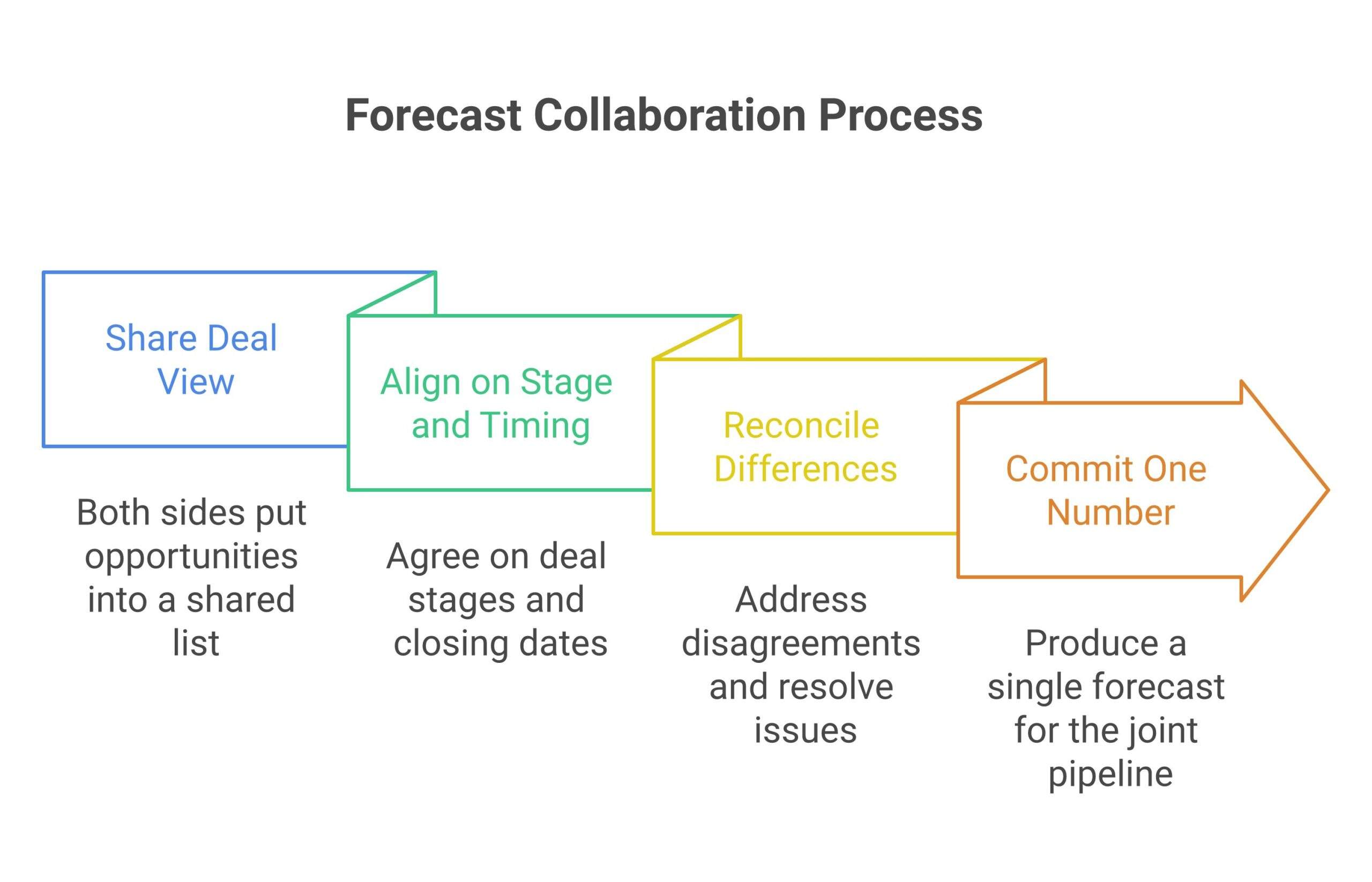
- Share the deal view: Both sides put the jointly worked opportunities into one shared list, so the conversation starts from the same set of deals rather than two private pipelines.
- Align on stage and timing: Agree on where each deal really sits and when it is likely to close, reconciling the optimistic and cautious reads into one honest estimate.
- Reconcile the differences: Surface where the partner and the vendor disagree, a stalled deal one side still counts, a budget signal the other has not heard, and resolve it with the better information.
- Commit one number: Produce a single forecast for the joint pipeline that both sides stand behind, and report it beside direct pipeline so leadership sees one coherent picture.
Forecast collaboration is working when the partner and the vendor describe the same deals the same way, and failing when each still carries a private number that only meets reality at quarter end.
Common pitfalls with forecast collaboration
- Collaborating without shared data: A forecast meeting with no shared deal view is two parties reading separate spreadsheets at each other. Align the data first, then the forecast.
- Treating it as a status update: Forecast collaboration is reconciliation, not a readout. If nobody changes an estimate based on what the other side knows, no collaboration happened.
- Excluding finance: Leaving finance out means the collaborative number never makes it into the planning model. Include the team that has to consume the forecast.
- One-time alignment: A forecast aligned once and never revisited drifts immediately. Collaboration is a recurring loop, not a kickoff event.
What this looks like in practice
A vendor and a co-selling partner kept arriving at quarterly business reviews with different numbers for the same accounts, which made the partner pipeline easy for finance to discount. They started a short biweekly forecast collaboration: one shared list of jointly worked deals, a quick pass to align stage and timing, and an explicit reconciliation of disagreements. Within a quarter the two sides were forecasting the same deals the same way, and the partner-influenced number moved from “directional” to a line finance was willing to include in the plan. The deals did not change; agreeing on how to see them is what made the forecast usable.
Forecastable’s POV on forecast collaboration
Our position is that a partner forecast you build alone is a guess, and a partner forecast you build together is information. The whole value of partners in the pipeline is that they often know things about a deal the internal rep does not, and forecast collaboration is the mechanism that gets that knowledge into the number. Skip the collaboration and you keep the partners but lose the information advantage that made them worth forecasting in the first place.
The second conviction is that collaboration without shared data is theater. Two parties reconciling from one deal view can actually change a number; two parties reading separate spreadsheets can only restate them. The investment that makes forecast collaboration real is the shared view of the joint pipeline, not the meeting on top of it. Get the data aligned and the collaboration becomes the cheapest reliability gain available to a partner program.
Forecastable is a partnerships operating platform; any third-party tools or methods referenced here are independent and naming them is not an endorsement of one approach over another. Build forecast collaboration around your own pipeline and partners.
Frequently asked questions
What does forecast collaboration mean? Building one revenue forecast jointly across the parties who influence it, partners, sales, and finance, from shared data, rather than each maintaining a separate, private estimate of the same deals.
Who is involved in forecast collaboration? The internal sales team, finance, and the partners co-selling the deals. Anyone whose information changes the forecast or who has to consume it should be in the loop.
How is forecast collaboration different from normal forecasting? Normal forecasting is often siloed, each party estimating its own pipeline. Forecast collaboration reconciles those estimates into one agreed view of jointly worked deals.
What do you need to collaborate on a forecast? A shared view of the joint pipeline, an agreed definition of stages and timing, and a recurring cadence to reconcile differences. Shared data is the precondition.
Does forecast collaboration require special software? Not necessarily, though shared deal data makes it far easier. The essential ingredient is one agreed view of the same deals, however that view is maintained.
Next step
If your partner pipeline and your partners’ pipeline are two different numbers, forecast collaboration is how they become one. Forecastable helps partnerships and revenue teams build a shared forecast across partners and internal teams, so partner pipeline is credible enough to commit. Start your growth journey now to make the partner forecast a collaborative number. The forecastability hub explains how a reliable partner forecast fits the wider revenue picture.
Uncover Your Growth Potential
Schedule a Discovery Call