Forecast Collaboration Feature: What to Look For

What is a forecast collaboration feature?
Short answer: A forecast collaboration feature is the capability in a revenue or partnerships system that lets two sides who influence the same deals, internal sellers and the partners co-selling with them, build and adjust one forecast together instead of maintaining separate, private estimates. It exists so the joint pipeline is forecast from a shared view rather than from two numbers that only meet at quarter end.
The capability is narrow and specific. It is not a dashboard that shows two pipelines side by side; it is the mechanism that lets both parties act on the same opportunities, agree on stage and timing, and produce a number both will stand behind.
Why a forecast collaboration feature matters in 2026
A forecast collaboration feature matters because partner-influenced revenue is now a real share of pipeline, and a forecast that cannot incorporate what partners know is structurally incomplete. When the partner working a deal sees a budget freeze the internal rep has not heard about, the capability is what gets that signal into the committed number before the quarter closes on a surprise.
In 2026 it matters more because revenue leaders increasingly hold partner pipeline to the same forecasting standard as direct. A program whose tooling cannot collaborate on the forecast produces a partner number that swings, and a number that swings gets discounted to zero in planning. The capability is what makes partner pipeline credible enough to commit.
There is also an efficiency argument. Reconciling forecasts over email and spreadsheets is slow and lossy, and the loss usually lands on the partner number because it is the one nobody owns end to end. A purpose-built capability removes the manual reconciliation and replaces it with a shared, current view.
How a forecast collaboration feature actually works
A working forecast collaboration feature runs as a short loop that turns two private estimates into one agreed number, where each step depends on the one before it. The loop is the mechanism; a screen that only displays both pipelines without letting either side change the shared number is reporting, not collaboration.
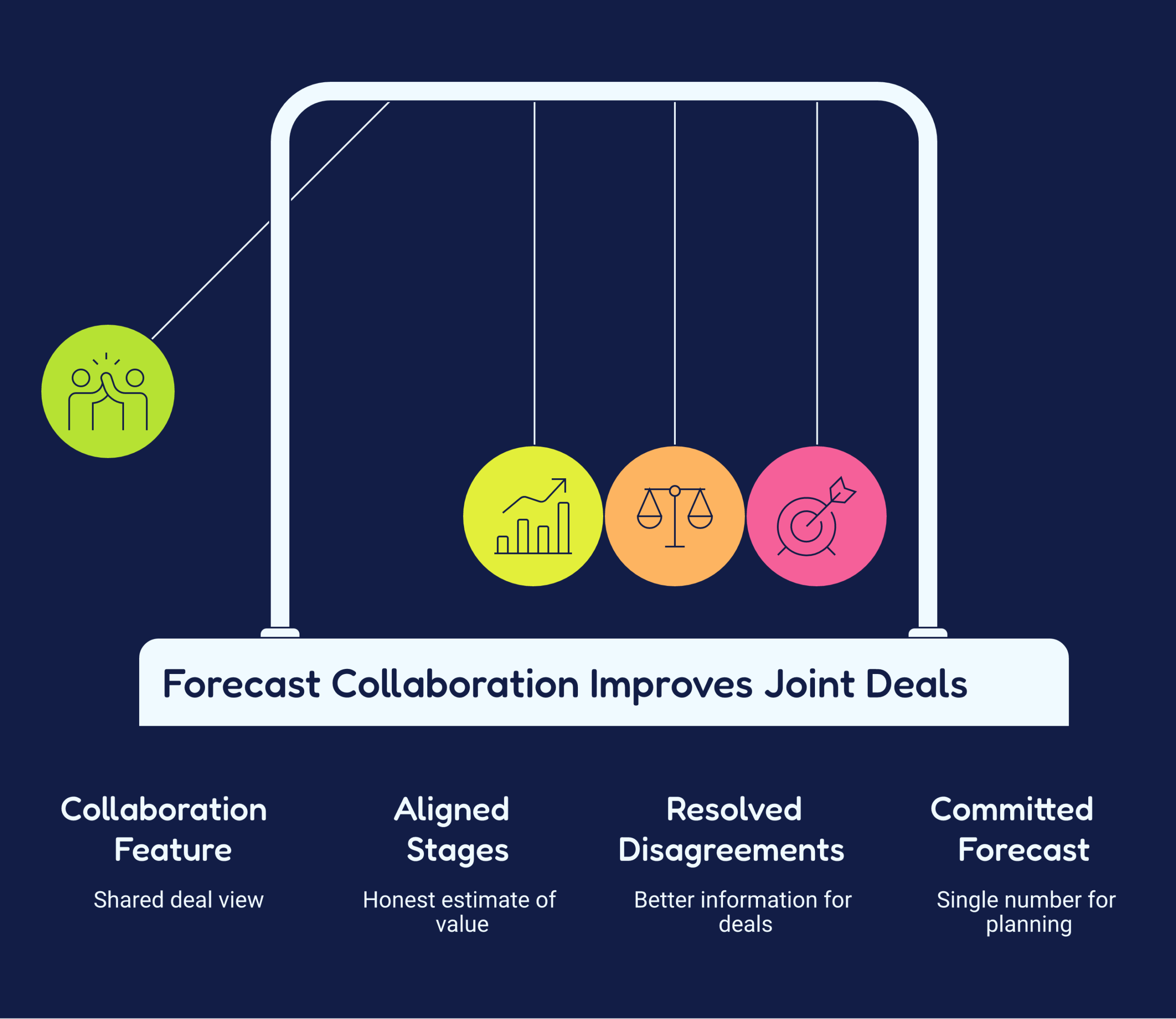
- Share one joint deal view: The capability puts the opportunities both sides are working into a single list both can see and edit, so every conversation starts from the same deals rather than two private pipelines.
- Align on stage and timing: Both sides set where each deal actually sits and when it is likely to close, reconciling the optimistic and cautious reads into one honest estimate of stage and value.
- Reconcile the disagreements: The capability surfaces where the partner and the internal team differ, a deal one side still counts and the other has written off, and routes it to be resolved with the better information.
- Commit one number into planning: It produces a single forecast for the joint pipeline that both sides stand behind and pushes that number into the company forecast, so collaboration ends in a committed line rather than a private agreement.
The capability is working when the partner and the internal team describe the same deals the same way and the joint number reaches the plan, and failing when each still carries a private estimate that only meets reality at the end of the quarter.
What the capability includes in detail
The most important part of a forecast collaboration feature is the shared deal view, because every other part depends on it. Without one trusted list of the jointly worked opportunities, the rest of the capability has nothing to operate on, and the two sides spend their time arguing about which list is right instead of improving the forecast. The shared view should carry the fields that matter for forecasting, stage, expected close, and value, and keep them current for both sides.
The second part is permissioned editing. Collaboration means both sides can change the shared estimate, not that one side publishes a number the other can only read. The capability has to let the partner contribute what they know and let the internal team incorporate it, with a clear record of who changed what, so the reconciliation is real rather than one-directional.
The third part is the reconciliation surface, the place where disagreements are made visible and resolved. A capability that quietly averages two numbers hides the exact information that makes collaboration valuable. The disagreement is the signal; the capability should expose it, not smooth it over, so the better-informed side can correct the estimate.
The fourth part is the path to planning. A forecast that lives only inside the collaboration screen is a private agreement that improves nobody’s plan. The capability has to route the committed joint number into the company forecast and the planning model, because that handoff is the entire reason to do the work.
Common pitfalls with a forecast collaboration feature
- Mistaking side-by-side display for collaboration: A screen that shows two pipelines next to each other lets you compare numbers, not reconcile them. The capability has to let both sides change one shared estimate, or it is just a fancier report.
- No shared data underneath: A collaboration surface sitting on top of two disconnected systems inherits their disagreement. Align the deal data first, then the forecast capability has something real to work on.
- Read-only for the partner: If the partner can see the forecast but not contribute to it, the capability captures none of the information advantage that made the partner worth forecasting. Collaboration requires permissioned editing on both sides.
- No route to planning: A committed joint number that stays inside the tool produces no benefit. The capability is incomplete until that number reaches the finance planning model.
- Treating it as a quarterly event: A capability used once a quarter drifts immediately. The forecast collaboration feature earns its value on a recurring cadence, not at a single alignment meeting.
What this looks like in practice
A software company with a growing co-sell motion kept arriving at quarterly reviews with a partner-influenced number that finance discounted because it swung quarter to quarter. The partnerships team moved the joint pipeline into a shared view both they and their partners could edit, ran a short biweekly pass to align stage and timing, and made disagreements explicit rather than averaging them away. The committed joint number then flowed into the company forecast on the same cadence as direct pipeline. Within two quarters the partner-influenced line was stable enough that finance included it at full value. The deals did not change; the capability to forecast them together is what made the number usable.
Forecastable’s POV on the forecast collaboration feature
Our position is that the value of the capability is entirely in the shared, editable view of the joint pipeline, not in the screen on top of it. The appealing parts of forecast collaboration, the reconciliation, the partner’s information reaching the number, the committed joint line, are all impossible without one current view both sides can act on. Teams that buy a collaboration screen without first aligning the underlying deal data get the screen and none of the benefit, because the capability is only as good as the data it operates on.
The second conviction is that the capability has to expose disagreement rather than hide it. A forecast collaboration feature that quietly averages two estimates is discarding the exact thing that made collaboration worth doing. The partner’s dissent, a deal they have written off that the internal rep still counts, is information; the capability should surface it and route it to resolution, because that is where the partner’s knowledge becomes the company’s forecast. Smoothing it over produces a number that looks agreed and is not.
Forecastable is a partnerships operating platform; any third-party tools or methods referenced here are independent and naming them is not an endorsement of one approach over another. Evaluate any forecast collaboration feature against your own pipeline, partners, and planning model.
Frequently asked questions
What is a forecast collaboration feature?
The capability in a revenue or partnerships system that lets internal sellers and their partners build and adjust one forecast of the deals they work together, from a shared view, instead of keeping two separate estimates.
How is it different from a forecasting dashboard?
A dashboard displays pipeline; a forecast collaboration feature lets both sides change one shared estimate and reconcile their differences. Display is one-directional; collaboration is two-directional.
Who uses a forecast collaboration feature?
The internal account team and the partner reps who hold deal information, plus partnerships and finance who consume the committed number and route it into the plan.
What should a forecast collaboration feature include?
A shared joint deal view, permissioned editing for both sides, a surface that exposes and resolves disagreements, and a path that routes the committed number into the planning model.
Does a forecast collaboration feature require shared data?
Yes. The capability is only as reliable as the joint deal view underneath it; without aligned, current data, the reconciliation degrades into an argument about whose list is correct.
How often should the capability be used?
Often enough that the forecast stays current, frequently biweekly during active quarters, with a disciplined pass that changes estimates based on new information rather than just restating them.
Next step
If your partner pipeline and your partners’ pipeline are two different numbers, a forecast collaboration feature is how they become one. Forecastable helps partnerships and revenue teams forecast the joint pipeline from a shared view, so partner pipeline is credible enough to commit. Start your growth journey now to make the joint forecast a collaborative number. The forecastability hub frames how a reliable partner forecast fits the wider revenue picture, and the forecast collaboration process shows how to run the loop the capability supports.
Uncover Your Growth Potential
Schedule a Discovery Call