Forecast Collaboration Process: A Step-by-Step Guide

What is the forecast collaboration process?
Short answer: The forecast collaboration process is the repeatable loop a company and its partners run to build one revenue forecast of the deals they work together, moving from a shared deal view through alignment and reconciliation to a committed number that reaches planning. It is the operating procedure that turns the idea of collaborating on a forecast into a routine both sides actually follow.
The process exists because collaboration does not happen by goodwill. Two organizations forecasting the same deals will drift into two numbers unless there is a defined sequence of steps that pulls them back together, and the process is that sequence.
Why the forecast collaboration process matters in 2026
The forecast collaboration process matters because an undefined, ad hoc collaboration produces a partner number that swings, and a swinging number gets discounted in planning. When the two sides align only occasionally and informally, the joint forecast is unreliable, finance stops counting it, and the program loses the credibility it needs to be funded. A defined process stabilizes the number by making alignment routine.
In 2026 the stakes are higher because revenue leaders apply the same forecasting rigor to partner pipeline that they apply to direct. A program that runs a disciplined forecast collaboration process can present a reconciled, partner-informed number that earns a real line in the plan; one that runs the collaboration by feel presents a guess that gets discounted to zero.
There is also an information argument. Partners often see things in a deal the internal rep does not, a competing evaluation, a budget shift, a champion leaving. A defined process is how that knowledge reaches the forecast systematically rather than by accident, so the information advantage of having partners in the deal actually reaches the number.
How the forecast collaboration process actually works
The forecast collaboration process runs as a five-step loop, where each step turns separate estimates a little more into one agreed view. The loop repeats on a cadence; running it once is alignment, running it routinely is a process.
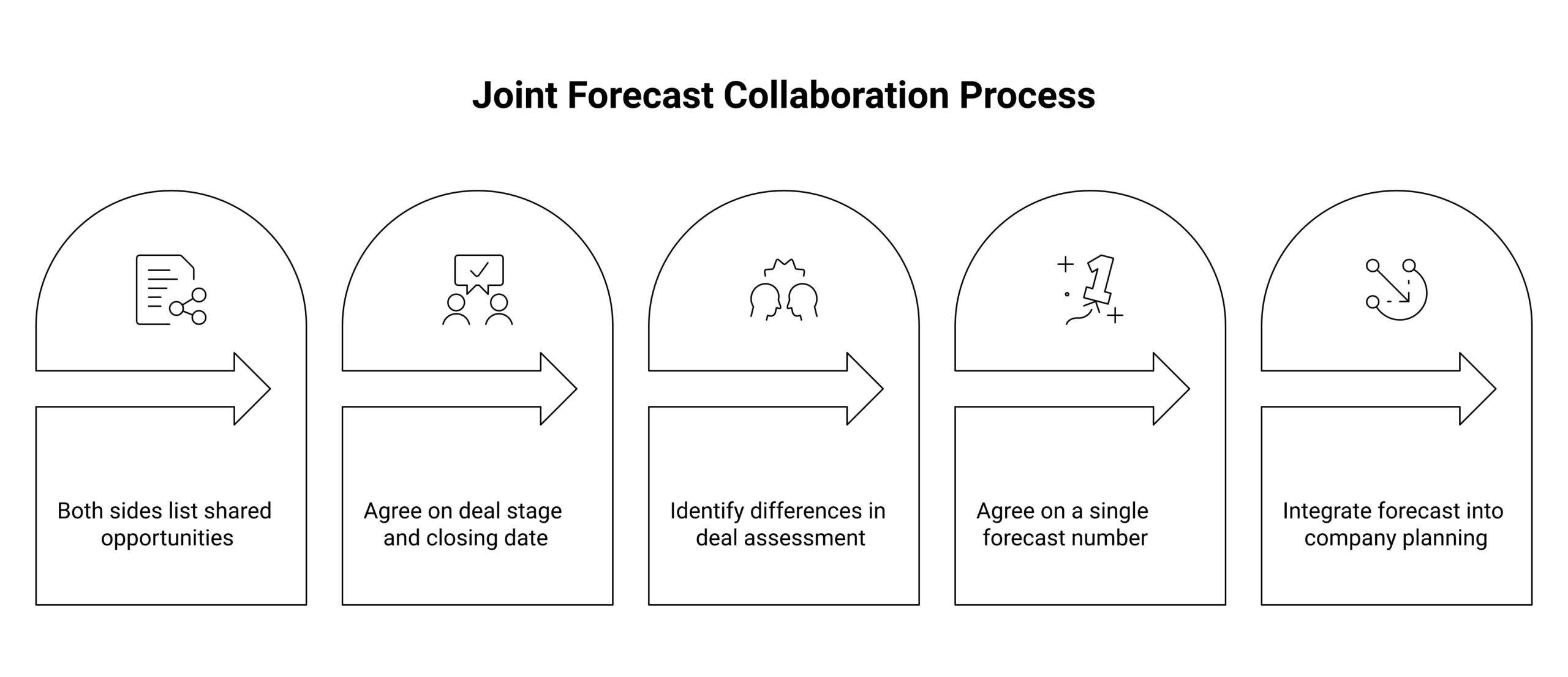
- Share the joint deal view: Both sides put the opportunities they are working together into one list both can see, so the process starts from the same deals rather than two private pipelines.
- Align on stage and timing: The two sides set where each deal really sits and when it is likely to close, reconciling the optimistic and cautious reads into one honest estimate.
- Surface the disagreements: The process makes explicit where the partner and the internal team differ, a stalled deal one side still counts, a budget signal the other has not heard, so the difference can be resolved rather than averaged away.
- Commit one number: The two sides agree a single forecast for the joint pipeline that both will stand behind, replacing the two private estimates with one.
- Route it into planning: The committed joint number flows into the company forecast and the planning model, so the process ends in a line finance can use rather than a private agreement.
The process is working when the partner and the internal team consistently describe the same deals the same way and the joint number lands in the plan, and failing when the steps happen only at quarter end and the partner pipeline is discounted because nobody trusts it.
Setting up the process before the first cycle
Before the first cycle of the process can run cleanly, two things have to be in place: the shared deal view and the agreed definitions. The shared view is the list of jointly worked opportunities both sides can see, carrying the fields that matter for forecasting, stage, expected close, and value. Without it, step one of the process degrades into assembling and arguing about lists, which consumes the whole cycle before any forecasting happens.
The agreed definitions prevent a subtler failure. If the partner’s idea of a committed deal is the vendor’s best case, the two sides can run the process diligently and still produce a number that only looks agreed. Settling what each stage means, how timing is estimated, and how value is treated, before the first cycle, is what lets the later steps reconcile real differences instead of vocabulary mismatches.
The setup is one-time work that every subsequent cycle benefits from. Teams that skip it spend their first several cycles doing it badly under time pressure; teams that do it deliberately reach a clean reconciliation faster.
Running the cadence
The process is a loop, so the cadence is what makes it a process rather than a single event. The reconciliation pass should be frequent enough that the forecast stays current, often biweekly during an active quarter, and short enough that both sides will actually attend. A cadence that is too rare lets the forecast drift between passes; one that is too heavy gets skipped.
The discipline that makes the cadence worth running is that it has to change estimates. A pass where no number ever moves is a status meeting wearing the process as a costume. Each cycle should surface at least the disagreements that have emerged since the last one and resolve them with the better information, so the forecast improves rather than just being restated.
The cadence also keeps the participants engaged. Forecast collaboration that happens only at quarter end teaches both sides that their input does not matter until it is too late to act on it. A regular, light cadence keeps the partner’s deal knowledge flowing into the number while there is still time to use it.
Common pitfalls in the forecast collaboration process
- Running the loop without the shared view: Starting the process before the joint deal list exists turns step one into an argument about whose spreadsheet is right. Set up the shared view before the first cycle.
- Averaging instead of reconciling: Splitting the difference between two estimates discards the information that made collaboration valuable. Surface the disagreement and resolve it with the better-informed side.
- A cadence that only reports: A recurring pass where no estimate moves is a status update. The process has to change numbers, not just restate them.
- Excluding finance from the loop: A committed number that never reaches the planning team produces no benefit. Finance belongs in the process, not downstream of it.
- Stopping at the commit: Agreeing a joint number and never routing it into planning leaves the process one step short of producing anything usable. The handoff to planning is part of the loop, not an afterthought.
What this looks like in practice
A vendor and a co-selling partner kept arriving at quarterly reviews with different numbers for the same accounts, which made the partner pipeline easy for finance to discount. They set up the process deliberately: first a shared view of the jointly worked deals and agreed stage definitions, then a biweekly loop that aligned stage and timing, surfaced disagreements explicitly, committed one number, and routed it into the company forecast. Within a quarter the two sides were forecasting the same deals the same way, and the partner-influenced number moved from directional to a line finance was willing to include. The deals did not change; running a defined process to forecast them together is what made the number usable.
Forecastable’s POV on the forecast collaboration process
Our position is that the process lives or dies on the setup before the first cycle. The appealing parts of the loop, the reconciliation, the committed number, the partner’s information reaching the forecast, all assume the shared view and aligned definitions are already in place. Teams that jump straight to the recurring meeting without the setup get a meeting that argues about lists and definitions instead of improving the number, and they usually conclude that collaboration does not work when what failed was the preparation.
The second conviction is that reconciliation has to change estimates to count. The recurring pass is the engine of the process, but a pass where no number ever moves is a status meeting in disguise. The discipline that makes the process worth the time is surfacing real disagreements, a deal one side counts and the other has written off, and resolving them with the better information. That is the step where the partner’s knowledge becomes the company’s forecast, and a process that skips it keeps the cadence while losing the point.
The third conviction is that the process is not finished at the commit. A joint number agreed between the partner and partnerships and never routed into planning is a private agreement that improves nobody’s plan. The handoff to finance is the final step of the loop, not a separate project, because the reason to run the process is to produce a partner number credible enough to be consumed in the plan.
Forecastable is a partnerships operating platform; any third-party tools or methods referenced here are independent and naming them is not an endorsement of one approach over another. Run the process around your own pipeline, partners, and planning model.
Frequently asked questions
What is the forecast collaboration process?
The repeatable loop a company and its partners run to forecast their joint deals together, from a shared deal view through alignment, reconciliation, and a committed number, into the planning model.
What are the steps in the forecast collaboration process?
Share the joint deal view, align on stage and timing, surface the disagreements, commit one number, and route it into planning. The loop repeats on a cadence.
How often should the process run?
Often enough that the forecast stays current, frequently biweekly during an active quarter, with a pass short enough that both sides will attend and disciplined enough to change estimates.
What has to be in place before the first cycle?
A shared view of the jointly worked deals and agreed definitions of stage, timing, and value, so the first cycle reconciles real differences instead of assembling lists and arguing about terms.
What is the most common failure in the process?
Running the recurring pass without the shared data underneath, which turns the loop into an argument about whose list is right rather than a reconciliation of the same deals.
How does the process make partner pipeline credible?
By producing a reconciled, partner-informed number on a reliable cadence and routing it into planning, so finance can include it at full value instead of discounting an unstable guess.
Next step
If your partner forecast swings because the two sides align only at quarter end, a defined forecast collaboration process is how you stabilize it. Forecastable helps partnerships and revenue teams set up the shared view and run the cadence that make partner pipeline credible enough to commit. Start your growth journey now to put the process in place around your motion. The forecastability hub frames how a reliable partner forecast fits the wider revenue picture, and the elements for forecast collaboration detail the parts this process puts into motion.
Uncover Your Growth Potential
Schedule a Discovery Call