Elements for Forecast Collaboration: The Core 5

What are the elements for forecast collaboration?
Short answer: The elements for forecast collaboration are the five parts that have to be present for a company and its partners to build one revenue forecast together: a shared view of the joint deals, a defined set of participants, aligned definitions of stage and timing, a recurring reconciliation cadence, and a path that routes the committed number into planning. They are what turn an occasional forecast conversation into a system that produces a partner number worth committing.
These parts are not optional add-ons. Each one makes the next possible, so missing any single element collapses the collaboration into two sides reading separate spreadsheets at each other.
Why the elements for forecast collaboration matter in 2026
The elements for forecast collaboration matter because partner-influenced pipeline is now expected on the forecast, and a collaboration that is missing pieces produces a partner number nobody trusts. When the participants are wrong or the definitions are misaligned, the joint forecast swings, finance discounts it, and the program loses the credibility it needs to be funded.
In 2026 the bar is higher because revenue leaders apply the same forecasting rigor to partner pipeline that they apply to direct. A program that has all five elements in place can present a reconciled, partner-informed number that earns a real line in the plan; one that has the meeting but not the shared data or the path to planning gets its number discounted to zero.
How the elements for forecast collaboration actually work
The five elements operate together as a sequence, where each one is the precondition for the next. Assemble them in order and collaboration becomes a repeatable system rather than a series of disconnected meetings.
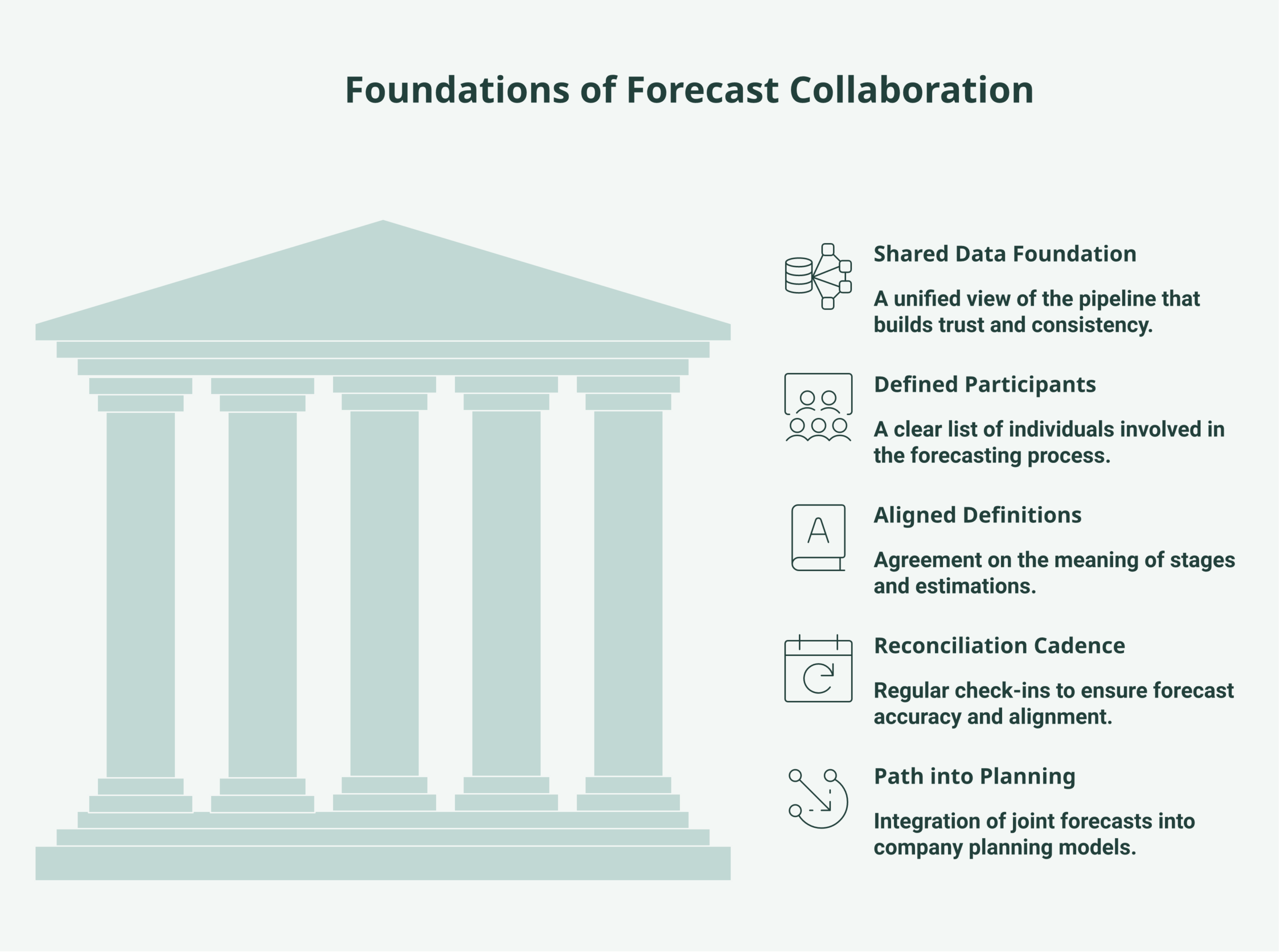
- Shared data foundation: One view of the jointly worked pipeline that both the company and the partner can see and trust, so every conversation starts from the same deals.
- Defined participants: A named set that includes the people who hold deal information, the partner reps and internal account team, and the people who consume the forecast, partnerships and finance.
- Aligned definitions: An agreed meaning for each stage and for how timing and value are estimated, so the two sides are measuring the same thing before they try to reconcile.
- Reconciliation cadence: A recurring, short pass that aligns stage and timing and surfaces disagreements, so the forecast stays current instead of drifting between quarterly reviews.
- Path into planning: A connection that routes the reconciled joint number into the company forecast and the planning model, so collaboration ends in a committed line.
The elements are working when the company and the partner consistently forecast the same deals the same way and the number reaches the plan, and failing when any element is missing and the partner pipeline is discounted because it cannot be trusted.
Common pitfalls with the elements for forecast collaboration
- Starting with the cadence, not the data: Scheduling a recurring forecast meeting before the shared deal view exists produces a meeting that argues about which list is right. The data element comes first.
- Leaving finance out of the participants: A reconciled number that never reaches the team that builds the plan produces no benefit. Finance is a participant, not an audience.
- Skipping aligned definitions: Reconciling without agreeing on what each stage means produces a number that looks agreed but is not, because the two sides are counting different things.
- A cadence that only reports: A recurring pass where no estimate ever moves is a status update, not reconciliation. The cadence has to change numbers based on new information.
- No path to planning: A joint forecast that stays between partnerships and the partner is a private agreement. Without the planning connection, the other four elements produce nothing committable.
What this looks like in practice
A company with a co-sell motion had the reconciliation cadence in place, a standing biweekly forecast call with its top partner, but the number still swung. The missing elements were the shared data and the path to planning: the two sides reconciled from separate spreadsheets and the agreed number never reached finance. They added one shared view of the joint deals and a connection that routed the committed number into the company forecast. With all five elements present, the partner-influenced line stabilized and finance began counting it at full value. The cadence had always been there; the forecast only became reliable once the other elements joined it.
Forecastable’s POV on the elements for forecast collaboration
Our position is that the shared data element is load-bearing and the rest are scaffolding around it. Participants, definitions, cadence, and the planning path all assume there is one trusted view of the joint pipeline to operate on. Teams that try to assemble the human elements without the data element get diligent meetings that cannot change an unreliable number, because reconciliation needs a single list to reconcile against.
The second conviction is that the planning path is the element most often skipped and the one that determines whether any of the work pays off. A reconciled forecast that stays inside the partnership is effort that produces a document, not a committed line. Design the connection to planning from the start, because the reason to assemble the other four elements is to produce a partner number finance will actually consume.
Forecastable is a partnerships operating platform; any third-party tools or methods referenced here are independent and naming them is not an endorsement of one approach over another. Assemble the elements around your own pipeline, partners, and planning model.
Frequently asked questions
What are the elements for forecast collaboration? A shared data foundation, a defined participant set, aligned stage and timing definitions, a recurring reconciliation cadence, and a path that routes the joint number into planning.
Which element comes first? The shared data foundation. Every other element assumes there is one trusted view of the joint pipeline to operate on, so it has to be in place first.
Who are the participants in forecast collaboration? The partner reps and internal account team who hold deal information, plus partnerships leadership and finance who consume the forecast and route it into the plan.
Why does forecast collaboration need aligned definitions? Because two sides reconciling without agreeing on what each stage means produce a number that looks agreed but is not, since they are counting different things.
What happens if the path to planning is missing? The reconciled number stays a private agreement between the partner and partnerships, never reaches finance, and produces no committable line, so the other elements deliver nothing.
Next step
If your partner forecast is missing one of these elements, that gap is usually why the number cannot be trusted. Forecastable helps partnerships and revenue teams put the shared data, cadence, and planning path in place so partner pipeline becomes credible enough to commit. Start your growth journey now to assemble the elements around your motion. The forecastability hub frames how a reliable partner forecast fits the wider revenue picture, and the forecast collaboration process shows the loop these elements support.
Uncover Your Growth Potential
Schedule a Discovery Call