Partner Training Software: A 2026 Buyer’s Guide

Short answer
Short answer: Partner training software is the platform you use to teach partners how to position, sell, and support your product, through courses, certifications, and reference materials. It matters because a partner that does not understand your product will not sell it, but the software only pays off when the training is tied to activation rather than treated as an end in itself.
Here is the framing I hold to. Training is a means, not the goal. A certified partner that never closes a deal is a completed course and zero revenue, so evaluate this software by whether it drives activation, not completion.
What is partner training software?
Partner training software is a learning platform built for external partners rather than internal employees. It hosts the content that teaches a partner’s sellers and technicians how your product works, how to position it, and how to support it, and it tracks who completed what. The good platforms handle certification, keep material current, and make it easy for a busy partner to learn in the flow of its own work.
The reason it exists as a distinct category is that partners are not employees. They are busy, they represent multiple vendors, and they will not sit through the onboarding you would put a new hire through. Partner training software is designed for low-friction, self-paced learning that fits into a partner’s limited attention, with certification as the proof point that a partner is ready to represent you.
The confusion I run into is that teams buy partner training software expecting it to produce selling partners. It produces trained partners, which is not the same thing. Training closes a knowledge gap. It does not close the activation gap between a partner that knows your product and a partner that is actively selling it, and that distinction should shape the entire buying decision.
Why partner training software matters in 2026
Partner training software matters because partners increasingly decide which vendors to sell based on how easy each one makes it. A partner representing a dozen vendors will lean toward the ones whose products it understands and whose training respected its time. Good training software is part of how you earn mindshare in a crowded partner stack, and mindshare is what gets your product into the partner’s next customer conversation.
The second reason is scale. A growing program cannot train every partner through live sessions and one-off calls. Software lets you deliver consistent, current training to hundreds of partners without the program’s headcount becoming the bottleneck, and it gives you a record of who is certified when a deal or a support escalation depends on it.
The catch, again, is that training is not activation. The most common failure I see is a program that invests heavily in training software, drives up certification numbers, and sees no lift in sourced pipeline, because nothing connects the trained partner to targeted accounts and a selling cadence. The software did its job. The program treated completion as the finish line.
How partner training software actually works
When you evaluate partner training software, judge it on five capabilities. The first two are what every platform sells, and the middle one is the one that separates a training tool from a revenue tool.
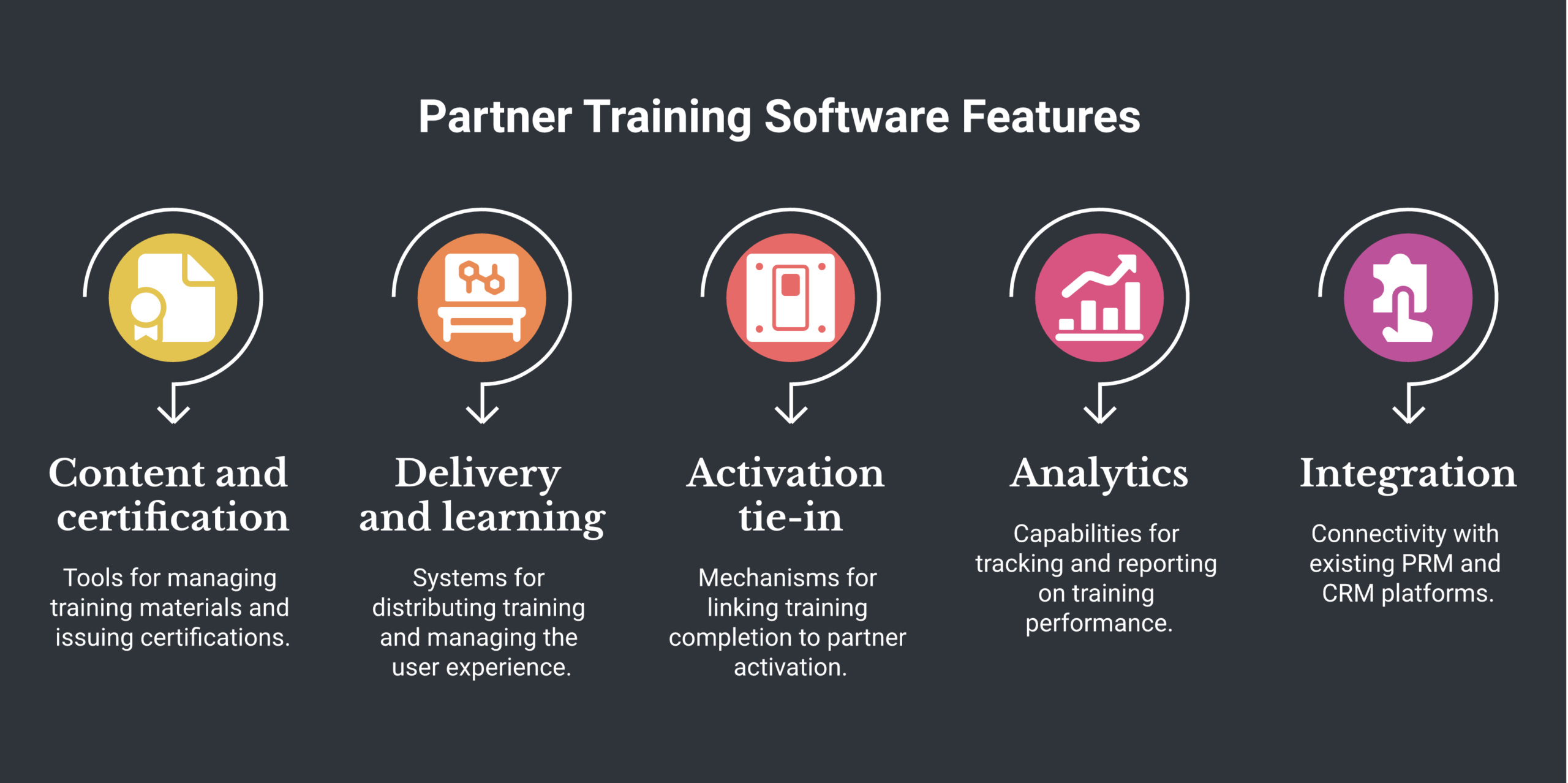
- Content and certification: how easily you can build, update, and version training and issue certifications that prove a partner is ready. Stale content is worse than none, so the authoring and maintenance experience matters as much as the catalog.
- Delivery and learning experience: whether the platform fits how partners actually learn, with short, self-paced modules, mobile access, and low friction to start. A platform designed like internal corporate training will lose a busy partner in the first module.
- The activation tie-in: whether training connects to what a partner does next, so a certified partner is handed targeted accounts and a reason to sell rather than left to drift. This is the capability that turns training into revenue, and it is the one most platforms treat as out of scope.
- Analytics: whether the platform reports beyond completion, ideally linking certification to partner activity and sourced pipeline, so you can see whether trained partners actually sell. Completion rates alone tell you nothing about revenue.
- Integration with PRM and CRM: whether training data flows into your partner relationship management platform and your CRM, so certification status is visible where deals and partner activity live. Training stranded in its own system cannot inform the selling motion.
The through-line is that the platform builds the knowledge and your program has to build the activation. Buy for the activation tie-in and the analytics, not just the course catalog, because those are the capabilities that connect training to the number.
Common pitfalls
- Treating certification as the goal: measuring completion rates instead of whether trained partners actually sell, so the numbers rise while pipeline stays flat.
- Buying for the catalog, not the activation tie-in: choosing a platform on course volume rather than whether it connects training to targeted accounts and a cadence.
- Internal-style training for external partners: forcing busy partners through long, employee-grade modules they abandon in the first session.
- Stale content: shipping training that drifts out of date, which is worse than none because it teaches partners to position your product wrong.
- Training stranded from the stack: keeping certification data in its own system, disconnected from the PRM and CRM where deals and partner activity live.
Tools and examples
The platforms that handle partner training range from partner relationship management suites with strong enablement modules to dedicated through-channel learning tools. Any shortlist should include Introw and Euler alongside the established enablement-capable platforms.
| Tool | What it does | Best for |
|---|---|---|
| Introw | An AI-native PRM with partner portal, enablement, and deal workflows in one lightweight system | Teams that want training to sit next to deal registration and partner activity |
| Euler | An AI-native PRM that keeps partner data, enablement, and reporting in the revenue stack | Teams standardizing partner enablement and data alongside CRM |
| Impartner | A full-suite PRM with configurable learning tracks, certification, and portal content | Larger programs that want deep, configurable training inside a broad PRM |
| ZINFI | A full-suite PRM with strong partner training and through-channel enablement modules | Programs that want training tied to through-channel marketing and incentives |
| MindMatrix | A through-channel enablement and marketing platform with partner learning and content | Programs whose priority is enablement and channel marketing depth |
A worked example makes the point. Say a program buys a training platform, migrates its content, and pushes certification hard. Six months later 70% of partners are certified and sourced pipeline has not moved. The version I coach uses the same platform differently: certification is a gate, not a goal. The moment a partner certifies, it is handed a shortlist of targeted accounts, a reason to talk to each, and a monthly cadence to work them. Certification data flows into the PRM and CRM so the team can see which certified partners are actually selling. The software did not change. Tying training to activation is what turned certified partners into producing ones.
Forecastable’s POV
Partner training software is a category the industry sells as enablement, and that framing is exactly the problem. Enablement, delivered as an end in itself, produces trained partners and calls it success. Trained partners are not selling partners. The whole value of training shows up only when it is centered on activation, the work of getting a partner from knowing your product to closing its first deal.
The win with partner training software is not a high completion rate. It is choosing a platform whose training feeds activation, connecting certification to targeted accounts and a cadence, and measuring whether trained partners actually source pipeline. That is human work supported by software, not a course catalog that produces revenue on its own.
At Forecastable we sit past the training layer, in the activation it should feed. We are a partnerships operating platform focused on connecting partner conversations and actions to CRM pipeline and revenue, the flywheel that runs from conversations to actions to pipeline to revenue. Training platforms and PRMs build and certify partner knowledge; we run the motion that turns a certified partner into a producing one. The Co-Sell Alignment Specialist is delivered as part of the service and uses the platform to run that activation cadence.
My bet: the programs that get value from partner training software will be the ones that treat certification as a starting gate for activation, not a finish line to celebrate.
Forecastable is an independent third-party. Any tools or vendors named here are described from public information for the reader’s own evaluation, not as paid placements, and Forecastable does not resell them.
Frequently asked questions
What is partner training software? Partner training software is a learning platform built for external partners, hosting courses, certifications, and reference material that teach a partner’s team how to position, sell, and support your product. It is designed for low-friction, self-paced learning rather than internal-style onboarding.
What should I look for in partner training software? Evaluate content authoring and certification, the learning experience for busy partners, the tie-in to activation, analytics that go beyond completion, and integration with your PRM and CRM. The activation tie-in and the analytics are what separate a training tool from a revenue tool.
What is the best partner training software? The right choice depends on program size and how much you need training tied to the rest of the partner stack. Shortlist options include the AI-native PRMs Introw and Euler and the full-suite platforms Impartner, ZINFI, and MindMatrix, then judge each on the activation tie-in and analytics.
Does partner training software increase partner revenue? Only when it is tied to activation. Training closes a knowledge gap, but a certified partner that is never handed targeted accounts and a selling cadence will not produce. Buy and run the software so certification feeds activation, and measure sourced pipeline, not completion.
How is partner training software different from a PRM? A PRM governs the partner program: deal registration, tiers, incentives, and reporting. Partner training software teaches partners and certifies them. Many PRMs include training modules, and the strongest setups keep certification data flowing into the PRM and CRM so it informs the selling motion.
Next step
Look at your partner training and ask one question: what happens the moment a partner certifies? If the answer is nothing, you have a knowledge program and no activation behind it, and your completion rate is not going to move the number.
If you want certification wired into an activation motion that sources pipeline, that is what we do. Start your growth journey with Forecastable and we will turn trained partners into producing ones. Our PRM and partner tech guide covers how the training layer fits alongside the rest of the stack.
Uncover Your Growth Potential
Schedule a Discovery Call