Outsourced Sales Development: Build vs Buy in 2026

Short answer
Short answer: Outsourced sales development is the decision to rent the entire top-of-funnel function, the reps, the process, the tooling, and the management, from a provider rather than building it in-house. It makes sense when sales development is not a source of durable advantage for you and you need the function running now, and it is a mistake when the opening motion is central to how you win and you are trading away the capability you most need to own.
Here is the position. This is a build-versus-buy decision about a function, not a staffing shortcut. Decide what the function is worth to your business before you decide who runs it.
What is outsourced sales development?
Outsourced sales development is a model where an external provider owns your sales development function end to end: recruiting and training the reps, defining the process and cadences, supplying the tooling and data, and managing the day-to-day. Where hiring an outsourced rep fills a seat, outsourcing the function hands over the whole system that produces qualified pipeline at the top of your funnel.
You are buying an operating capability you do not have to build. For a company where sales development is not a differentiator, that can be a sound trade: you get a running function without the multi-quarter effort of standing one up. The risk is strategic, not tactical. If opening conversations is where your advantage lives, renting the function means renting the thing you should be building, and the knowledge compounds on the provider’s side, not yours.
Why the outsourced sales development decision matters in 2026
Standing up a sales development function got harder and more expensive, which makes outsourcing more tempting and the stakes higher. Hiring is slow, management is specialized, and the tooling and data stack is its own project. A provider can compress all of that, which is a real advantage when speed matters more than ownership.
The counterweight is that top-of-funnel is where a lot of go-to-market advantage now sits. Buyers filter hard, and the companies that win the opening motion do it with sharp targeting and messages only a team that lives in the market can write. In my work with revenue teams, the ones that outsourced the whole function and later regretted it were the ones for whom opening conversations was core, who found they had rented away the capability and the account knowledge. The decision in 2026 is less about cost and more about whether this function is one you need to own.
How outsourced sales development actually works
Outsourcing the function works through a four-part structure, from scoping the handover to measuring what the provider owns.
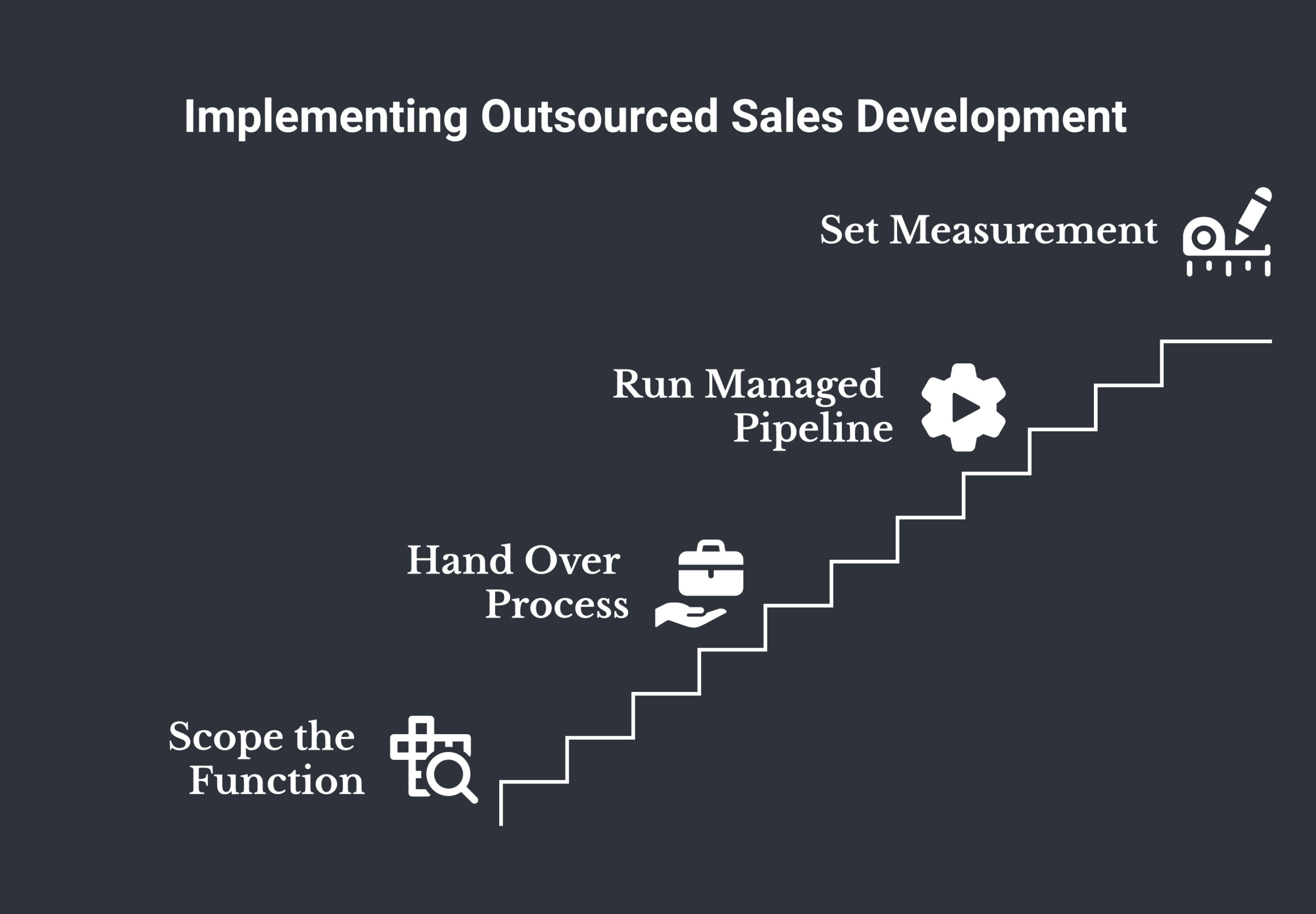
- Scope the function: decide exactly which parts of sales development the provider owns, list, message, outreach, qualification, and where your team stays involved. An unclear boundary is where these engagements drift.
- Hand over process and tooling: transfer or align the cadences, the data, and the tooling, so the provider runs a defined system rather than improvising one. The process you hand over is the process you get back.
- Run managed pipeline generation: the provider operates the function against your profile and qualification bar, producing qualified pipeline at an agreed volume and quality. The bar and the profile stay yours.
- Set the measurement and ownership line: agree what you measure, qualified pipeline and conversion, and what knowledge transfers back, so you are not blind to how the function performs or trapped if you bring it back in. Ownership is the clause people skip and later wish they had not.
The through-line is that outsourcing a function is only as good as the boundary you draw. Scope it tightly, keep the profile and qualification bar in-house, and protect the path back.
Common pitfalls
- Treating it as staffing, not strategy: outsourcing the function without deciding whether it is core, and renting away a capability you needed to own.
- A fuzzy scope: leaving the ownership boundary undefined, so accountability blurs and quality drifts.
- Buying on activity: measuring the function on calls and meetings rather than qualified pipeline, which rewards volume over outcome.
- No knowledge transfer: letting all the account and message learning accumulate on the provider’s side, so you cannot bring the function back in without starting over.
- Ignoring the warm channel: outsourcing cold top-of-funnel while leaving partner-sourced pipeline, the highest-converting source, completely unbuilt.
Tools and examples
The decision is a build-versus-buy choice about the function. Compare the three common paths on ownership and outcome.
| Option | Best for | Watch for |
|---|---|---|
| Build the function in-house | Companies where top-of-funnel is a differentiator | Multi-quarter build; recruiting, management, and tooling cost |
| Buy an outsourced function | Companies where sales development is not core, need it now | Renting a core capability; knowledge compounds on the provider’s side |
| Hybrid with partner-sourced pipeline | Most teams; cold coverage plus a warm, high-converting channel | Needs a managed partner motion to run alongside the outsourced function |
A quick worked example shows the trade. A company outsources its entire sales development function to move fast. A year in, pipeline is steady but undifferentiated, and the company realizes every lesson about its best accounts lives with the provider. It restructures: the provider keeps cold breadth under a tight qualified-pipeline measure, the company rebuilds in-house ownership of its highest-value segment, and partner introductions are stood up as the warm channel into priority accounts. The function still runs; the capability and the account knowledge come back home where they create advantage. The fix was drawing the ownership line the original deal never did.
Forecastable’s POV
Outsourcing sales development is a legitimate build-versus-buy decision, not a staffing convenience. If top-of-funnel is core to how you win, owning it beats renting it, even when renting is faster. If it is not core, buy it, but scope the boundary and protect the path back.
Whichever way the build-versus-buy call goes, the warm channel is the piece most functions never build, because it is the hardest to instrument. At Forecastable we are a partnerships operating platform that connects partner conversations and actions to CRM pipeline and revenue, so partner-sourced pipeline runs as a measured channel alongside whatever you build or buy for cold outreach. Our Co-Sell Alignment Specialist is delivered as part of the service and uses the platform to run that channel on your priority accounts.
My bet: the teams that treat outsourced sales development as a strategic build-versus-buy decision, and build the partner channel regardless of how they answer it, keep the advantage that matters in-house.
Forecastable is an independent third-party. Any tools, vendors, or third-party figures referenced here are described from public information for the reader’s own evaluation, not as paid placements.
Frequently asked questions
What is outsourced sales development? It is renting the entire top-of-funnel function, the reps, the process, the tooling, and the management, from a provider instead of building it in-house. It is broader than hiring an outsourced rep, which fills a seat rather than owning the whole system.
What is the difference between an outsourced SDR and outsourced sales development? An outsourced SDR is a rented rep working your top of funnel. Outsourced sales development is renting the whole function, including the process, tooling, and management, which makes it a strategic build-versus-buy decision rather than a staffing one.
Should I outsource sales development or build it in-house? Build it if opening conversations is a source of durable advantage for you, because the capability and account knowledge compound in-house. Buy it if sales development is not core and you need the function running faster than you can build it.
How do you measure an outsourced sales development function? On qualified pipeline and conversion, not activity or meetings. Define the qualification bar and the ownership boundary up front, and make sure knowledge transfers back so you are not trapped with the provider.
Where does the partner channel fit? As the warm, high-converting source that runs alongside whatever you build or buy for cold outreach. Most outsourced functions never build it, which leaves the best-converting channel unmanaged.
Next step
If you are weighing outsourced sales development, answer the strategic question first: is top-of-funnel core to how you win? That decides build versus buy more than cost does.
Either way, build the warm channel. Start your growth journey with Forecastable and we will run partner-sourced pipeline as a measured channel alongside your function. Our outbound sales guide covers the full motion, and our guide to the outsourced SDR decision weighs renting the role specifically.
Uncover Your Growth Potential
Schedule a Discovery Call