MDF ROI: How to Prove Market Development Funds Work

Short answer
MDF ROI is the return a vendor gets on the market development funds it puts behind partner activity: the sales-qualified opportunities (SQOs), pipeline and revenue that activity produced, measured against what it cost. Most programs can’t show it, because the spend and the pipeline live in different systems that never get joined.
Here’s my position. You don’t prove MDF ROI at reporting time. You prove it at approval time, by refusing to fund anything that isn’t tied to a number of SQOs and a way to track them.
What is MDF ROI?
MDF, or market development funds, is the money a vendor gives partners to run demand generation: events, campaigns, webinars, outbound and content that sell the vendor’s product. MDF ROI is the return on that money, expressed as the SQOs, pipeline and closed revenue the funded activity produced, divided by what was spent.
It’s hard because of how the process runs. The vendor approves a request, the partner runs the activity and files a claim, and the leads land weeks later in a CRM or deal-registration system. Nobody joins the claim to the pipeline. So the program can report how much it spent and how fast it paid claims, but not what any of it produced.
Why does MDF ROI matter in 2026?
Because finance now asks what the money returned, and “we paid every claim on time” doesn’t answer that. A program that can only report spend-to-plan is answering an operational question, not a return question. Those are the programs that get cut.
The flip side is that MDF is expected to be spent. Nobody gets promoted for leaving it on the table. When I ask partner teams how a funder decides, it almost always comes down to a dollar amount of SQOs. If the number is acceptable, the partner puts up the MDF. One platform’s partner team told me their internal guidance for partner MDF is a 10 to 12x return in top-of-funnel pipeline. That’s the bar you’re being measured against, whether anyone says it out loud or not.
How do you prove MDF ROI?
You instrument the chain from the funded dollar to the sourced deal before the activity runs. Each step keeps the link the next one needs.
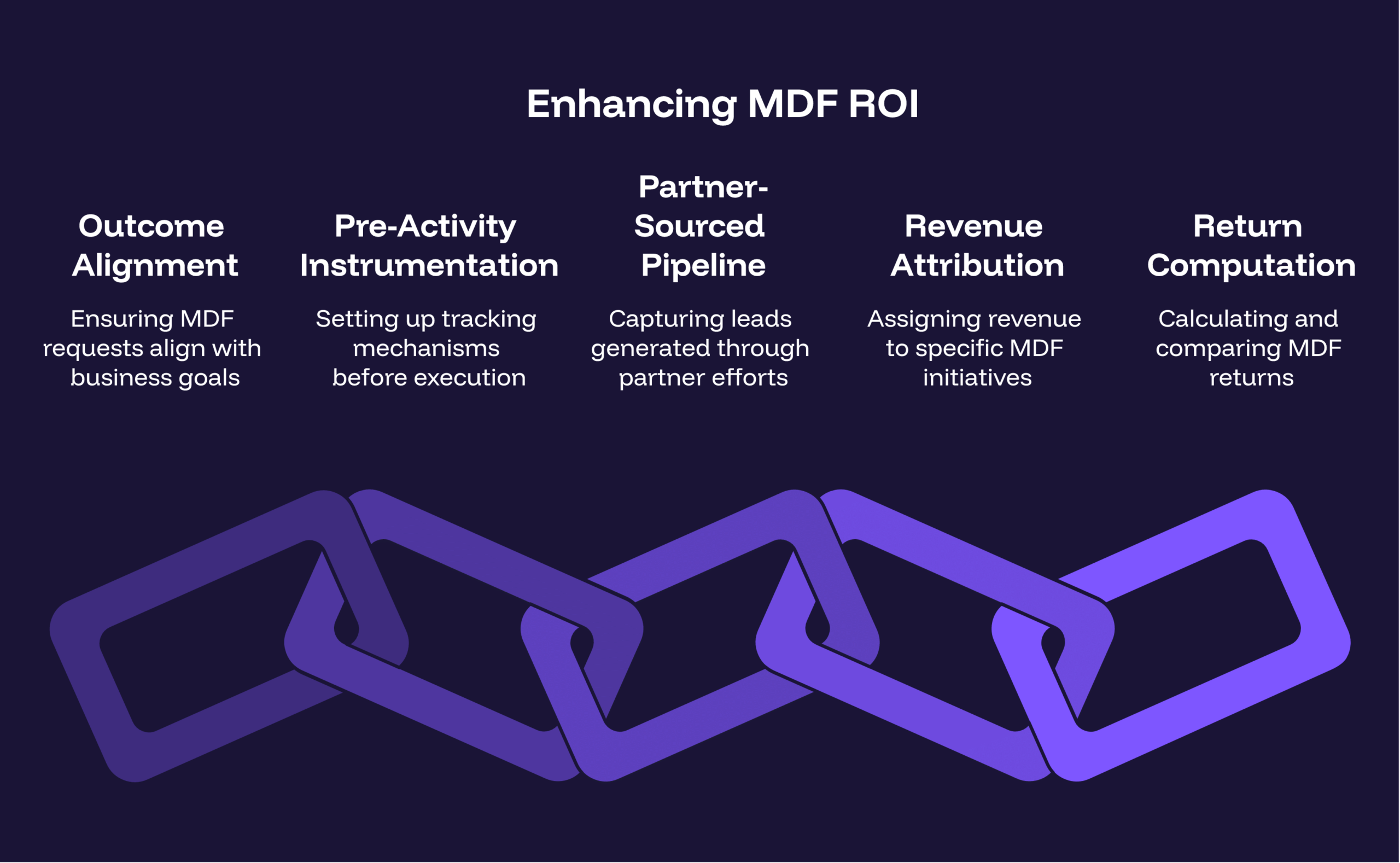
- Tie the request to a number of SQOs. Approve each request against a specific outcome, usually SQOs, sometimes booked meetings or qualified accounts at an event. A fund approved for “a webinar” can only ever report that a webinar happened.
- Instrument the activity before it runs. Agree how leads and deals will be captured and tagged: a tracked registration path, a deal-registration requirement, a dedicated sending domain. Tracking set up after the event can’t recover what it missed.
- Protect the partner’s credit. Decide who follows up on the leads and how credit is kept. At many vendors, event leads nobody works within about 30 days get routed to an internal team, and the partner loses the credit. Then the MDF looks like it produced nothing.
- Follow it to revenue. Track sourced pipeline through to closed revenue with the funding source intact. Stopping at leads measures activity, not return.
- Compare return by partner and activity. Divide attributed pipeline and revenue by funds spent, per partner and per activity type. Then fund more of what returns and stop funding what doesn’t.
What mistakes kill MDF ROI?
- Funding activities, not outcomes. No committed SQO number means the program can report spend but never return.
- Instrumenting after the fact. Setting up tracking once leads arrive loses the attribution the activity already generated.
- Letting leads go stale. If nobody works the leads, they default somewhere else and the partner’s credit disappears with them.
- Measuring claims, not results. Claim-approval speed and budget-to-plan describe administration, not performance.
- One blended ROI number. A single program figure hides that a few partners and activity types produce most of the return.
What if the activity didn’t source the deal?
Not every funded touch earns sourced credit, and you shouldn’t claim it when it doesn’t. A hand-raise on a partner-run experience is clean partner-sourced pipeline. Orchestrated warming across many partners without a hand-raise isn’t sourced, but it’s still evidence. Report coverage too: how many of your top accounts the funded activity reached, and how many engaged with more than one partner. That’s what justifies continued MDF allocation when the sourced number is still building.
What does this look like in practice?
A partner marketing manager has to defend the MDF budget. The old report shows funds allocated, claims paid and spend within plan. None of it says what the money returned. So she rebuilds the approval gate. Every new request has to name an SQO target and a tracking method before it’s approved. A funded field event routes registrations through a tagged path and registers the resulting deals. A funded outbound campaign sends from a tracked domain with a sourced-pipeline target.
A quarter later, the report shows that a handful of partners and one activity type produced most of the sourced pipeline per dollar, and a scatter of small co-branded ads produced almost none. The budget conversation flips. Instead of defending a lump sum on faith, she proposes concentrating funds where the return is proven.
Forecastable’s POV
MDF ROI is an instrumentation problem you solve at the start, not a reporting problem you solve at the end. Most programs invert it: approve freely, report loosely. That’s why MDF is the partner marketing spend least able to defend itself.
We’re a B2B partnerships agency, and we sell outcomes: partner-sourced pipeline, measured in SQOs. Our campaign operations team and SDRs run GTM motions with and as your partners, and every motion is set up with its SQO target and tracking before it launches. Partners often fund those motions with MDF, and you see every activity and result as it happens. That’s how the funded dollar stays joined to the pipeline it produced.
My bet: the teams that decide the outcome and the tracking before the MDF goes out are the ones whose budget grows while everyone else’s gets cut.
Forecastable is an independent third-party. Any tools, vendors, or third-party figures referenced here are described from public information for the reader’s own evaluation, not as paid placements.
Related reading
- How to Go to Market With a Partner: 2026 Field Guide
- Market Development Funds: What They Are and Use
- Partner Event ROI: How to Measure It Properly
- Partner Program ROI Metrics That a CFO Will Trust
- Partner ROI: Measuring Return on Partnerships
Frequently asked questions
What is MDF ROI?
It’s the return on market development funds: the SQOs, pipeline and revenue partner-funded activity produced, measured against what it cost. It’s different from program metrics like claim-payment speed and spend-to-plan, which describe administration.
Why is MDF ROI so hard to measure?
Because the funded spend and the resulting pipeline usually live in different systems that never get joined. Without a deliberate link set up before the activity runs, a program can report spend but not return.
How do you calculate MDF ROI?
Divide the partner-sourced pipeline and closed revenue attributable to a funded activity by the funds spent on it, per partner and per activity type. It only works if attribution was set up before the activity ran.
What is a good MDF ROI?
There’s no universal benchmark. Many funders hold partner MDF to a multiple of pipeline returned, and some set it as high as 10 to 12x in top-of-funnel pipeline. The useful comparison is across your own partners and activity types.
How is MDF different from co-op funds?
MDF is usually approved up front for a planned activity. Co-op funds typically accrue as a percentage of a partner’s sales and reimburse past marketing. The ROI discipline is the same: tie the dollar to a tracked outcome. See co-op marketing funds vs MDF for the full breakdown.
Why do MDF programs get cut first?
Because most can’t show what they returned. A program that reports only spend and claim speed has no defense in a budget review. One that shows SQOs and pipeline per dollar has the clearest case for keeping its budget.
Next step
Before you approve the next MDF request, require two things on it: an SQO target and the tracking method that will capture it. Then report return per partner and per activity, not spend. For how the big funders structure their programs, see AWS Partner Funding and AWS’s guide to co-marketing as a partner.
Our MDF guide covers how to find and unlock market development funds, and the partner marketing guide covers where MDF fits in the wider motion.
Want partner-funded GTM motions that report in SQOs from day one? Book a Program-Fit Analysis.
Uncover Your Growth Potential
Schedule a Discovery Call