Market Development Funds: What They Are and Use

What are market development funds?
Short answer: Market development funds are money a vendor gives a partner to spend on marketing the vendor’s product, usually tied to specific approved activities and repaid or granted against proof of spend. They exist to get partners marketing when partners lack the budget or incentive to do it alone. Used well, MDF turns partners into a marketing channel; used badly, it becomes an entitlement nobody can measure.
The term is often shortened to MDF, and it overlaps with co-op funds. The practical distinction is that MDF is usually proactive and tied to a plan, while co-op is often earned as a percentage of a partner’s sales and spent more loosely.
Why market development funds matter in 2026
Market development funds matter because a partner who will not fund marketing on their own can still be activated with vendor money, and that activation reaches buyers a vendor’s direct marketing never touches. The best partners have local trust and audiences; MDF is how a vendor rents access to them. Without funds, most partners default to no marketing at all.
In 2026, with acquisition costs high and buyers arriving through trusted local sources, the reach a partner brings is worth paying for. A well-run MDF program buys demand generation in segments and geographies a central team cannot cover efficiently. That is why MDF remains a standard line in mature partner programs even as budgets tighten.
The pressure point is accountability. Finance increasingly asks what MDF returned, and a program that cannot answer loses the budget. The vendors keeping their MDF are the ones that tie every dollar to an approved activity and a measurable result, rather than treating it as a relationship gift.
How market development funds actually work
Market development funds work as a controlled loop: a plan, an approval, a spend, and proof of what it produced. The components below are what separates a real MDF program from a slush fund.
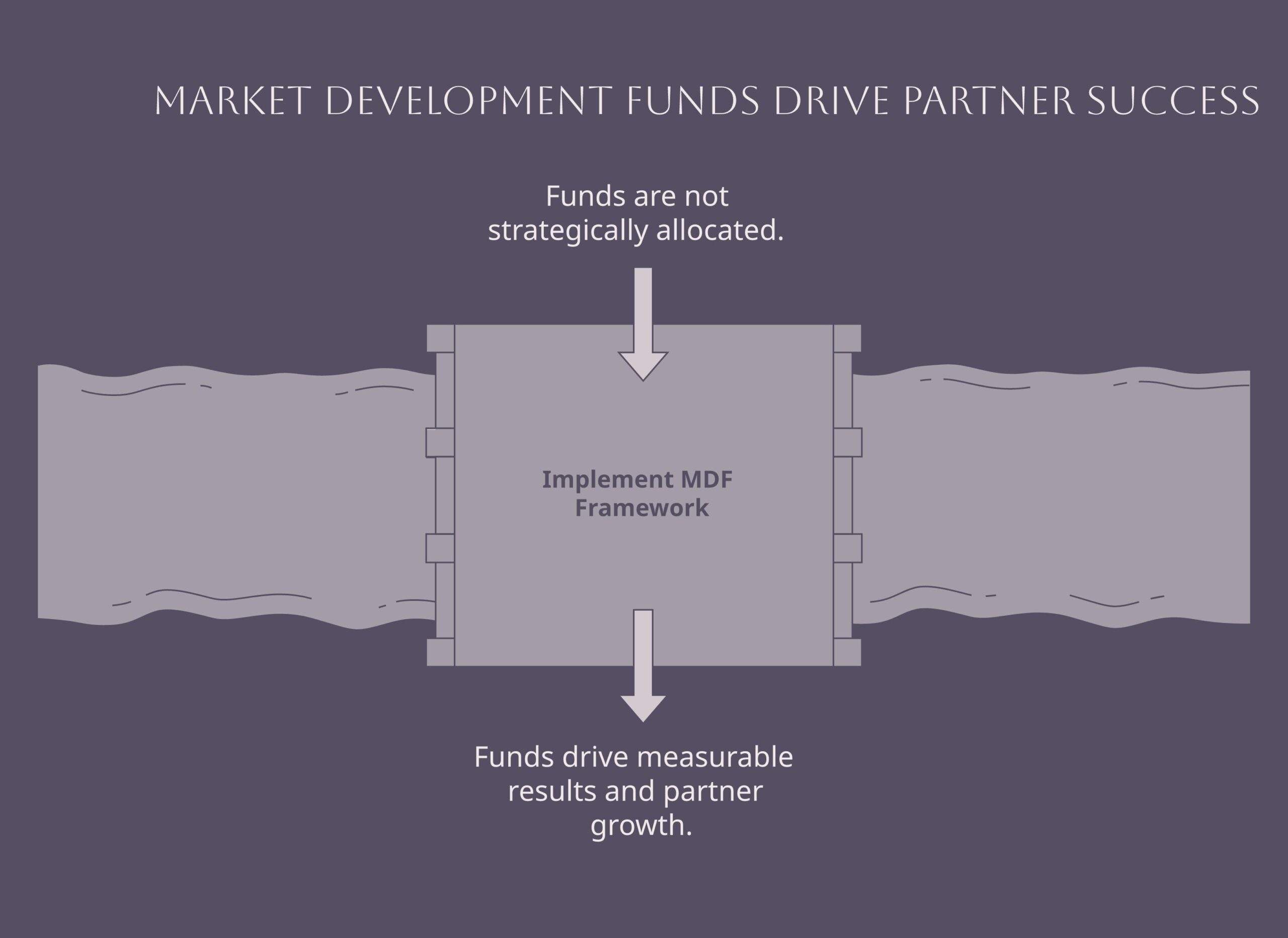
- Eligibility and allocation: The rules that decide which partners get funds and how much, whether by tier, commitment, or earned co-op, so money goes where it can produce.
- Request and approval: The workflow where a partner proposes an activity and the vendor approves it against a plan, so spend is intentional rather than reactive.
- Approved activity: The specific marketing the funds pay for, from events to digital campaigns to content, defined tightly enough that the vendor knows what it bought.
- Proof of performance: The receipts, deliverables, and results a partner submits to claim the funds, which is the accountability that keeps MDF from becoming an entitlement.
- Attribution: Connecting the leads and pipeline a funded activity produced back to CRM, so the program’s return is a defensible number.
Common pitfalls with market development funds
- Funds with no proof of performance: Handing over money against a plan but never requiring evidence of spend or results turns MDF into a gift the business cannot measure or defend.
- Approving activities that do not generate demand: Paying for branded swag and sponsorships with no lead capture spends the budget without producing pipeline. Fund activities that create measurable interest.
- Making claims painful: If the reimbursement process is slow and bureaucratic, partners stop bothering, and unused MDF is a program that failed quietly. The workflow has to be easy.
- No attribution loop: Spending MDF without tracking the leads it produced back to CRM means you can never say what it returned, which is exactly the question finance will ask.
- Spreading funds too thin: Allocating small amounts to every partner produces activity too small to matter anywhere. Concentrate funds on partners who can actually move a number.
What this looks like in practice
A worked example: a vendor offered every partner a flat MDF allowance and, at year end, could not say what any of it produced. It restructured the program around a plan-approve-prove loop: funds went to a smaller set of committed partners, each activity required an approved plan with lead capture, and claims required proof of spend and results routed to CRM. The next year, MDF spend was lower in dollars but every dollar was traceable to an activity and a pipeline number. When finance questioned the line, the team had an answer. The lesson was that MDF is not a generosity program; it is an investment that has to be managed like one.
Forecastable’s POV on market development funds
Our position is that MDF is only as good as its accountability loop. The money is easy to give and hard to prove, and the programs that get cut are the ones that never closed the loop between funded activity and pipeline. An MDF dollar with no attribution is a dollar that cannot defend itself, and undefendable spend is the first to go when budgets tighten.
We also think MDF should be concentrated, not sprinkled. The instinct to give every partner a little is fair but produces activity too small to register anywhere. Funds put behind partners who have real reach and a plan produce results you can see; funds spread evenly produce a spreadsheet of tiny line items and no story. Treat MDF like a portfolio, not a participation trophy.
Forecastable is a partnerships operating platform focused on connecting partner conversations and actions to CRM pipeline and revenue. We do not administer MDF, but we make the pipeline funded partner marketing produces visible in the forecast leadership plans around, so the return on those funds stops being a guess. The funds buy the activity; we help you prove what the activity was worth.
Forecastable is a partnerships operating platform and a category authority, not a PRM vendor. Any third-party tools or firms referenced in this space are independent third-party products, and mentioning them is not an endorsement. Evaluate any MDF approach against your own partner mix, motion, and CRM.
Frequently asked questions
What are market development funds?
They are money a vendor gives a partner to spend on marketing the vendor’s product, tied to approved activities and usually paid against proof of spend and results.
What is the difference between MDF and co-op funds?
MDF is typically proactive and tied to an approved plan, while co-op funds are often earned as a percentage of a partner’s sales and spent more loosely. Many programs run both.
What can market development funds be used for?
Approved marketing activities such as events, digital campaigns, content, and demand generation. The tighter the definition of eligible activity, the more measurable the program.
How is MDF return measured?
By tracking the leads and pipeline a funded activity produced back to CRM, so each dollar ties to a defensible outcome rather than an unmeasured spend.
Why do partners leave MDF unused?
Usually because the claim process is slow or bureaucratic. If proving spend is painful, partners skip it, and unused funds signal a program that failed on execution, not on budget.
Should every partner get MDF?
No. Funds concentrated on partners with real reach and a plan produce visible results; funds spread evenly across every partner produce activity too small to matter.
Next step
If you cannot say what last year’s MDF produced, the funds are not the problem, the missing accountability loop is. The fix is to tie every funded activity to an approved plan and route the leads it produces into the forecast leadership already trusts. Forecastable helps partnerships teams connect funded partner marketing to measured CRM pipeline, so MDF becomes an investment you can defend. Start your growth journey now to make partner marketing spend provable. The partner program hub frames how market development funds fit alongside partner marketing and attribution.
Uncover Your Growth Potential
Schedule a Discovery Call