Partner ROI: Measuring Return on Partnerships

What is partner ROI?
Short answer: Partner ROI is the return a partner program produces measured against everything it costs to run. It compares the revenue and pipeline partnerships generates to the fully loaded investment, people, tooling, and incentives, so the program can be judged as a financial decision rather than on activity or partner count.
Most programs report partner ROI as a number that quietly counts every deal a partner ever touched against a cost that quietly omits half the spend. Real ROI is the harder, honest version, and it is the only version that survives a finance review.
The useful frame is that partner ROI is an accountability tool, not a marketing number. Its job is to tell you, and your CFO, whether the program is worth the money, which means it has to be calculated to withstand scrutiny rather than to look good on a slide.
Why partner ROI matters in 2026
Partnerships is now a funded channel competing for budget against sales and marketing, and channels that compete for budget have to show return. The era when partnerships could report partner count and call it impact is over, and a defensible ROI number is the price of staying funded.
The second force is the credibility tax partnerships pays. Many finance leaders distrust partner attribution because they have seen it inflated, so an honestly calculated ROI does double duty: it justifies the program and it rebuilds the trust that loose attribution eroded. The rigor of the number is itself a credibility signal.
The third force is the maturity of measurement. Tooling and CRM hygiene have advanced enough that programs can now separate sourced from influenced revenue and tie cost to outcome, which means the excuse of “partnerships is hard to measure” carries less weight. In 2026 leadership expects a real number, and the programs that can produce one have a structural advantage in the budget conversation.
How partner ROI actually works
Calculating partner ROI honestly runs in a fixed order, because the integrity of the number depends on counting both sides completely.
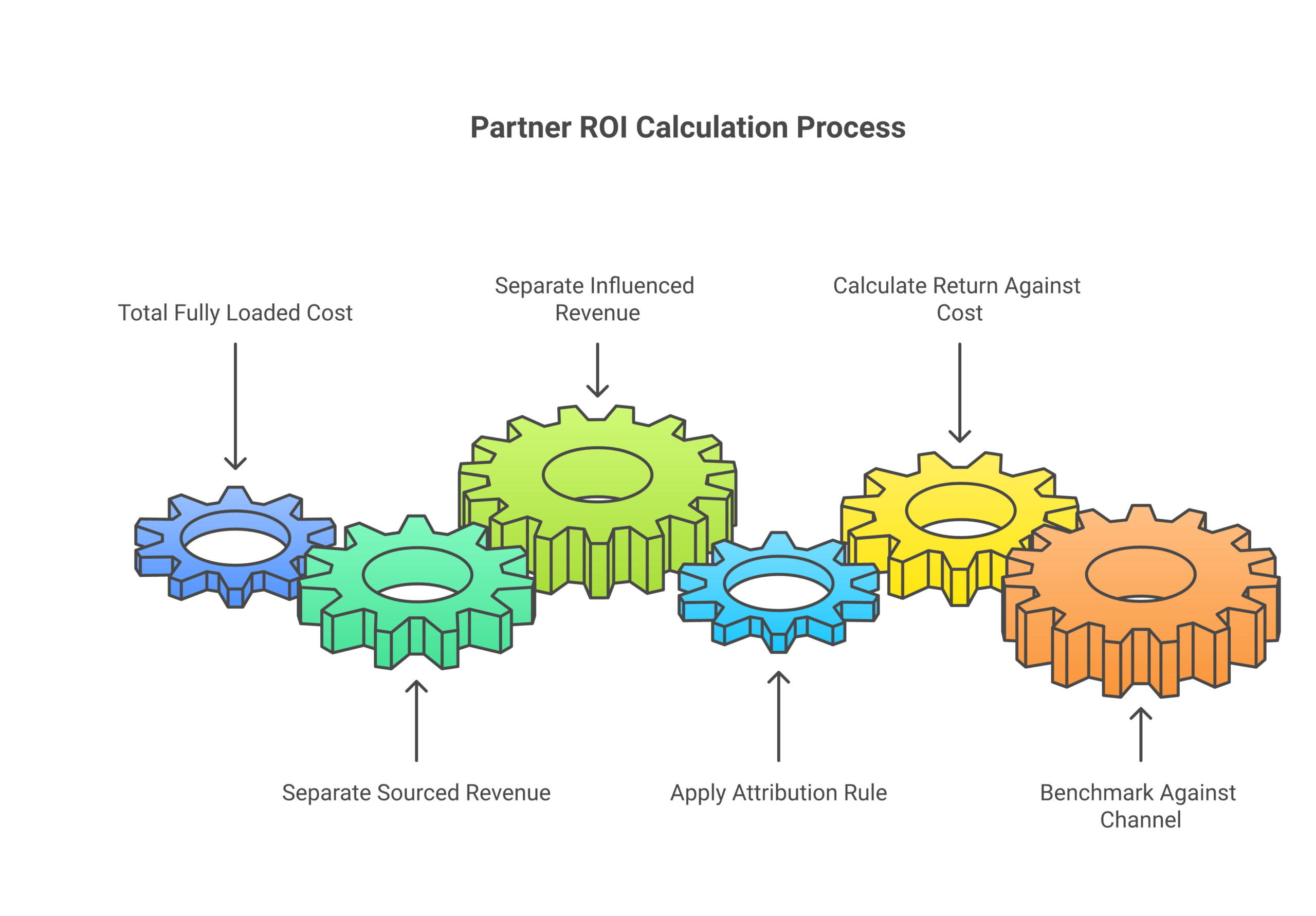
- Total the fully loaded cost: Add up everything the program consumes, salaries, tooling, partner incentives, market development funds, and program spend, into one investment figure. ROI calculated against a partial cost, usually one that omits headcount, produces a flattering number that finance will dismantle.
- Separate sourced revenue from influenced revenue: Measure partner-sourced revenue, where the partner originated the deal, apart from partner-influenced revenue, where the partner touched a deal sales would have won anyway. Blending the two is the single most common way partner ROI gets inflated.
- Apply an honest attribution rule and hold it: Decide the rule for what counts as sourced or influenced and apply it consistently, rather than crediting partnerships generously whenever a partner appears anywhere near a deal. A stable, conservative rule is more defensible than a generous one.
- Calculate return against cost for a defined period: Compute the return over a period that respects the program’s ramp, because partnerships pays back slower than paid acquisition and a too-short window understates it. The period has to be long enough to be fair and bounded enough to be real.
- Benchmark the result against a known channel: Express the ROI in a form comparable to a channel finance already funds, such as return per dollar invested or cost per sourced opportunity, so the number has a reference point. An ROI figure in isolation cannot be judged good or bad.
The calculation is rerun each period against actuals, so the program’s claimed return is continually checked against what it actually produced.
Common pitfalls in partner ROI
- Omitting headcount from the cost: Calculating ROI against only tooling and incentives while leaving out the team’s fully loaded salaries produces a number that looks great and collapses the moment finance asks what the program costs in total. The cost side has to be complete.
- Counting influenced as sourced: Crediting partnerships with the full value of every deal a partner merely touched inflates the return and destroys trust when examined. Sourced and influenced revenue have to be reported separately and weighted honestly.
- Generous, drifting attribution: Applying a loose rule that credits partnerships whenever a partner appears anywhere near a deal makes the number indefensible. A conservative rule held steady beats a generous rule that flatters this quarter and embarrasses you next.
- Too short a measurement window: Judging partner ROI on a window shorter than the program’s ramp understates the return and can sink a program that was actually working. The period has to account for the slow payback partnerships inherently has.
- A number with no benchmark: Reporting an ROI figure with nothing to compare it to leaves finance unable to tell whether it is good. Anchoring the result to a channel they already fund is what turns the number into a decision.
What this looks like in practice
A partnerships leader had been reporting a partner ROI that finance never trusted, and a quick audit showed why: the cost side omitted the team’s salaries, and the return side counted every influenced deal as fully sourced. They rebuilt it honestly. The cost became the fully loaded figure, two salaries, tooling, and incentives. The return split into two lines, a conservative sourced number where the partner clearly originated the deal, and a separately labeled influenced number. They held a strict attribution rule and measured over a trailing four quarters to respect the ramp. The honest sourced ROI was lower than the old headline, but for the first time finance believed it, and when benchmarked against the company’s outbound program on cost per sourced opportunity, partnerships came out favorably. The smaller, credible number won the budget argument that the larger, unbelievable one had been losing for a year.
Forecastable’s POV on partner ROI
The temptation in partner ROI is to make the number big, and that instinct is exactly what keeps partnerships from being trusted. Inflated ROI, omitted costs, generous attribution, blended sourced and influenced, buys a better slide and a worse reputation, because finance has seen the trick and discounts the whole function for it. The counterintuitive move is to report the smaller, honest number, because credibility compounds and a believable ROI wins more budget over time than an unbelievable one ever does.
The second conviction is that sourced and influenced revenue are different claims and must never be merged. Influence is real and worth reporting, but a deal a partner touched is not a deal a partner created, and treating them as the same is the fastest way to lose a CFO. Keeping the two lines separate costs you a bigger headline and earns you a number people will act on.
The candid limit is that not every valuable thing partnerships does shows up in ROI. Trust built, references generated, and ecosystem position established are real and hard to monetize in a return calculation, and a program judged only on near-term sourced ROI can be undervalued. The honest answer is to report the rigorous ROI as the financial spine and name the unmeasured value separately, rather than smuggling it into the number where it makes the whole figure suspect.
Forecastable is a partnerships operating platform; any third-party tools or platforms referenced here are independent third-party products, and naming them is not an endorsement of one deployment over another. Evaluate each against your own motion.
Frequently asked questions
How do you calculate partner ROI?
Total the fully loaded program cost, including salaries, tooling, and incentives, then measure the return against it over a period that respects the ramp. Report partner-sourced revenue separately from influenced revenue, and benchmark the result against a channel finance already funds.
Should partner ROI include influenced revenue?
Report it, but separately and clearly labeled, never blended into sourced revenue. Influence is real value, but counting a deal a partner merely touched as one the partner created inflates the number and costs you credibility when finance examines it.
Why is my partner ROI not believed by finance?
Usually because the cost side omits headcount or the attribution is too generous. A number calculated against partial cost with loose attribution looks great and falls apart under scrutiny, and finance discounts the whole function once it spots the pattern.
What time period should partner ROI use?
A window long enough to respect partnerships’ slow ramp, often a trailing four quarters. Judging the program on a window shorter than its payback understates the return and can sink a program that is actually working.
What is a good partner ROI?
There is no universal threshold; the meaningful test is how the return compares to a channel the company already funds, such as outbound or paid. Expressing partner ROI as return per dollar or cost per sourced opportunity against a known benchmark is what makes it judgeable.
What does partner ROI miss?
Hard-to-monetize value like trust, references, and ecosystem position. A program judged only on near-term sourced ROI can be undervalued, so report the rigorous number as the financial spine and name the unmeasured value separately rather than inflating the figure.
Next step
If your partner ROI is not trusted, the move this week is to rebuild it with a complete cost side including salaries, split sourced from influenced revenue into two clear lines, and benchmark the honest result against a channel finance already funds.
Start your growth journey now to build a partner ROI number finance will believe, or read the orientation on the partner program for the broader operating model.
Uncover Your Growth Potential
Schedule a Discovery Call