B2B Cost Per Lead: The Number That Misleads Budgets

Short answer
Short answer: B2B cost per lead is the total spend of a channel divided by the number of leads it produced, a quick gauge of how expensive it is to get a prospect to raise a hand. It is easy to calculate and easy to misread, because it stops exactly where the money question starts: whether those leads become customers.
Here is the position. Cost per lead rewards cheap volume and hides conversion, so optimizing to it reliably makes your real acquisition cost worse. The number that matters is cost per customer by source.
What is b2b cost per lead?
B2B cost per lead is a unit-economics metric: take the fully loaded spend on a channel over a period, divide by the leads that channel generated, and you have the average price of one lead. Most teams compute a blended figure across all of marketing and a per-channel figure for paid campaigns.
The metric answers one narrow question, what did it cost to get a hand raised, and people treat it as if it answered a broader one, what did it cost to grow revenue. Those are different questions with different answers. A lead is a person who responded. A customer is a person who bought. Cost per lead measures the first and implies nothing reliable about the second.
Why b2b cost per lead matters in 2026
B2B cost per lead matters in 2026 because it is still the default metric in most marketing dashboards, which means it is still the number steering most budgets, and the steering is off. When lead costs rose across paid and outbound channels, teams optimizing to cost per lead chased the cheapest sources, and the cheapest sources were usually the lowest-converting.
The deeper issue is that finance stopped accepting it. CFOs now ask for cost per acquired customer and payback period, and a marketing team that can only report cost per lead is answering a question nobody senior is asking. The gap between a channel’s cost per lead and its cost per customer is where budgets get misallocated, sometimes for years.
In my work with revenue teams, the most expensive mistake I see is a team proudly cutting cost per lead quarter over quarter while cost per customer climbs, because the cheaper leads converted so much worse that the company paid more per customer to celebrate a lower cost per lead.
How b2b cost per lead actually works
B2B cost per lead works as a ratio that looks complete and is not, because it omits the two things that determine real cost: lead quality and conversion.
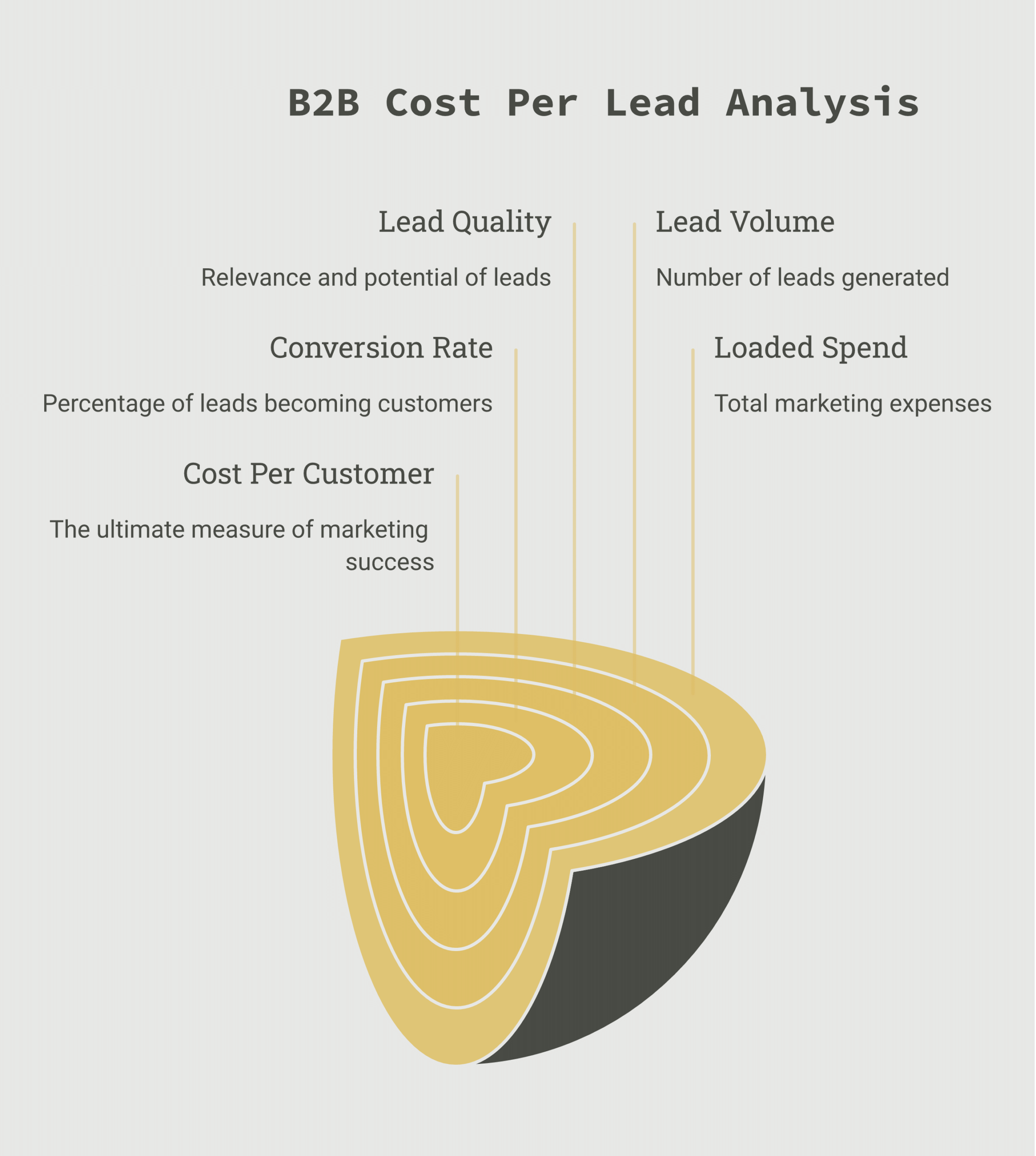
- Loaded spend: total the real cost of a channel, including media, tools, data, and the loaded cost of the people running it, because a cost per lead built on media spend alone understates the true figure and flatters cheap-looking channels.
- Lead volume: count the leads the channel produced, but define a lead consistently across channels, since a form fill and a booked meeting are not the same object and mixing them makes the ratio meaningless.
- Lead quality: segment leads by fit and intent, because a channel that produces many low-fit leads will show a low cost per lead and a terrible cost per customer, and the quality step is where that divergence first appears.
- Conversion rate: track what share of each channel’s leads become customers, since this is the multiplier that turns cost per lead into cost per customer and the single factor cost per lead ignores entirely.
- Cost per customer by source: divide loaded spend by customers won, split by source, because this is the number that actually tells you where the next dollar should go and the only one finance should be shown.
The through-line is that cost per lead is the first link in a chain and teams treat it as the whole chain. Every link after it, quality and conversion, can reverse the ranking, which is why the cheapest lead so often becomes the most expensive customer.
Common pitfalls
- Optimizing to the ratio: cutting cost per lead as the goal, which pushes spend toward cheap, low-fit sources and quietly raises the cost of every customer.
- Media-only spend: computing cost per lead on ad spend without the loaded cost of tools, data, and people, so the number is lower than reality and the comparison across channels is unfair.
- Inconsistent lead definitions: counting form fills in one channel and meetings in another, which makes the per-channel costs non-comparable and the blended figure fiction.
- Ignoring conversion: reporting cost per lead with no conversion rate attached, so a channel that never closes anyone keeps its budget because its leads look cheap.
- No source in the customer number: measuring cost per customer as a single blended figure, which hides that one source produces most of the cheap customers and another produces most of the expensive leads.
What this looks like in practice
A demand-gen manager reports a strong quarter: blended cost per lead is down 30 percent. The CFO asks one question, what did a customer cost, and the number has to be rebuilt by source. Paid social drove the cheap leads, at 40 dollars each, and converted at under 1 percent, so each customer from that source cost over 6,000 dollars. Partner-sourced leads cost almost nothing to generate and converted at 28 percent, so each of those customers cost a few hundred dollars. The quarter that looked efficient on cost per lead was, on cost per customer, a quarter of overpaying for the cheap channel.
The fix was not more budget or less. It was moving spend from the channel with the best cost per lead to the channel with the best cost per customer, which happened to be the warm one the dashboard had never credited.
Forecastable’s POV
Cost per lead survives because it is easy and because it flatters the channels that are easy to buy. It is a volume metric masquerading as an efficiency metric, and the longer a team optimizes to it, the worse its real acquisition economics get. The whole fix is to stop reporting cost per lead to anyone who makes budget decisions and report cost per customer by source instead.
When teams make that switch, partner-sourced revenue almost always moves to the top of the efficiency ranking, and it almost always surprises people, because it was invisible on the cost-per-lead view. A partner introduction is not a lead you bought; it is a warm referral that converts several times higher than a cold hand-raise. At Forecastable we are a partnerships operating platform that connects partner conversations and actions to CRM pipeline and revenue, so partner-sourced cost and conversion sit in the same economics as every paid channel.
My bet: the teams that retire cost per lead as a decision metric, and rank channels by cost per customer, are the ones whose acquisition costs finally start falling for real instead of on paper.
Forecastable is an independent third-party. Any tools, vendors, or third-party figures referenced here are described from public information for the reader’s own evaluation, not as paid placements.
Frequently asked questions
How do you calculate b2b cost per lead? Divide the fully loaded spend on a channel over a period by the number of leads it produced, including the cost of tools, data, and people, not just media. Compute it per channel with a consistent lead definition so the figures are comparable.
What is a good cost per lead in B2B? There is no universal benchmark worth chasing, because a good cost per lead that converts poorly is worse than a high one that converts well. Rank your channels by cost per customer instead, and a good cost per lead is simply one attached to a strong conversion rate.
Why is cost per lead a misleading metric? Because it stops before conversion. Two channels with the same cost per lead can have wildly different costs per customer, so optimizing to cost per lead routinely pushes money toward cheap, low-converting sources and raises real acquisition cost.
What should I measure instead of cost per lead? Cost per acquired customer, split by source, alongside payback period and the conversion rate at each stage. Those are the numbers that tell you which channel grows revenue efficiently rather than which one produces the cheapest hand-raises.
Why do cheap leads often cost more per customer? Because cheap leads usually come from low-intent, high-volume sources that convert poorly. Once you divide spend by customers won rather than leads generated, the cheap-lead channel frequently turns out to be the most expensive source of customers.
How does partner-sourced pipeline compare on cost per lead? It often looks invisible on cost per lead because partners do not bill per lead, but on cost per customer it usually ranks first, since the referral arrives with trust and converts far higher than a purchased lead.
Next step
Rebuild last quarter’s channels as loaded cost per customer by source, not cost per lead, and show that view to whoever sets the budget. The ranking will change, and so should the spend.
If the most efficient source turns out to be partner-sourced and missing from your reports, that is the gap we close. Start your growth journey with Forecastable and we will put partner-sourced economics next to your paid channels. Our B2B outbound sales guide covers the cold-channel math, and the partner attribution guide covers crediting the source correctly.
Uncover Your Growth Potential
Schedule a Discovery Call