Cost Per Lead vs Cost Per Acquisition: Which to Trust

Short answer
Short answer: Cost per lead vs cost per acquisition is the difference between what you pay for a hand-raise and what you pay for a customer, and the two numbers can point in opposite directions. Cost per lead measures the top of the funnel, cost per acquisition measures the bottom, and only one of them should steer a budget.
Here is the position. It is not a tie. Cost per lead is useful for diagnosing a channel and dangerous for deciding a budget, because the cheapest leads are so often the most expensive customers.
What is cost per lead vs cost per acquisition?
Cost per lead is a channel’s loaded spend divided by the leads it produced. Cost per acquisition, sometimes called cost per customer, is that spend divided by the customers it actually won. The gap between them is conversion, and conversion is where channels that look identical at the top of the funnel separate completely at the bottom.
The two metrics live at opposite ends of the same pipeline. One tells you how efficiently a channel creates interest. The other tells you how efficiently it creates revenue. A team that confuses the two will fund interest and wonder why revenue did not follow.
Why cost per lead vs cost per acquisition matters in 2026
The comparison matters because budget scrutiny moved to the bottom of the funnel. For years marketing optimized to cost per lead because leads were the thing marketing controlled, and sales owned conversion. That division let a cheap-lead channel keep its budget no matter how poorly it closed. Finance closed the loophole by asking for cost per acquisition, by source, with a payback period attached.
The second reason is that cold channels got more expensive and their conversion got worse at the same time, which widens the gap between the two metrics. The wider the gap, the more a cost-per-lead view misleads, and in 2026 that gap is as wide as it has been.
In my work with revenue teams, the single clearest tell of a misallocated budget is a channel that ranks first on cost per lead and last on cost per acquisition, funded for years because only the first number was ever reported upward.
How cost per lead vs cost per acquisition actually works
The relationship between the two metrics is governed by conversion, and reading them together is a short, repeatable process.
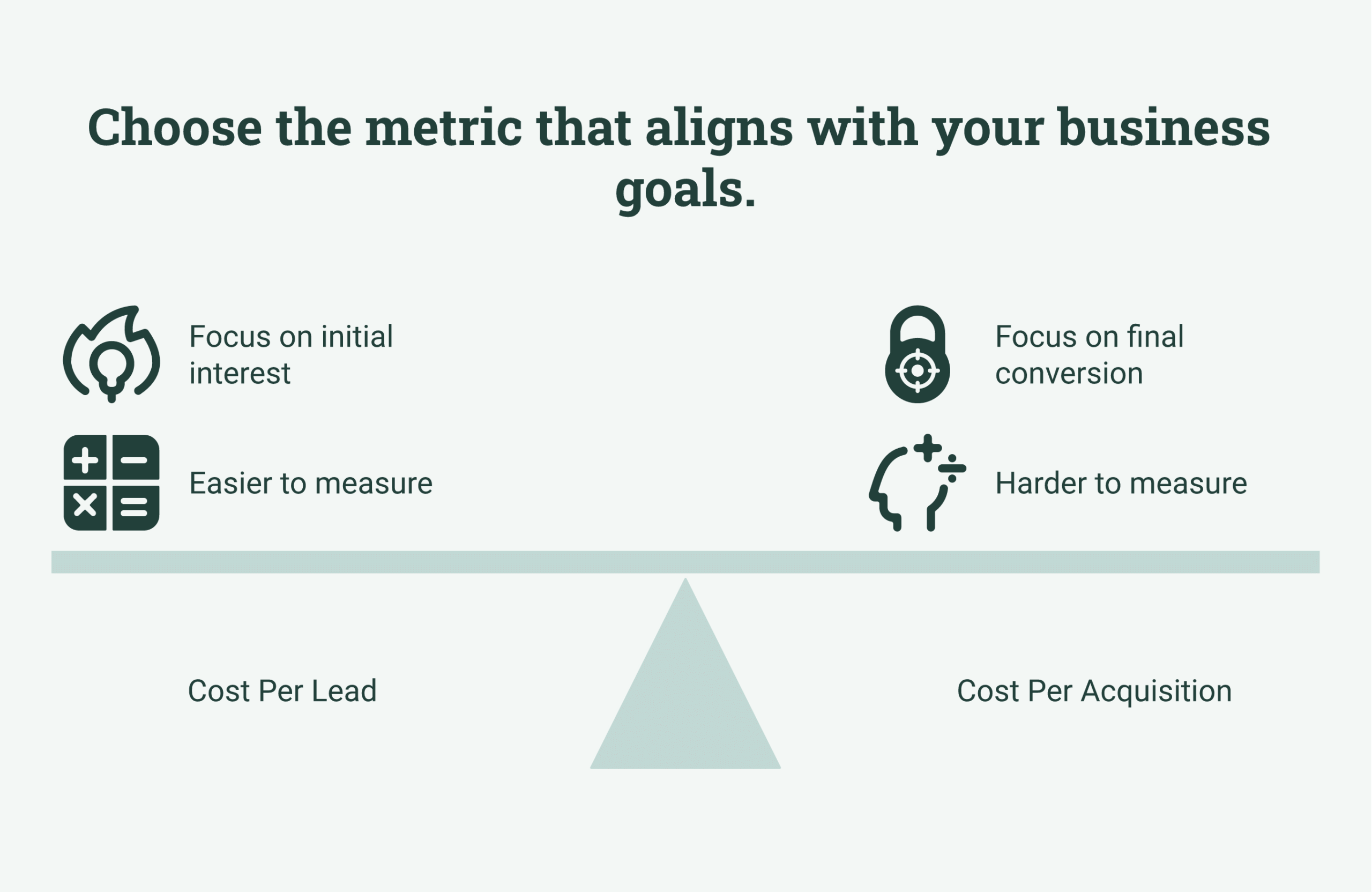
- Compute cost per lead by channel: divide loaded channel spend by leads with a consistent lead definition, and use this only as a diagnostic of top-of-funnel efficiency, never as a budget signal on its own.
- Compute cost per acquisition by channel: divide the same loaded spend by customers won, which converts the top-of-funnel number into the revenue number finance cares about.
- Read the ratio between them: the gap is one over the conversion rate, so a channel with a cheap cost per lead and a wide gap is a low-converting channel wearing a disguise.
- Rank on acquisition, not lead: order channels by cost per acquisition and fund from the top, because that ranking reflects which channel grows revenue efficiently rather than which produces the cheapest interest.
- Add payback and lifetime value: check cost per acquisition against customer lifetime value and payback period, since a low acquisition cost on low-value customers can still be a bad trade.
The through-line is that cost per lead is a lens for fixing a channel and cost per acquisition is the lens for funding one. Use each for its job and the two stop contradicting you.
Tools and examples
The two metrics compare cleanly when you line them up against what they measure and when each one lies.
| Dimension | Cost per lead | Cost per acquisition |
|---|---|---|
| What it measures | Spend per hand-raise (top of funnel) | Spend per won customer (bottom of funnel) |
| When it is useful | Diagnosing channel efficiency and creative | Deciding where budget goes |
| How it misleads | Rewards cheap, low-fit volume | Misleads only if lifetime value is ignored |
| Who should watch it | Demand-gen and campaign owners | CFO, CRO, and anyone setting budget |
A worked example makes the divergence concrete. Paid social delivers leads at 45 dollars and converts at 0.8 percent, so cost per acquisition is about 5,600 dollars. A partner-sourced motion delivers leads at an effective 120 dollars of internal effort and converts at 30 percent, so cost per acquisition is about 400 dollars. On cost per lead, paid social wins by nearly three to one. On cost per acquisition, partner-sourced wins by fourteen to one. Same two channels, opposite verdicts, and only the acquisition verdict pays the bills.
Forecastable’s POV
The reason this comparison keeps mattering is that cost per lead is the number that is easy to produce and cost per acquisition is the number that is true. Teams default to the easy one and defend it upward, and the budget drifts toward whatever channel produces the cheapest hand-raises regardless of whether those hands ever sign.
Partner-sourced revenue is the channel that exposes the whole problem, because it is usually mediocre on cost per lead and dominant on cost per acquisition. The introduction is not free to produce, but it converts so much higher than a cold lead that its cost per customer sits far below every paid alternative. It stays underfunded because the cost-per-lead view cannot see its advantage. At Forecastable we are a partnerships operating platform that connects partner conversations and actions to CRM pipeline and revenue, so partner-sourced acquisition cost sits in the same table as every other channel.
My bet: the teams that ban cost per lead from budget conversations, and decide on cost per acquisition by source, stop overfunding their coldest channel within a quarter.
Forecastable is an independent third-party. Any tools, vendors, or third-party figures referenced here are described from public information for the reader’s own evaluation, not as paid placements.
Frequently asked questions
What is the difference between cost per lead and cost per acquisition? Cost per lead is spend divided by leads generated; cost per acquisition is spend divided by customers won. The difference between them is conversion, so two channels with the same cost per lead can have wildly different costs per acquisition.
Which metric should I use for budgeting? Cost per acquisition, split by source, checked against lifetime value and payback. Cost per lead is a diagnostic for channel efficiency, not a budget signal, because it ignores whether leads ever become customers.
Can a channel have a low cost per lead and a high cost per acquisition? Yes, and it is common. A channel that produces cheap, low-intent leads shows a low cost per lead and, once its weak conversion is applied, a high cost per acquisition. That pattern is the main reason budgets get misallocated.
How do I lower cost per acquisition? Shift budget toward the sources with the best cost per acquisition and improve conversion on the ones you keep. For most teams the fastest lever is funding the warm, high-converting channels, which are usually partner-sourced, rather than buying more cheap leads.
Is cost per acquisition the same as customer acquisition cost? They are closely related; cost per acquisition usually refers to a channel or campaign level figure, while customer acquisition cost often refers to the fully blended company-wide number. Both should be read by source to be useful.
Why does partner-sourced pipeline win on cost per acquisition? Because a partner introduction converts far higher than a cold lead, so even when its cost to produce is not trivial, the cost spread across the customers it wins is low. That advantage only shows up on cost per acquisition, never on cost per lead.
Next step
Build one table this week with every channel’s cost per lead and cost per acquisition side by side, ranked by acquisition. Fund from the top of the acquisition column and ignore the lead column for the budget decision.
If the top of that column is partner-sourced and your reports cannot see it, that is the gap we close. Start your growth journey with Forecastable and we will put partner-sourced acquisition cost in the same table as your paid channels. Our B2B cost per lead guide covers the top-of-funnel metric, and the partner attribution guide covers crediting the source correctly.
Uncover Your Growth Potential
Schedule a Discovery Call