Co-Sell vs Co-Marketing: Where They Differ

What is the difference between co-sell and co-marketing?
Short answer: Co-sell vs co-marketing compares two partner motions that work at different stages of the same funnel. It is not a question of which to pick: co-marketing creates joint awareness and demand, co-sell works joint deals to a close, and a mature partnership runs both with a clear handoff between them.
The confusion is understandable. Both motions involve two companies, both produce something a partnerships team reports, and both get filed under “partner programs.” But they have different units of work, different owners, and different metrics, and treating them as one motion is why so many partnerships do a webinar and call it co-sell.
This page lays out how the two motions differ across the dimensions that matter, where they connect, and when each one should run.
Why the distinction matters in 2026
Three shifts have made the distinction practical rather than academic. Ecosystem-led growth has made both motions revenue-relevant, so blurring them now hides where partner revenue actually comes from. Buying committees have grown past seven stakeholders, and co-marketing reaching them is not the same as co-sell closing them. And finance now expects partner revenue reported with rigor, which is impossible when a campaign and a deal motion are reported as one number.
The cost of blurring the two is concrete. A partnership that calls co-marketing co-sell runs campaigns, generates some leads, and never builds the deal-review cadence that closes them. The partnership looks active and produces little, because the awareness motion was mistaken for the revenue motion.
How co-sell and co-marketing actually differ
The two motions differ across five dimensions. Each dimension is a place teams conflate them.
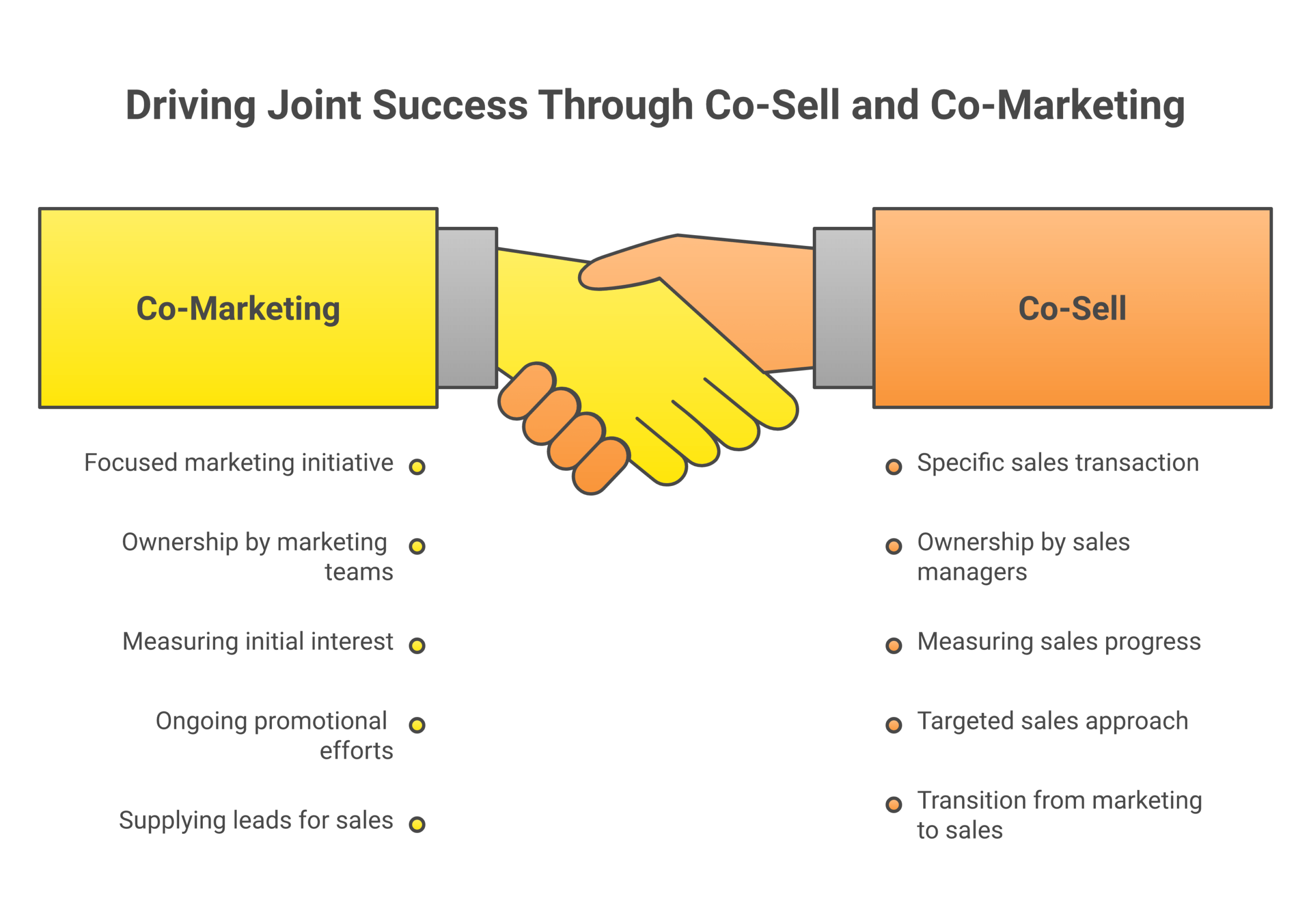
- The unit of work: Co-marketing’s unit is a campaign, a webinar, a joint guide, an event. Co-sell’s unit is a deal, a single joint opportunity worked to a close. One produces content and reach; the other produces pipeline.
- Who owns it: Co-marketing is owned by partner marketing, working with both companies’ marketing teams. Co-sell is owned by the partner manager and the account executives. Different people, different skills, different calendars.
- The metric: Co-marketing is measured on reach, leads, and influenced pipeline. Co-sell is measured on sourced pipeline, joint win rate, and partner-attributed revenue. A campaign metric cannot prove a deal motion.
- When it runs: Co-marketing runs early and continuously, building awareness and demand before specific deals exist. Co-sell runs on named accounts, account by account, once there is a deal to work.
- How they connect: Co-marketing feeds co-sell. A joint campaign surfaces interest; co-sell picks the resulting accounts off the overlap list and works them. The handoff between the two is where partnerships leak the most value.
The closing point is that the two motions are sequential, not competing. Co-marketing without co-sell generates demand nobody closes. Co-sell without co-marketing works a thin account list with no air cover. The partnerships that produce run both and manage the handoff deliberately.
Common pitfalls
Teams conflate the two motions in consistent ways, and every pitfall is a dimension above being ignored.
- Calling co-marketing co-sell: A partnership runs a webinar, reports it as co-sell, and never builds a deal-review cadence. The awareness motion is mistaken for the revenue motion.
- No handoff: Co-marketing generates leads and co-sell never picks them up. The demand the campaign created decays untouched.
- One owner for both: A single partner manager is asked to run campaigns and work deals. One motion always gets shortchanged, usually co-sell.
- Campaign metrics for a deal motion: Co-sell is reported on leads and reach because that is what the co-marketing report measured. The deal motion’s real numbers never surface.
- Co-sell with no air cover: A partnership works named accounts cold, with no joint co-marketing presence. Every deal starts colder than it had to.
What this looks like in practice
The two motions run on overlapping but distinct tooling. The table separates them.
Two companies run both motions with a deliberate handoff. Co-marketing publishes a joint guide and runs a webinar, owned by partner marketing, measured on registrations and influenced pipeline. The accounts that engage flow onto the co-sell overlap list. Co-sell, owned by the partner manager, picks the strongest of those accounts and works them through the deal-review cadence. The campaign created the demand; the deal motion closed it. Each is reported on its own metric, and the handoff is a named step.
The contrast is a partnership that runs only the campaign, reports it as co-sell, and wonders why revenue never appears. The webinar happened. The deal motion never did.
Forecastable’s POV
The most useful thing to understand about co-sell vs co-marketing is that the comparison is not a decision. Partnerships leaders ask which one to invest in as though picking the wrong one is the risk. The real risk is running one and calling it the other. A partnership that runs co-marketing well and never builds a co-sell motion will generate demand and close little, and the report will still look busy.
The dimension that gets blurred most is ownership. Co-marketing and co-sell need different people. The campaign motion needs a marketer who can build joint content and demand. The deal motion needs a partner manager who can run a cadence and work an account. Asking one person to do both guarantees the harder motion, co-sell, gets shortchanged, because a campaign has a deadline and a deal does not.
The contrarian point is that most partnerships should fix their co-sell motion before adding more co-marketing. Co-marketing is visible and satisfying; a webinar happens and there is something to show. Co-sell is slower and quieter and is where the revenue actually is. When a partnership underperforms, the instinct is another campaign. The fix is usually the deal-review cadence that no one built.
If your partnership feels active but the revenue is thin, check whether you have been running co-marketing and calling it co-sell.
Forecastable is an independent third-party professional services company. Our evaluations of partner motions and tooling are based on publicly-available information as of May 2026 and our own client experience.
Frequently asked questions
Is co-sell better than co-marketing?
Neither is better; they do different jobs. Co-marketing builds joint demand, co-sell closes joint deals. A mature partnership runs both with a handoff between them.
Can one person run both co-sell and co-marketing?
Rarely well. The motions need different skills and calendars. When one person owns both, co-sell usually gets shortchanged because campaigns have deadlines and deals do not.
How do co-sell and co-marketing connect?
Co-marketing feeds co-sell. A joint campaign surfaces interested accounts; co-sell picks them off the overlap list and works them through a deal cadence.
Why do partnerships confuse the two?
Because both involve two companies and both get reported by partnerships. The difference is the unit of work: a campaign versus a deal.
Which should a new partnership start with?
Either can start first, but the co-sell motion is the one most often skipped. Building the deal-review cadence early prevents the partnership from becoming campaign-only.
Do co-sell and co-marketing use the same metrics?
No. Co-marketing is measured on reach, leads, and influenced pipeline. Co-sell is measured on sourced pipeline, win rate, and attributed revenue.
Next step
If your partnership runs campaigns but the deal revenue stays thin, the gap is a co-sell motion that was never built. Separate the two motions, give each an owner, and manage the handoff between them.
Talk to our team about your co-sell motion →
The co-sell hub holds the broader operating context, and the co-sell programs write-up covers how the deal motion is managed at scale.
Uncover Your Growth Potential
Schedule a Discovery Call