SentinelOne Partner Program: PartnerOne Tracks, Tiers and How Vendors Get Noticed

Short answer: The SentinelOne partner program is called PartnerOne. It launched globally in April 2025 with four tracks: Manage, Sell, Build and Deliver. Partners sit in one of three tiers: Associate, Advanced and Elite. There’s also a tech alliance for software firms, a marketplace for apps, and a group of cyber risk partners. In October 2026, AI security services were added. So vendors get noticed by building pipeline with the firms that already sell and run it.
Looking for the SentinelOne partner portal login? Go to the SentinelOne partner portal.
Already in the program? Here’s how partners turn it into pipeline.
What is the SentinelOne partner program?
The SentinelOne partner program is how the company works with the firms that sell, run and build on its platform. Its formal name is the Global PartnerOne Program.
It launched on April 3rd, 2025, at the North American PartnerOne Summit. Per the launch announcement, the goal was one program with “simplified, clearly defined requirements.” Its partner chief said at launch that “partners are at the core of our mission.”
The program has kept moving since then. In October 2026, it grew again with AI security services for partners. More on that below.
What are the SentinelOne PartnerOne tracks?
PartnerOne sorts partners by how they make money. The partner overview lists four tracks, as of November 8th, 2026:
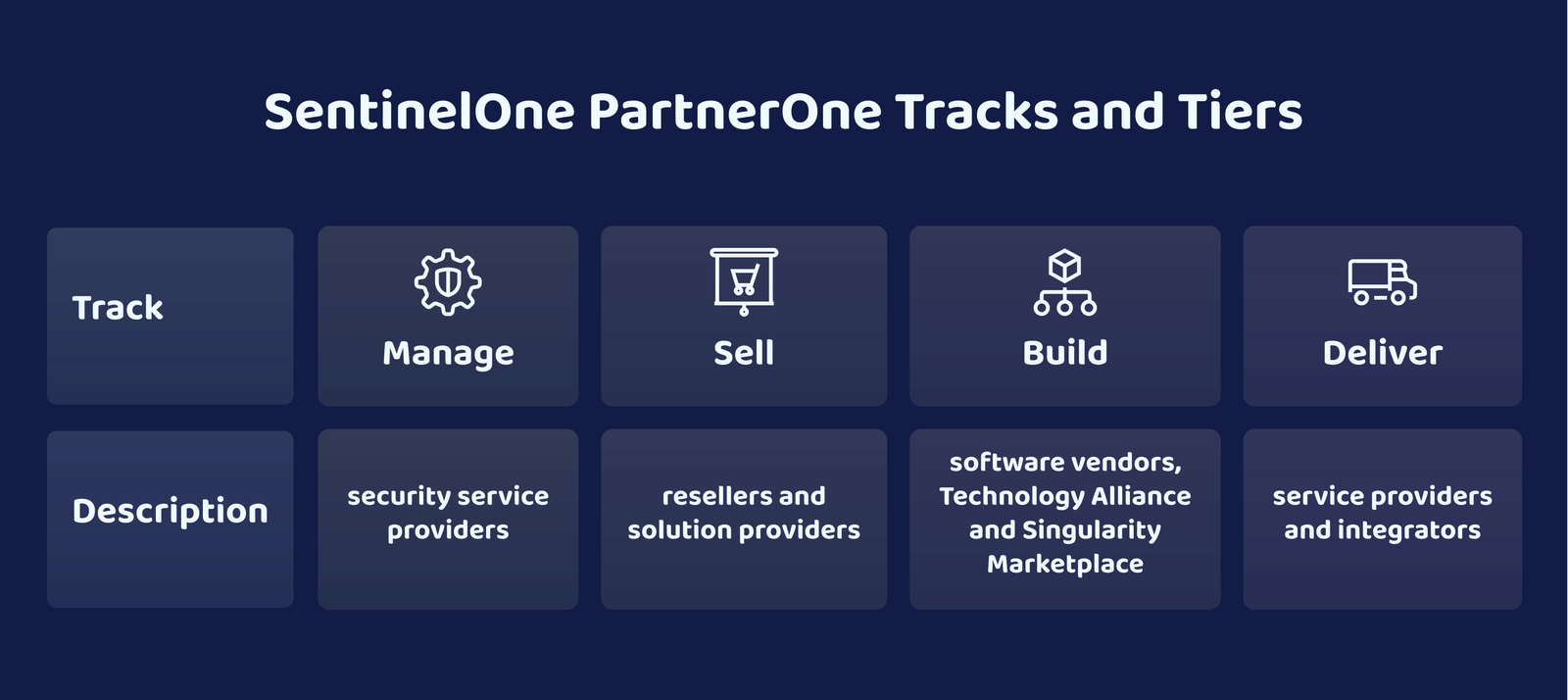
| Track | Who it fits | What it’s for |
|---|---|---|
| Manage | Security service providers | Build SentinelOne into customer protection |
| Sell | Resellers and solution providers | Win customers and keep them |
| Build | Independent software vendors | Make products that work with the platform |
| Deliver | Service providers and integrators | Deploy and improve it for customers |
So a firm picks the track that fits its model. Those are SentinelOne’s track labels. Around any one customer, though, you’ll meet tech alliance partners, resellers, distributors, OEMs, agencies and consultancies, ISVs, implementation partners, and the list goes on.
What are the SentinelOne partner tiers?
PartnerOne has three tiers. Per the launch release, they are Elite, Advanced and Associate.
Here’s the honest part, though, and it matters if you’re comparing programs. The company hasn’t posted tier rules or tier perks on its public pages. The release calls the incentives “industry-best.” But it gives no thresholds, margins or fund amounts. Those details sit in the partner portal and program guides, behind a login.
So if a blog post quotes exact SentinelOne tier thresholds, ask where they came from. And if you’re applying, ask your channel contact for the current guide.
How does the SentinelOne Technology Alliance work?
The Build track is for software firms. In practice, that runs through the Technology Alliance. The page lists three perks:
- Grow your audience, with expanded market opportunities.
- Deliver enterprise solutions, with access to the Singularity platform API.
- Amplify your brand, by joining SentinelOne’s marketing programs.
To join, you apply through the partner portal. The page lists no fees or tiers for alliances.
What is the Singularity Marketplace?
The Singularity Marketplace is where those add-ons show up for buyers. SentinelOne describes the listings as one-click integrations.
Listings come in two levels. Premier Partners get top billing, with integrations SentinelOne supports and validates. Other partners show up in a wider grid. Buyers can filter by areas like threat intel, SIEM and cloud security.
So the Marketplace is where your app lives. But a listing alone won’t get you co-sell time.
Who are SentinelOne cyber risk partners?
This group surprises people. Per the cyber risk partners page, it includes three kinds of firms:
- Incident response firms that contain attacks and clean up.
- Cyber insurance providers that take on breach risk.
- Data privacy and security law firms that work out what happened and what must be disclosed.
The page also lists proactive service providers for pen testing, red teaming and threat hunting.
These firms show up when a customer is under the most stress, which makes them strong door-openers for the right vendor. However, they’re advisers first. So any motion with them has to help their client, not just your pipeline.
What changed in the SentinelOne partner program in October 2026?
On October 21st, 2026, at its OneCon event, the company expanded PartnerOne. The goal is to help resellers and managed service providers build AI security and autonomous SOC practices.
Here’s what was announced:
- Partner-led AI Security Services, the core of the news.
- New certs, with online courses and exams for products like AI SIEM and Purple AI.
- Assessments partners can sell, such as an AI Recon Assessment.
- Delivery kits for certified partners, with scoping guides, statement of work templates and runbooks.
- Public listing for certified partners, so buyers can find them.
Three launch partners went first: LevelBlue, GuidePoint Security and World Wide Technology. A wider rollout to the rest of PartnerOne comes “in the coming months.” The company’s president and COO put it plainly: “AI Security represents the biggest cybersecurity opportunity for the channel in decades.”
How do you join the SentinelOne partner program?
Every path starts at the partner portal. Here’s the path the public pages point to:
- Pick your track. Manage, Sell, Build or Deliver.
- Apply in the portal. Tech alliance requests go through the same portal.
- Get certified. Certs prove you can deliver, which matters most for the new AI services.
- List your app, if you’re a software firm, so buyers find it in the Marketplace.
How does a vendor in the SentinelOne ecosystem get SentinelOne’s attention?
Look at where the company is putting its energy. Its newest push is about partners who build services and win new customers. The October 2026 news is aimed at resellers and managed firms who sell and deliver.
In other words, it wants partners who bring it deals. An integration helps. But if all you do is list in the Marketplace, you’re one more tile on the page.
Why partner-sourced pipeline beats going it alone
Think about who already holds the buyer’s trust. For example, a managed security firm runs the customer’s security center every day. Meanwhile, a software vendor has an add-on that fills a real gap in that stack. And neither one gets far calling cold.
As a pair, though, they have a reason to call the same accounts. That’s partner-sourced pipeline: deals that start because a partner opened the door. Here’s how partner-sourced and partner-influenced pipeline differ, if the terms are new.
But there’s a catch. If your own SDR team books the meeting, it most likely won’t count as partner-sourced. Run the outreach as the partner, on the partner’s behalf, and it can. Credit still follows the platform’s own rules, though. So confirm how your deals get registered, and track every touch.
Start with the accounts, not the pitch
Most partner meetings waste the first ten minutes pulling up lists live. Instead, set an agenda of named accounts before the call. Then sort each account three ways:
- Ask: accounts where you want the partner’s intro.
- Give: accounts where you can hand the partner something.
- Mutual: accounts where you both belong in the room.
If you use Crossbeam, that sorting is where account mapping turns into pipeline. Either way, the list comes first. If you also sell into Cisco shops, here’s how the Cisco 360 Partner Program is set up.
Turn SentinelOne’s partners into your door-openers
Look at the October 2026 news. SentinelOne gave partners assessments they can sell, like the AI Recon Assessment. That’s the right instinct, and you can borrow it. A managed security firm wants billable services it can put in front of its customers.
So build one with your product inside it. For example, a fixed-scope review of how a customer’s add-on tools feed its security center, run for a few accounts this quarter. Give it a stated value and agree who funds it: you, the partner or the buyer. Partners rarely respect free, so a free add-on trial won’t get you a slot.
Lead with the use cases where you already win. Then map SentinelOne’s channel and alliance teams one by one, and get each team’s feedback before you launch.
What does a partner GTM motion in the SentinelOne ecosystem look like?
A partner go-to-market (GTM) motion is one campaign, run with one partner, into accounts you both care about. Here’s how we run one in the SentinelOne ecosystem:
- Pick the partner. Pair a Build-track vendor with a managed security firm, a reseller or an incident response firm.
- Agree on the accounts. Overlap your lists and choose accounts where both of you belong in the room.
- Write one joint story. Answer one question: why these two firms, for this customer, right now?
- Run the outreach. A human SDR, not AI, cold calls the accounts in the partner’s name, backed by email and LinkedIn. Where it fits, add a field event.
- Hand off the meetings. Booked meetings go to whoever owns the deal, with the partner’s context attached.
- Track every result. Count meetings, registered deals and closed revenue, so you have proof for the partner team.
We run these done for you or done with you. Forecastable is a B2B partnerships agency, and we sell partner-sourced pipeline as a service, measured on SQOs, pipeline and revenue. A real campaign operations team and human SDRs do the work. Eva, our AI partner ops agent, tracks every activity, and you get full MCP access to it. You don’t buy seats or a PRM.
One-off motions are quoted individually. Roughly $15K tends to be the average for a one-off motion with one partner, with a part-time SDR making a limited number of calls. That’s a way to prove the model before you scale it. For planning, one SDR makes about 1,000 cold calls a month. A program running three to five motions either prioritizes which motions get SDR calling or adds a second SDR. Our Produce My Pipeline program is the version that runs every quarter.
Partners often fund these motions, too. Big partners rarely pay for your tools, but they will fund a program that produces pipeline. Any GTM motion could cost you $0 if partners pay for it. Before you fund one alone, read how market development funds work.
Frequently asked questions
What is SentinelOne PartnerOne?
It’s the company’s global partner program. It launched on April 3rd, 2025, with four tracks (Manage, Sell, Build and Deliver) and three tiers.
What are the SentinelOne partner tiers?
Elite, Advanced and Associate. The rules for each tier aren’t on the public pages, so ask for the current program guide.
How do software vendors partner with SentinelOne?
Through the Build track and the Technology Alliance. Vendors get access to the platform’s API and can list apps in the Marketplace.
Does SentinelOne work with MSSPs?
Yes. The Manage track is for security service providers. SentinelOne’s MSSP page promises “transparent consumption-based billing.”
What are SentinelOne AI Security Services?
They’re partner-led services announced on October 21st, 2026. Certified partners get delivery kits and a public listing. A wider rollout is planned.
Where is the SentinelOne partner portal?
It’s at partners.sentinelone.com. Applications, the Technology Alliance and partner logins all run through it.
What’s the bottom line on the SentinelOne partner program?
The SentinelOne partner program is betting on partners who build practices and win customers. Tracks and tiers sort you, while certs and apps keep you in the game. But new deals are what earn attention. So don’t wait for leads to show up. Instead, go build pipeline with the partners who protect the same customers. That’s what gets a platform’s attention. Backup is the other half of most security conversations, so the Veeam partner program is worth knowing. Our directory of partner programs has the rest.
Forecastable is an independent third-party B2B partnerships agency. We are not affiliated with or endorsed by SentinelOne. Program details are drawn from SentinelOne’s public pages and are current as of November 8th, 2026.
Are you a security vendor or partner selling alongside SentinelOne? Find out which GTM motion to run first. Book a Program-Fit Analysis
Uncover Your Growth Potential
Schedule a Discovery Call