Partner Events: B2B Event Marketing That Puts Target Accounts in the Room

Short answer: Partner events are webinars, dinners, roadshows and conference meetings you run with your partners. Forecastable runs partner events as co-marketing motions, soup to nuts. We build the invite list from partner overlap data, handle registration, venue and follow-up, and measure each event by target accounts in the room and meetings held. A fully run webinar is $10,000, and most standard physical events are about $10,000, priced by complexity.
What are partner events?
Partner events are any events you plan, fund or host with a partner. Think of a joint webinar with a technology partner, a dinner with a systems integrator, or a three-city roadshow with two partners and you.
They’re a huge source of partner-sourced pipeline, and a lot of teams don’t take advantage of them. Usually, that’s not because the ideas are bad. It’s because most people don’t run them with precision, and nobody has the time to. They work best as one part of a broader partner marketing plan.
Here are the formats we run:
- Webinars: fully run, from registration to follow-up.
- Happy hours and dinners: invites, venue and attendees handled.
- Roadshows: executive experiences, end to end.
- Virtual event series: recurring sessions, fully run.
- Conference activation: meetings booked with partners around events you’re already attending.
Why does B2B event marketing work better with partners?
Because partners bring the people you can’t reach alone. B2B event marketing usually means filling a room with your own list. That works, up to a point. But a partner’s customers already know that partner. If you integrate with a tool they run, they’re much more likely to take the conversation, because you’re relevant to them.
There’s a second reason. A partner who isn’t even sponsoring the event can still invite their customers. And if those customers come because of that partner, the meeting can count as partner-sourced. Credit follows each platform’s own attribution policy. Here’s how partner-sourced and partner-influenced pipeline differ.
And there’s a third. Side events at big conferences are great. Your target accounts are already in town, and a dinner or happy hour gives them a reason to spend an hour with you. They get even better when you pull them together with a group of partners, because each partner brings its own customers to the room. So we build events with partners, not just for them.
Start the invite list from partner data
Crossbeam’s guide on what to do after you find overlaps points to “accounts that are your partner’s customers but still prospects for you.” It also suggests uploading that list into your marketing platform for co-marketing. So that’s your invite list. Then we tailor the message to it, because partner data often tells you which stack each account runs.
Why do most partner events fail to produce pipeline?
Usually, it’s one of five reasons:
- The calendar is the bottleneck. A partner asks for an event, and your marketing calendar is full this quarter and mostly full next quarter. So the partner waits in line.
- Nobody owns the invite list. Is it your marketing team, the partner’s, or nobody?
- No goal up front. Teams track registrants and attendees, but they don’t set a pipeline target before the event.
- No visibility. When the partner runs it, you can’t see registrations or activity in real time.
- Follow-up is every rep for themselves. No one controls who calls whom after the event.
Money is often not the problem. MDF is my favorite budget on the planet, and there’s a lot of it available for events. The calendar and the hands are what’s missing.
How does Forecastable run partner events?
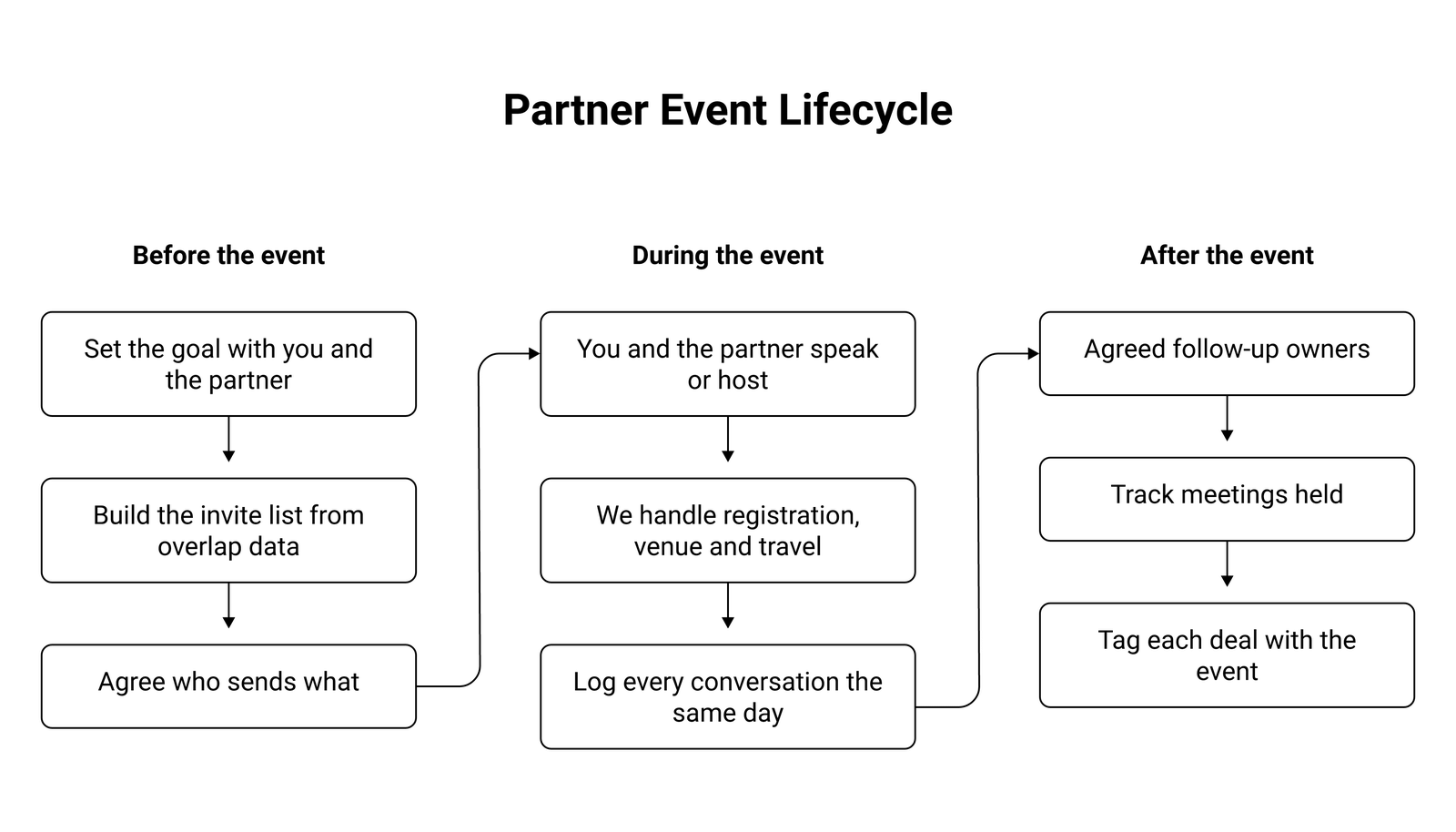
Every event runs as a co-marketing motion. That means a campaign operations specialist owns it from start to finish, and you and the partner see the same plan.
Before the event
First, we set the goal with you and the partner. That includes the funnel math: how many registrants you need, how many will likely attend, and how many meetings should come out of it. Then we build the invite list from overlap data. For a conference, that means answering three questions:
- Which of our target accounts are attending?
- Which partners already have them as customers or open opportunities?
- Which of those partners will make an intro for a coffee at the event?
For example, a list of 200 attendees might drop to 50 that matter. Then we ask the partners to introduce you to those 50. No attendee list? We rebuild one from last year’s registrants, track where those people work now, and match them against your target accounts. When the event app opens, we use it to find and message attendees too.
We also settle who sends what. Invites can come from the rep who’s attending or from one central sender, and we split the list so no invite is doubled or dropped. Outreach starts weeks ahead, not days. And if the event is invite-only, you can still tease it publicly. Say it’s invite-only and tell people to make sure they’re on the list. Just never publish the registration link, because once that’s public, it isn’t invite-only anymore.
During the event
For webinars, your team and the partner speak. You own moderation and Q&A, and our producer stays on standby off camera. For physical events, we handle registration, attendees, venue and travel booking. We partner with Fora Travel for the travel side. On the floor, every conversation gets logged the same day, with names and notes, so nothing waits for the badge scanner.
After the event
Follow-up isn’t left to chance. Instead, we agree in advance who follows up with each account, and how fast. We set the response times with your sales leader before launch. Then we track every meeting that comes out of the room. We also tag each deal with the event it came from, so you can see which events earn their budget. Everyone sees the same activity in real time.
What’s included, and what does it cost?
Here’s what each format includes, as of November 8th, 2026:
| Format | What’s included | Price |
|---|---|---|
| Fully run webinar | Registration page, recruiting, outbound campaigns, hosting infrastructure and follow-up | $10,000 each |
| Happy hour or dinner | Invite list, registration, attendees, venue and follow-up | About $10,000 each, priced by complexity |
| Roadshow or executive experience | Multi-stop planning, venues, attendees and travel booking | Priced by complexity |
| Conference activation | Target-account list, partner intros and meetings booked around the event | Priced by complexity |
Events can run on their own or alongside GTM motions in Produce My Pipeline. One rule holds across all of them: there’s no SDR on webinars or events. The campaign operations specialist runs them. See our pricing for the full list.
Who funds partner events?
Often, partners do. AWS, for example, says its Marketing Development Funds “help offset your marketing costs to drive demand generation and build your sales pipeline.” Partners can cover all of an event or split it with you. Our post on MDF for events and our MDF guide explain how the money works.
Before you spend, check how credit works. If the platform’s own team follows up on the leads, ask the platform whether the deals still count as partner-sourced. Then get the terms in writing. Our co-marketing agreement guide covers who pays, who owns the leads and how credit works.
How do you measure partner events?
We measure every event on two numbers first:
- Target accounts in the room. Not registrants. Named accounts from the invite list who actually showed up.
- Meetings held. Not booked. Held.
After that, we track SQOs and partner-sourced pipeline. Also, set the targets before the event, not after. And load the real cost, including partner manager time and outreach, not just the venue. Then judge the event over a longer window than the week it happened. Deals from an event can take months to show up.
Still, visibility matters as much as the numbers. Every party should see goals, registrations and meetings as they happen. You should be able to ask Claude, “What’s happening with each of my events this quarter?” and get an answer. With Forecastable, you can. You see everything through the Forecastable MCP in Claude, ChatGPT or Microsoft 365 Copilot. Meanwhile, Eva, our AI partner ops agent, watches the data in the background.
Which partner event fits which goal?
Match the format to what you need:
- Time with executives at priority accounts: executive dinners, with one-to-one personal invitations.
- Pipeline from a named list: happy hours and dinners co-hosted with the partners whose customers are on the list.
- Reviving dormant or closed-lost accounts: a partner event gives those accounts a fresh reason to come back.
- Named accounts across many cities: joint webinars and virtual event series, with invites targeted from partner data.
- More from events you already attend: conference activation with partner intros.
For more on in-person formats, read our guide to partner field marketing.
Related reading
- B2B Partner Marketing Strategy: To, Through, With
- B2B SaaS Marketing Partner: What It Is and How
- Co-Marketing Campaigns That Actually Convert (and Why Most Don’t)
- Event-Driven vs Always-On Partner Marketing
- Greenfield Accounts: How Partners Find Them
Frequently asked questions
What is B2B event marketing?
B2B event marketing uses webinars, dinners, roadshows and conferences to start conversations with business buyers. Partner events do the same thing with a partner’s credibility and customer list behind the invite.
What does a webinar marketing agency do?
A webinar marketing agency builds the registration page, recruits attendees, runs the platform and handles follow-up. Ours does all of that with a partner, for $10,000 per webinar. Your team and the partner do the speaking.
What does a B2B event marketing agency cost?
Our fully run webinars are $10,000 each. Most standard physical events are about $10,000 each, priced by complexity. Partners can often cover part or all of it with MDF.
How do we fill event seats with the right attendees?
Start from partner data, not your own list. Find the target accounts that are already your partners’ customers, then ask those partners to invite them. Qualify every name against your target account list before you send.
Do you put SDRs on partner events?
No. SDRs are never part of webinars or events. A campaign operations specialist runs them.
How many events can we run a quarter?
That depends on your goals, your partners and the budget behind each event. The point is that your own marketing calendar stops being the bottleneck. We price each event, so you add more when the pipeline justifies it.
Do I need Crossbeam for partner events?
Not strictly, but it helps a lot, because overlap data builds the invite list. When data can’t be shared, partners can work from shared account lists instead.
Who is Forecastable?
Forecastable is a B2B partnerships agency. We run partner-sourced pipeline for our clients, including partner events and co-marketing. Events are one piece of our work as a partner marketing agency.
What’s the bottom line?
Partner events work when the right accounts are in the room and someone owns what happens next. So build the invite list from partner data, set the goal before the event and stop waiting on your own calendar. Then measure it by target accounts in the room and meetings held.
Forecastable is an independent third-party professional services company. Our evaluations of other vendors are based on publicly-available information as of November 2026 and our own client experience. AWS and Crossbeam details are drawn from their public pages and are current as of November 8th, 2026.
Planning your next partner event? Book a Program-Fit Analysis
Uncover Your Growth Potential
Schedule a Discovery Call