Cisco 360 Partner Program: Designations, the Partner Value Index and How Vendors Get Noticed

Short answer: The Cisco partner program is now the Cisco 360 Partner Program. It replaced Gold, Premier and Select in January 2026. Every partner starts as a Registered Cisco Partner. Then it earns Portfolio and Preferred levels in areas like Security. Cisco scores everyone on a Partner Value Index that rewards results over process. So vendors who want Cisco’s attention should show customer wins, often by producing partner-sourced pipeline with other Cisco partners.
Looking for the Cisco partner portal login? Go to the Cisco partner portal.
Already in the program? Here’s how partners turn it into pipeline.
What is the Cisco 360 Partner Program?
The Cisco 360 Partner Program is how Cisco works with the firms that sell, build on and run its tech. Per Cisco, that covers developers, consultants, managed services providers, resellers, and the list goes on. Cisco first unveiled it on October 28th, 2024. Then it spent fifteen months designing it with partners before launch.
Per Cisco’s designations FAQ, the old Gold, Premier and Select levels retired on January 24th, 2026. The new designations took effect the next day. Cisco’s launch announcement followed on January 26th, 2026.
The big change is how partners are measured. Cisco’s program highlights say partners “are measured on outcomes, not processes.” In practice, that means a score called the Partner Value Index. Higher scores unlock more benefits.
What are the Cisco partner designations?
Cisco 360 has three levels, as of November 8th, 2026. Cisco calls them designations. Here’s how they compare:
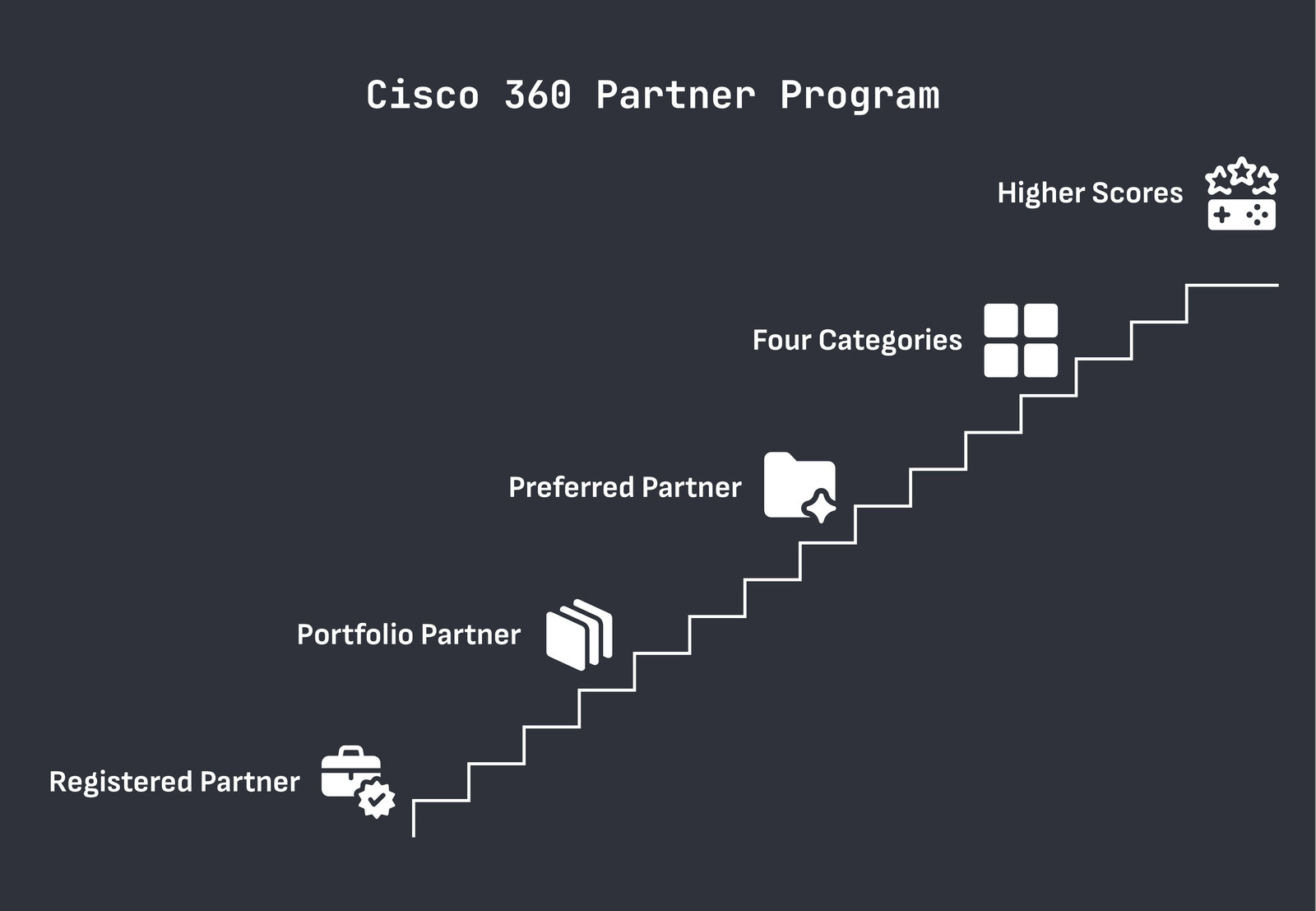
| Level | Who holds it | What it opens up |
|---|---|---|
| Registered Cisco Partner | Every partner that joins | The path to the next two levels |
| Cisco Portfolio Partner | Firms with proven sales and tech skills in one area | A named badge, like Cisco Security Partner |
| Cisco Preferred Partner | Firms with advanced skills and lifecycle practices in an area | The only level that can earn specializations |
You earn the top two levels one area at a time. Cisco calls each area a portfolio, and it lists nine. They include Networking, Security, Splunk, Services, Advisor and Developer.
One detail trips people up. Cisco says Preferred “is not a direct replacement for Gold.” It’s a new bar, set per area. So a firm can be Preferred in Security and hold a lower level in another area.
Specializations, competencies and Cisco Powered Services
On top of the levels, Cisco adds three kinds of badges:
- Specializations are reserved for Preferred Partners.
- Competencies identify partners with a unique skill.
- Cisco Powered Services show a firm can design, set up, manage and deliver services built on Cisco.
How does the Cisco Partner Value Index work?
The Partner Value Index (PVI) is Cisco’s main scorecard. Per the program highlights, it has four parts:
| PVI part | What Cisco checks |
|---|---|
| Foundational | How mature your lifecycle and managed services practices are |
| Capabilities | What you spend on skills, training and staff |
| Performance | How well you land, retain, expand and grow customers |
| Engagement | How involved you are across the customer journey, driving adoption and renewals |
Cisco ties incentives, levels, training and the right to earn specializations to that score. Its main payout plan is the Cisco Partner Incentive (CPI), which went live at launch. However, we didn’t find the PVI weights on Cisco’s public pages. Partners track their progress inside the Partner Experience Platform (PXP).
The program is still moving. At Partner Summit on October 26th, 2026, Cisco announced updates. It said Advisor and Developer PVIs “are now available,” raised the CPI reward for ACV growth by 50%, and doubled the Adopt incentive. It also said a unified Distributor PVI will be available by spring 2027, and added deal registration visibility in PXP.
How does the Cisco Developer path work?
The Developer path is the one software vendors care about. Cisco explained it in a June 3rd, 2026 partner blog. There, it defined developers as partners selling their own products, digital or physical, “alongside Cisco technology.”
The path rests on three stages of a deal:
- Value Discovery: learning what the customer needs.
- Value Definition: shaping the fix for a use case.
- Value Realization: helping the customer win after the sale.
In that post, Cisco said a PVI for developers would launch in August 2026 and a new Influence Deal Registration process would go live in September. By October 26th, 2026, Cisco said the Developer PVI was available. Influence Deal Registration is meant to let partners register deals and show their impact on customers. Cisco also lists not-for-resale product discounts and co-sell market development funds, which it says are co-funded.
AI software vendors get one more option. Cisco Compatible Solutions for AI is a set of outside AI software tested on Cisco’s AI hardware.
How do you join the Cisco partner program?
Per the Cisco Partners home page, joining takes three steps:
- Create a Cisco account and verify your email.
- Register your company in the Partner Registration tool, if it’s new to Cisco.
- Associate your account in Partner Self Service, if your company is already a partner.
From there, everything runs through PXP. That’s where you track progress, find training and see your scores.
How does a vendor in the Cisco ecosystem get Cisco’s attention?
Look at what Cisco measures. Two of the four PVI categories are about customers: Performance and Engagement. And when Cisco first announced the program, it said it would reward engagement across the customer journey and the partner ecosystem.
In other words, Cisco rewards partners who show up in customer wins. A badge alone won’t do it. If all you have is certs, you look like every other new partner.
Sell winning combinations, not one partner at a time
Here’s how I’d use that. Don’t pitch one partner at a time. Instead, ask which mix of partners your buyers need right now. Think Cisco plus a security vendor plus a services firm. Pick the strongest mixes. Then map accounts across all of them and build one joint offer that buyers can say yes to. Partners can even pool MDF to fund it.
Why partner-sourced pipeline beats going it alone
Think about who already holds the customer’s trust. For example, a Preferred Security Partner owns the firewall refresh. Meanwhile, a software vendor has the product that makes the new setup pay off. And neither one gets far calling cold.
As a pair, though, they have a reason to call the same accounts. That’s partner-sourced pipeline: deals that start because a partner opened the door. Here’s how partner-sourced and partner-influenced pipeline differ, if the terms are new.
But there’s a catch. If your own SDR team books the meeting, it isn’t partner-sourced. Run it with the partner, and it counts as partner-sourced. Credit still follows Cisco’s rules, though. That’s why Influence Deal Registration matters for developers. So register the deal and track every touch.
Give Cisco partners something they can sell this quarter
A Preferred Security Partner has a number to hit and a PVI to grow. So don’t pitch your roadmap. Bring a defined offer that helps it land, keep or expand a customer. For instance, a short readiness review for customers in the middle of a firewall refresh, run for a handful of accounts and priced. Partners rarely respect free. And if the partner funds part of it from its own MDF, the work should be delivered in the same quarter the money is spent.
Start with the accounts, not the pitch
A lot of partner meetings burn the first ten minutes clicking through overlap data live. Instead, set an agenda of named accounts before the call. Then sort each account three ways:
- Ask: accounts where you want the partner’s intro.
- Give: accounts where you can hand the partner something.
- Mutual: accounts where you both belong in the room.
Give first. One-off asks with no plan behind them don’t help anybody. If you use Crossbeam, that sorting is where account mapping turns into pipeline. Either way, the list comes first. For a security-focused program, see our breakdown of SentinelOne’s PartnerOne program.
What does a partner GTM motion in the Cisco ecosystem look like?
A partner go-to-market (GTM) motion is one campaign, run with one partner, into accounts you both care about. Here’s how we run one in the Cisco ecosystem:
- Pick the partner. Pair a software vendor with a Preferred Partner in the same area, a managed services provider, a consultant, and the list goes on.
- Agree on the accounts. Overlap your lists and choose accounts where both of you belong in the room.
- Write one joint story. Answer one question: why these two firms, for this customer, right now?
- Run the outreach. A real SDR makes the cold calls under the partner relationship, with email and LinkedIn around them. In-person events go in when the accounts justify it.
- Hand off the meetings. Booked meetings go to whoever owns the deal, with the partner’s context attached.
- Track every result. Count meetings, registered deals and closed revenue, so you have proof for Cisco’s partner team.
This is what Forecastable does. We’re a B2B partnerships agency that gets paid to produce partner-sourced pipeline, and we measure it in SQOs, pipeline and revenue. Our campaign operations team and human SDRs run GTM motions with and as your partners. Eva, our AI partner ops agent, records the activity, and you get full MCP access to every piece of it. No seats, no PRM required.
One-off motions are quoted individually. Roughly $15K tends to be the average for a one-off motion with one partner, with a part-time SDR making a limited number of calls. That’s a way to prove the model before you scale it. For planning, one SDR makes about 1,000 cold calls a month. A program running three to five motions either prioritizes which motions get SDR calling or adds a second SDR. Our Produce My Pipeline program is the version that runs every quarter.
Partners often fund these motions, too. Big partners rarely pay for your tools, but they will fund a program that produces pipeline. Cisco lists co-funded co-sell MDF for developers. Any GTM motion could cost you $0 if partners pay for it. Before you fund one alone, read how market development funds work.
Related reading
Frequently asked questions
What replaced Cisco Gold partner status?
The Cisco 360 Partner Program did. Gold, Premier and Select retired on January 24th, 2026. Cisco says the Preferred designation isn’t a direct replacement for Gold.
What are the Cisco partner designations?
There are three. Every firm starts as a Registered Cisco Partner. Then it can earn Portfolio Partner and Preferred Partner, one area at a time, such as Security.
What is the Cisco Partner Value Index?
It’s Cisco’s scorecard for partners. It measures four categories: Foundational, Capabilities, Performance and Engagement. Higher scores unlock more perks and pay. Advisor and Developer PVIs became available in October 2026.
Can software companies join the Cisco 360 Partner Program?
Yes. Developer is one of Cisco’s nine areas. It’s for firms that sell their own products alongside Cisco’s.
Does Cisco offer market development funds to developers?
Yes. Cisco lists co-sell market development funds for developers, and it says they’re co-funded. They cover building on Cisco, go-to-market work and customer trials.
How do customers find Cisco partners?
They use the Cisco Partner Locator. Cisco says buyers can search for partners across portfolios such as Security, Networking, Collaboration, Services, Splunk, and Cloud and AI Infrastructure.
What’s the bottom line on the Cisco partner program?
The Cisco partner program now scores value, not badges. Levels and certs get you in the door. But Performance and Engagement decide how far you go. So don’t wait for Cisco to send you deals. Instead, go build pipeline with the partners who sell to the same customers. That’s what gets a platform’s attention. If your buyers also care about backup and recovery, see how the Veeam ProPartner Network is built. Every platform we cover is in our partner program directory.
Forecastable is an independent third-party B2B partnerships agency. We are not affiliated with or endorsed by Cisco. Program details are drawn from Cisco’s public pages and are current as of November 8th, 2026.
Are you a software vendor or partner selling alongside Cisco? Find out which GTM motion to run first. Book a Program-Fit Analysis
Uncover Your Growth Potential
Schedule a Discovery Call