Adobe Partner Program: Levels, Fees and How to Get Adobe’s Attention

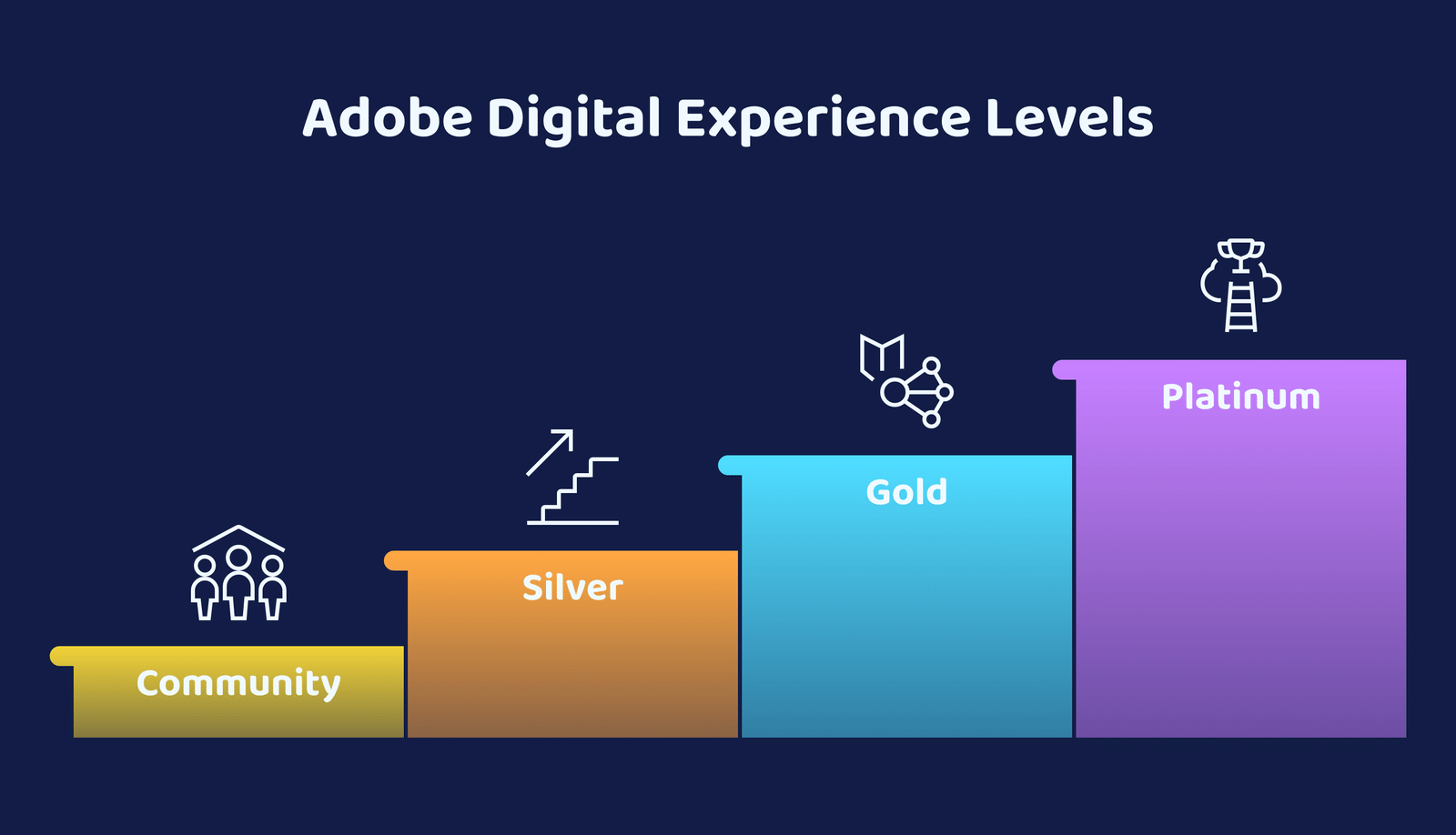
Short answer: To become an Adobe partner on the Digital Experience side, you join the Adobe Digital Experience Partner Program, newly launched for 2026. It has two tracks, Solution and Technology, and four levels. Community is free. Silver, Gold and Platinum cost $3,000, $15,000 and $25,000 a year. Adobe pays incentives on sourced or co-sold deals and names preferred co-sellers on bookings. So the vendors who get noticed are the ones producing partner-sourced pipeline with other Adobe partners.
Looking for the Adobe partner portal login? Go to the Adobe Digital Experience partner portal.
Already in the program? Here’s how partners turn it into pipeline.
What is the Adobe partner program?
Adobe runs more than one partner program. The one most B2B vendors mean is the Adobe Digital Experience Partner Program. It covers the firms that build on, plug into and set up Adobe’s Digital Experience products. Notably, Adobe says it’s “newly launched for 2026.”
Resellers, however, are separate. Adobe software sold to end customers runs through the Adobe Partner Connection Reseller Program. Its North America guide, version 10.0, took effect November 1st, 2025.
So this page sticks to the Digital Experience program. That’s the one with deal registration, account mapping and intros to Adobe sellers.
What types of Adobe partners are there?
Adobe’s level requirements page defines two tracks. Here’s how the partner types break down as of November 8th, 2026:
| Partner type | Who it fits | Program | Levels |
|---|---|---|---|
| Solution track | Consultancies, systems integrators, agencies | Digital Experience Partner Program | Community, Silver, Gold, Platinum |
| Technology track | Software vendors, platform providers, data specialists | Digital Experience Partner Program | Community, Silver, Gold, Platinum |
| Resellers | Businesses that sell Adobe software to end customers | Partner Connection Reseller Program | Registered, Certified, Gold, Platinum |
One detail helps firms that do both. Adobe says a partner that works across both tracks can meet both sets of rules and get credit for both.
How much does the Adobe partner program cost?
Community is the entry level, with no program fee. After that, each paid level carries an annual fee, per Adobe’s level requirements page:
| Level | Annual fee | Who it’s for, per Adobe |
|---|---|---|
| Community | None listed | Entry-level access to foundational resources |
| Silver | $3,000 | Partners starting their Adobe partnership |
| Gold | $15,000 | Partners with proven Adobe skills |
| Platinum | $25,000 | Mature Adobe practices and top integrations |
Those fees are real money for a small vendor. So the question isn’t just which level you can reach. Rather, it’s which level pays for itself.
How do Adobe partner levels work?
Each track has its own rules. In both cases, the bar rises with each paid level.
Solution track requirements
Solution partners are measured on three things:
- Certs your team has earned.
- Customer rollouts you’ve delivered.
- Specializations you hold.
The published Solution bars run from 30 to 100 certs and from 10 to 20 customer rollouts across the paid levels. Specializations run from one to five. Also, Adobe says specializations “are earned by region.” You earn them with certified staff and proven rollouts.
Technology track requirements
By contrast, tech partners are measured on what they’ve built:
- Tech integration credentials your team has earned.
- Customer rollouts of your integration.
- Listings on Adobe’s Exchange Marketplace.
- An App Assurance listing at the higher levels.
The published Technology bars are much lower: two to four credentials and two to three customer rollouts. In other words, a software vendor can climb on a handful of real customers.
What benefits do Adobe partners get?
Adobe’s benefits glossary spells out who gets what. Here are the perks that matter most for pipeline as of November 8th, 2026:
- Deal registration: all partners can register qualified deals in the Sales Center.
- Cash on deals: Silver, Gold and Platinum partners “are eligible to earn financial incentives for sourced or co-sold deals.”
- Exchange listing: Silver and up can list integrations. Gold and Platinum get a featured spot for three months.
- App Assurance listings: Gold gets two. Platinum gets unlimited.
- Sales support: Silver and up get help with deal submission and intros to Adobe sellers.
- Exam vouchers: 5 at Silver, 15 at Gold and 25 at Platinum, plus a 33% exam discount from Silver up.
- Partner directory listing: one at Silver and Gold, multiple subsidiaries at Platinum.
Adobe maps accounts on Crossbeam
One perk stands out. Adobe says Gold and Platinum partners “can request to connect with Adobe on Crossbeam.” Partners who can’t use Crossbeam can submit customer lists as CSVs instead. Per Adobe, its reps use that data “to surface co-sell opportunities and prioritize partner engagement.”
That tells you what Adobe values. It wants partners who show up with shared accounts, not just a listing.
How do you become a preferred co-seller?
Adobe also names preferred co-sellers. Per the glossary, it’s for partners with “consistent success in selling jointly with Adobe.” The bar depends on the market:
- Mature markets, such as the US, UK and Germany: $200K in bookings or four closed deals in a product category over a rolling 12 months.
- Emerging markets, such as LATAM, India and Southeast Asia: $100K or four deals.
- Staffing, everywhere: at least two sales-accredited people in that product category.
Preferred co-seller status shows up in Adobe’s partner directory. Adobe says it helps its reps and buyers find top partners.
How does an Adobe partner get Adobe’s attention?
Look at what Adobe actually rewards. First, incentives pay out on sourced or co-sold deals. Next, preferred co-seller status counts bookings and closed deals. And Adobe’s reps use Crossbeam data to find co-sell openings. In short, Adobe rewards partners who bring Adobe business.
That’s the opening for technology vendors. An Exchange listing puts you on a shelf. By contrast, closed deals with Adobe put you in front of its field team.
What I learned selling into Adobe’s field
I know this world from both sides. I sold Marketo as an enterprise AE and stayed through Adobe’s acquisition. On the Adobe side, I worked with SIs and tech partners to get things done. Then I switched to the SI side and co-sold the reverse way. We doubled revenue and flipped the company. I had 40+ enterprise AEs at Adobe pushing our work.
So here’s what I’d tell a vendor today:
- Pick a partner with real credibility inside Adobe. A Gold or boutique partner with the right expertise can move faster than waiting on a Platinum firm.
- Prove value with Adobe customers first. Then take that proof to Adobe’s sales team, not the other way around.
- Don’t chase every partner at once. Start with one, get it producing, then add the next.
Why partner-sourced pipeline beats going it alone
Think about who already holds the buyer’s trust. For example, an Adobe solution partner runs the marketing team’s Adobe rollout. Meanwhile, a tech vendor has the add-on that makes that rollout pay off. And neither one gets far calling cold.
As a pair, though, they have a reason to call the same accounts. That’s partner-sourced pipeline: deals that start because a partner opened the door. Here’s how partner-sourced and partner-influenced pipeline differ, if the terms are new.
But there’s a catch. If your own SDR team books the meeting, it isn’t partner-sourced. Run it with the partner, and it counts. Credit still follows Adobe’s rules, so register every deal in the Sales Center.
Start with the accounts, not the pitch
A lot of partner meetings burn the first ten minutes clicking through overlap data live. Instead, set an agenda of named accounts before the call. Then sort each one three ways:
- Ask: accounts where you want the partner’s intro.
- Give: accounts where you can hand the partner something.
- Mutual: accounts where you both have a reason to go in together.
Adobe already works on Crossbeam, so this is where account mapping turns into pipeline. Either way, the list comes first. Salesforce ISVs learn the same lesson. Listing on AgentExchange isn’t the business either.
What does a partner GTM motion in the Adobe ecosystem look like?
A partner go-to-market (GTM) motion is one campaign, run with one partner, into accounts you both care about. Here’s how we run one in the Adobe ecosystem:
- Pick the partner. Pair a tech vendor with a solution partner that runs Adobe rollouts, an agency, another technology partner, and the list goes on.
- Agree on the accounts. Overlap your lists and choose accounts where both of you belong in the room.
- Write one joint story. Answer one question: why these two firms, for this marketing team, right now?
- Run the outreach. Email, LinkedIn and cold calls go out under the partner relationship. A real human SDR makes the calls, not AI. Where it fits, add a field event or an in-person meeting.
- Hand off the meetings. Booked meetings go to whoever owns the deal, with the partner’s context attached.
- Track every result. Count meetings, registered deals and closed bookings, so you have proof for Adobe’s partner team.
Each one-off motion is quoted on its own, so there’s no fixed price. As a rough guide, about $15K tends to be the average for a one-off motion with a part-time SDR making a limited number of calls. For scale, one full-time SDR makes about 1,000 cold calls a month. So a program running three to five motions either picks which ones get the calling or adds a second SDR. And any GTM motion could cost you $0 if partners pay for it. Our Produce My Pipeline program is the version that runs every quarter.
Partners often fund these motions too. Before you pay for one alone, it’s worth reading how market development funds work.
Frequently asked questions
How do I become an Adobe partner?
Pick the program that fits. Vendors, SIs and agencies join the Adobe Digital Experience Partner Program on the Technology or Solution track. Resellers join the Adobe Partner Connection Reseller Program.
Is the Adobe partner program free?
The Community level has no program fee. Silver costs $3,000 a year, Gold $15,000 and Platinum $25,000.
What are the Adobe partner levels?
The Digital Experience program has four: Community, Silver, Gold and Platinum. The reseller program uses Registered, Certified, Gold and Platinum.
Does Adobe use Crossbeam?
Yes. Adobe says Gold and Platinum partners can request to connect with Adobe on Crossbeam. Partners who can’t use Crossbeam can send customer lists as CSV files.
Do Adobe partners earn money on deals?
Yes, from Silver up. Adobe says those partners can earn incentives on sourced or co-sold deals they register in the Sales Center.
What is an Adobe preferred co-seller?
It’s a badge for partners who sell well with Adobe. In mature markets, the bar is $200K in bookings or four deals in a product category over 12 months, plus two sales-accredited staff.
Where do Adobe partners log in?
Digital Experience partners sign in to the Partner Experience Hub from partners.adobe.com/digitalexperience, once they get their welcome email. New users register from the same site.
The bottom line
The Adobe partner program charges real fees, so every level has to earn its keep. Certs and integrations keep you in the game. But sourced deals, co-sold deals and bookings decide what you get back. So don’t wait for Adobe to send you deals. Instead, go build pipeline with the partners who sell to the same marketing teams. That’s what gets a platform’s attention. If your agency also builds on WordPress, see the WP Engine partner program. For every other platform, use our directory of partner programs.
Forecastable is an independent third-party B2B partnerships agency. We are not affiliated with or endorsed by Adobe. Program details are drawn from Adobe’s public pages and are current as of November 8th, 2026.
Are you an Adobe technology or solution partner that wants more sourced and co-sold deals? We’ll show you which partners and accounts to start with. Book a Program-Fit Analysis.
Uncover Your Growth Potential
Schedule a Discovery Call