Alex Buckles
Running GTM Motions as Your Partner: Controlled Surround Sound

Short answer: Controlled surround sound means a target account hears your story from you and from the partners it trusts, in a planned order, without anyone getting buried in messages. We run GTM motions as you, as the partner, or as both at once, with different messages at different stages. Because outreach goes out in the partner’s name, the pipeline counts as partner-sourced. And because one team runs every send, nobody gets overcommunicated.
Why partners don’t run your GTM motions for you
Here’s the trap almost every partner team falls into. You build a great GTM motion with a partner. Then you have two ways to run it, and both break.
If you hand the motion to your internal SDR team, the partner team doesn’t get credit. If you hand it to your partners and expect them to do the right things, they usually don’t. So the motion either runs and gets attributed to the wrong team, or it never runs at all.
And you can’t see which one happened. With partners running it, you have no view into whether the motion went out. With SDRs running it, the work happens but the partner-sourced number never moves.
That’s why we run the operations ourselves. Our default position is that we run the motion. The partner team stays in the driver’s seat, and everybody can see what’s going out the door.
What controlled surround sound actually means
Surround sound is simple. A buyer hears about you from several directions at once: from you, from the integration partner they already use, from the services firm they trust. Each message reinforces the last.
The effect is real. When an account hears from three trusted parties in a few weeks, the buyer starts thinking, “I’m hearing a lot about this vendor. Maybe I should have a conversation.” No single email does that. The pattern does.
But uncontrolled surround sound is just noise. Picture a prospect getting four different offers in the same week, from the same person, about four different partners. That’s not a good look. So the word that matters is “controlled.”
The rules that keep it controlled
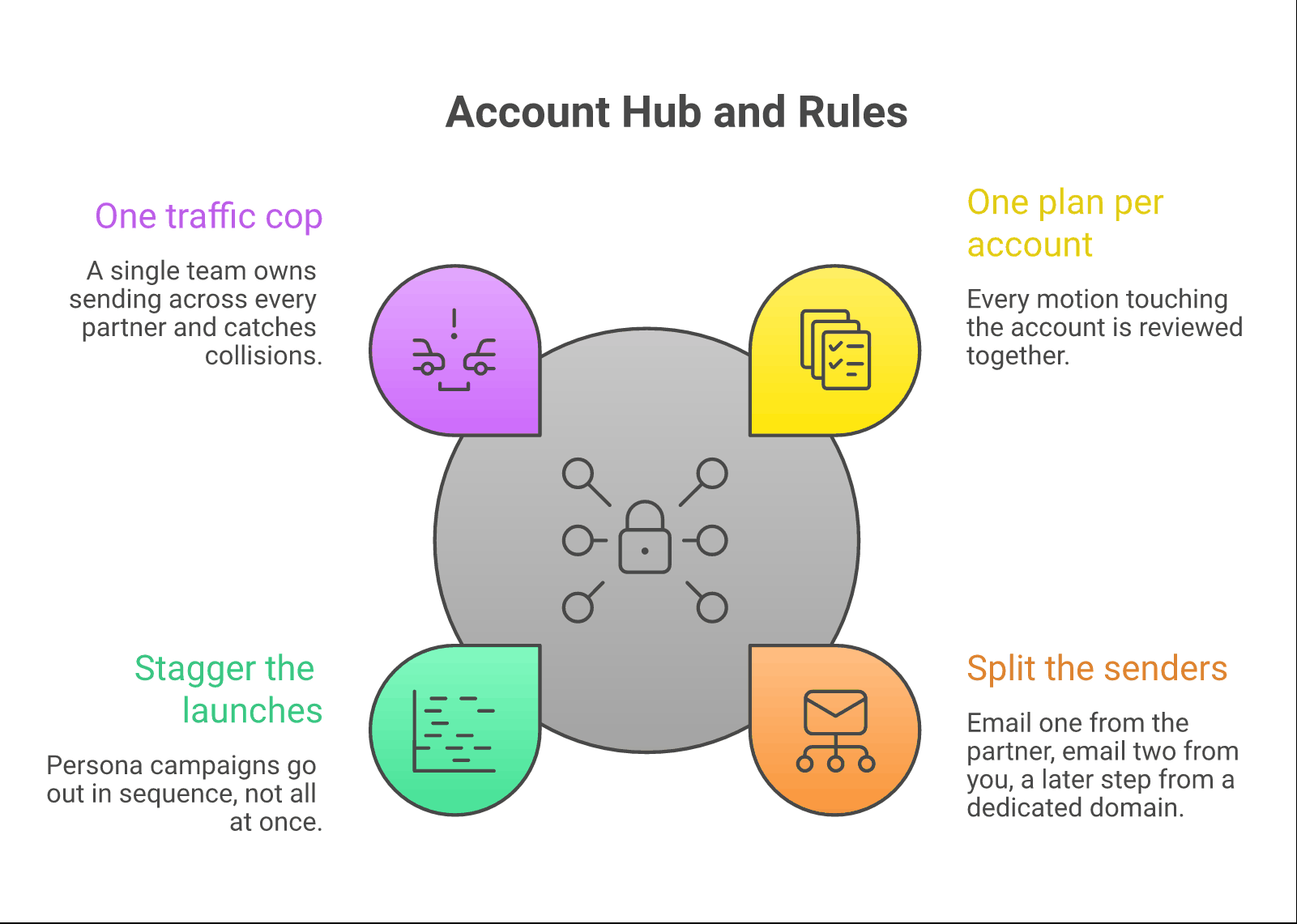
We hold every motion on an account to the same rules:
- One plan per account: Every motion touching the account is reviewed together, so no stakeholder hears too much from the same brand.
- Split the senders: Email one comes from the partner, email two from you, and a later step may come from a dedicated domain.
- Stagger the launches: Persona campaigns go out in sequence, not all at once, so the queue clears in order.
- One traffic cop: A single team owns sending across every partner, so collisions get caught before they reach the buyer.
Three ways to run a GTM motion
Every GTM motion we run has a sending identity decided while it’s built. There are three options.
Run it as you
Some motions belong in your own voice. We send from your domain, or from a rep’s own inbox with the rep’s approval, and replies route straight back to that rep. Your team keeps the relationship, and we keep the cadence moving.
Run it as the partner
This is where most partner-sourced pipeline comes from. We send email, LinkedIn messages and calls in the partner’s name. That can be an existing partner mailbox, a new mailbox on the partner’s domain run by a real named person, or a domain we buy and warm for the motion that redirects to the partner’s site.
It all counts as partner-sourced, because it’s sent from the partner’s domain or a domain we bought for the motion. Everybody gets pipeline, attribution is clear, and we don’t have to touch anybody’s systems.
Run it as both
The strongest motions use both voices at different stages. The partner opens the door with its own point of view. Then you follow with the product story. Later, a joint event or webinar invitation gives the buyer a reason to show up with both companies in the room.
So the buyer hears the story from multiple parties. But each touch has a job, and the order is planned.
Prospect communications and partner engagement
Surround sound has two audiences, and most programs only think about one.
The first is prospects. That’s the outbound sequence, the calls, the event invitations and the LinkedIn touches into target accounts.
The second is your partners’ own people. Their sellers need to know which accounts matter, which motion is running and what to say if a buyer brings it up. Across dozens or hundreds of partners, that’s impossible to do by hand. So we run partner engagement the same way we run prospect communications: planned, sequenced and tracked.
That second audience is where scale comes from. A partner rep who knows the motion is running will mention it on a call you’d never be invited to.
Where calls and events fit
Email alone isn’t surround sound. Buyers also need to hear a voice and see a face.
Calls in the partner’s name
Most people don’t call in partnerships, which is exactly why calling stands out. We staff every engagement with an SDR, and our SDRs make calls on the partner’s behalf by default. The partner’s own team calls only when a step needs expertise we can’t train on. And when they do, they call through our tech stack, so every call is still tracked.
Events with both brands in the room
Joint events turn surround sound into a conversation. A happy hour, a dinner or a webinar gives the buyer a low-pressure reason to meet both companies. We run them end to end, from the joint invite list to registration and follow-up, and partners can co-fund them.
Why controlled surround sound needs partner data
You can’t run surround sound across dozens of partners without knowing which partners touch which accounts. That’s what partner data is for.
So every motion we run starts with Crossbeam overlap data. It shows which partners share customers and open opportunities with you. Crossbeam lays out the idea well in turning ecosystem data into pipeline faster. Then the Crossbeam MCP lets AI work with that data directly, so motions can be matched to the right accounts and partners far faster than a person scanning lists. Crossbeam’s own team has written about multi-partner selling in the AI era, and the direction is the same: more partners per deal, coordinated.
The one rule that makes it partner-sourced
We don’t approve a motion until we have a reliable way to pull in the results automatically. That means sends, replies, meetings and opportunities, flowing back into your CRM.
If we’re running it, everybody knows what’s happening and what’s coming in the door. Attribution is never a question. Partners can join as collaborators and see their motion’s activity and results in real time, with only the visibility you choose to share.
How Forecastable runs controlled surround sound
At Forecastable, we deliver partner-sourced pipeline as a service. We build your partner program and run it with you or for you. We act like an SDR agency and a marketing agency combined, with partner data at the center. And we’re measured on pipeline and revenue.
There’s no new tech to buy and no seats. You don’t need a PRM. Co-sell automation is included in every program, and it runs on your Crossbeam data and the AI tools you already own. Partners can fund or co-fund motions through MDF, so the program can cost you $0. See how it works on our Produce My Pipeline page.
FAQ
What is surround sound in partner marketing?
Surround sound is when a target account hears your story from you and from its trusted partners in a coordinated way. Controlled surround sound adds one plan and one sending team, so no buyer gets overcommunicated.
Can you send outreach in a partner’s name?
Yes, with the partner’s agreement. We send from an existing partner mailbox, a new mailbox on the partner’s domain run by a real person, or a domain we buy and warm for the motion.
Does outreach sent in the partner’s name count as partner-sourced?
Yes. When the motion runs in the partner’s name and an opportunity is created from it, the pipeline is partner-sourced. That’s the point of running it as the partner.
How do you avoid overcommunicating to the same account?
Every motion on an account is planned together. Senders are split, launches are staggered and one team runs all sending.
How many partners can run surround sound at once?
There’s no hard limit. We run partner engagement across dozens or hundreds of partners, because the plan and the sending live in one place.
The bottom line
Surround sound works because buyers trust a story they hear from more than one place. Control is what keeps it from turning into spam. Pick one motion, decide its sending identity, and let your partners’ names open doors your own brand can’t.
Book a Program Fit Analysis to see which GTM motions you could run as your partners →
Related reading:
Uncover Your Growth Potential
Schedule a Discovery Call