Co-Sell Pipeline: Deals Two Companies Close Together

Short answer
Short answer: Co-sell pipeline is the set of opportunities two companies actively work together, each bringing its own relationship, product, and credibility into the same deal. It is built when partners agree not just to refer but to sell side by side, and it converts higher than solo pipeline because the buyer hears a case for value from two trusted sides at once.
Here is the position. Co-sell is not a referral and it is not a logo swap. It is two sales teams running one deal, and the pipeline only shows up when the operating details, who calls whom and who gets credit, are settled in advance.
What is co-sell pipeline?
Co-sell pipeline is opportunity created and advanced through a joint selling motion, where a partner and your own team work an account together toward a shared outcome. The partner might own the customer relationship, a complementary product, or the cloud marketplace the buyer purchases through, and the two companies coordinate their sellers rather than handing a lead across and walking away.
The distinction that matters is depth. A referral ends when the introduction is made. A co-sell continues through the whole deal: joint discovery, a shared account plan, coordinated meetings, and an agreed split of the work. That depth is why co-sell pipeline converts better and also why it is harder to run, because it requires two companies to operate as one on a single opportunity.
Why co-sell pipeline matters in 2026
Co-sell pipeline matters because buyers increasingly purchase solutions, not products, and a solution usually spans more than one vendor. When the buyer wants an outcome that takes your product plus a partner’s, the companies that sell it together win, and the ones that sell alone lose to the coordinated pair. Co-sell is how you show up as the solution rather than a piece of it.
The second driver is the cloud marketplaces and partner programs that now route real budget through co-sell. Selling alongside a hyperscaler or a strategic platform partner can unlock funding, procurement speed, and access that a solo motion never reaches. The pipeline is there for teams organized to co-sell and invisible to teams that are not.
In my work with revenue teams, the difference between co-sell that produces pipeline and co-sell that produces meetings and nothing else is always operational: the winning teams settle who owns what in the deal before the first joint call, and the losing teams improvise it live and confuse the buyer.
How co-sell pipeline actually works
Co-sell pipeline works when two companies run a shared operating motion on an account, where each step keeps both sellers aligned and the buyer facing one coherent case.
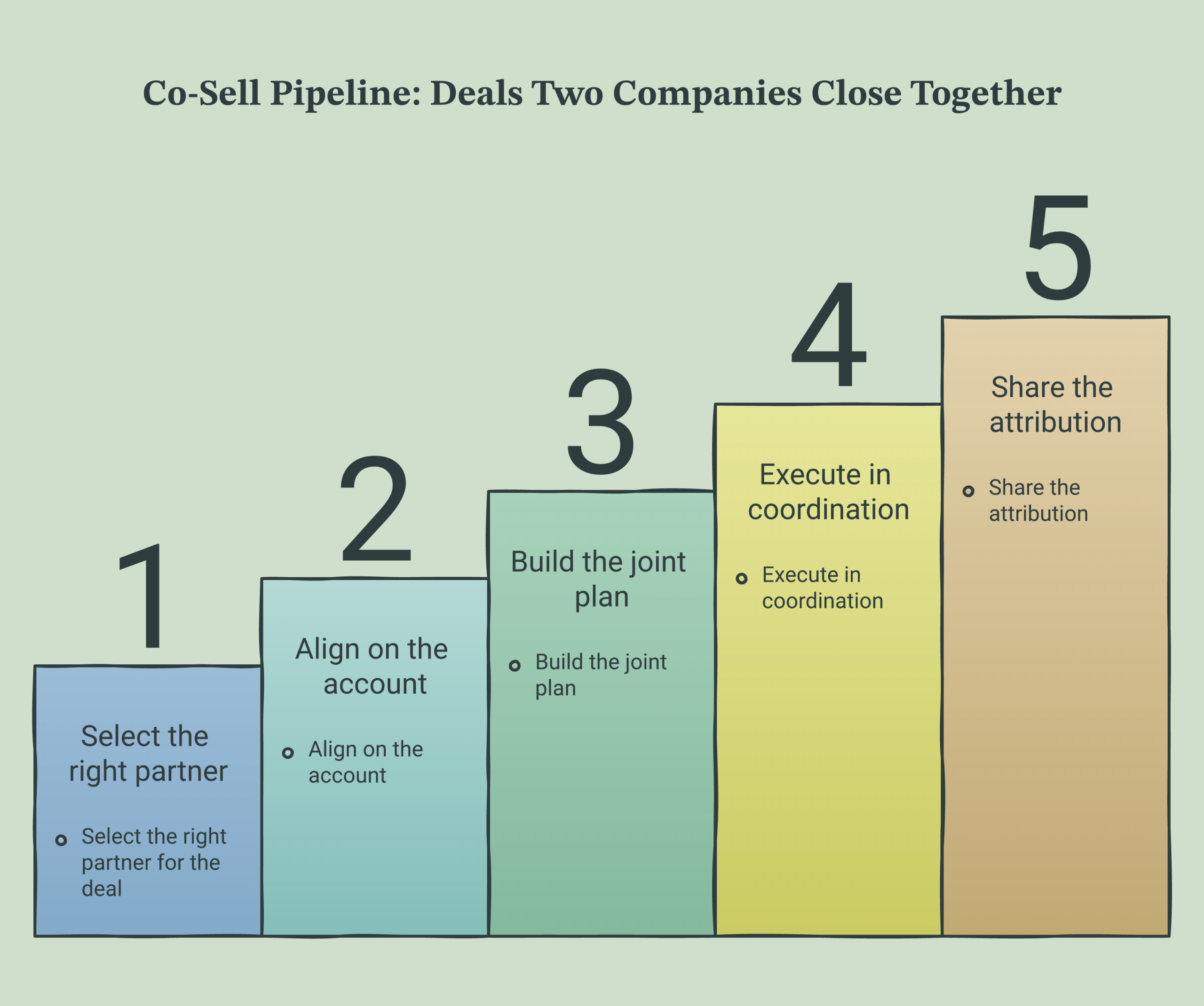
- Select the right partner for the deal: match the partner to the specific account and outcome, because co-sell only works when the partner brings a relationship, a product, or a buying path this deal actually needs, not just a logo on a slide.
- Align on the account: confirm both companies are targeting the same buyer and outcome, since a co-sell where the two sellers have different ideas of the deal produces a confused buyer and a stalled opportunity.
- Build the joint plan: agree who runs discovery, who leads which meeting, and how the two products fit the buyer’s outcome, because the plan is what turns two sellers into one motion instead of two competing pitches.
- Execute in coordination: run the deal with both sellers in the room on the key moments, as the trust and completeness of a true co-sell only reaches the buyer when the companies show up together rather than taking turns.
- Share the attribution: credit both sides and tag the opportunity as co-sell, because if the deal is logged as one company’s solo win, the partner stops showing up and the next co-sell never happens.
The through-line is that co-sell pipeline is an operating agreement, not a relationship. The partner selection and account alignment decide whether there is a deal, the joint plan and coordinated execution decide whether it converts, and the shared attribution decides whether the partner ever co-sells with you again.
Common pitfalls
- Co-sell theater: announcing a partnership and swapping logos without a single jointly worked deal, which produces press and no pipeline.
- Referral mistaken for co-sell: making the introduction and then selling solo, so the partner’s credibility is spent at the door and never carried through the deal.
- No operating agreement: entering joint deals without settling who owns what, so the two sellers improvise, contradict each other, and lose the buyer’s confidence.
- One-sided credit: logging the co-sell as a solo win, which quietly tells the partner their effort does not count and ends the motion.
- Measuring co-sell as ordinary pipeline: tracking joint deals with no co-sell tag, so the channel cannot be evaluated and co-sell keeps competing with solo pipeline for attention it can never win on the data.
What this looks like in practice
Two AEs, one from each company, and a partner manager sit down over a shared account that both companies touch. They agree the buyer wants an outcome that needs both products, so they build a joint plan: the partner, who owns the existing relationship, leads the first meeting and frames the problem, the company’s AE leads the technical validation, and they close together. They tag the opportunity as co-sell on both sides. The deal, which neither company could have won alone because each had only half the solution, closes in one cycle.
The counterexample is the same account run as co-sell theater: a joint press release, two sellers who never coordinate, and a buyer who gets two overlapping pitches and picks neither. The relationship was identical. The operating discipline was not, and that is the entire difference between co-sell pipeline and co-sell noise.
Forecastable’s POV
Co-sell is the most valuable partner motion and the easiest to fake. Companies announce co-sell relationships constantly and run co-sell deals rarely, because the announcement is a marketing act and the deal is an operating one. The pipeline shows up only when two sales teams accept the discipline of running one motion, and that discipline is what most co-sell programs never build.
The measurement problem compounds it. When a co-sell deal is logged as a solo win, the partner’s contribution disappears, the partner loses the incentive to co-sell again, and the whole channel decays. Co-sell pipeline has to be tagged and credited to both sides, or it cannot sustain itself. At Forecastable we are a partnerships operating platform that connects partner conversations and actions to CRM pipeline and revenue, so co-sell deals are tracked as joint work from the first aligned meeting through to shared credit at close.
My bet: the teams that run co-sell as an operating agreement with shared attribution, not as a logo partnership, are the ones whose joint pipeline actually converts and keeps renewing.
Forecastable is an independent third-party. Any tools, vendors, or third-party figures referenced here are described from public information for the reader’s own evaluation, not as paid placements.
Frequently asked questions
What is co-sell pipeline? It is the opportunities two companies work together, each contributing its relationship, product, or buying path to the same deal. It differs from a referral because both teams stay engaged through the whole deal rather than handing a lead across and disengaging.
How is co-sell different from a referral? A referral ends at the introduction; a co-sell continues through joint discovery, a shared plan, coordinated meetings, and shared credit at close. Co-sell converts higher because the partner’s credibility carries through the deal instead of being spent at the door.
What makes co-sell pipeline convert well? The buyer hears a coherent case for value from two trusted sides and sees a complete solution rather than a single product. That combination shortens the cycle and raises the win rate, provided the two sellers coordinate rather than deliver competing pitches.
Why do co-sell programs fail? Usually because they are relationships without operating discipline: logos are swapped, deals are not jointly planned, and credit goes to one side. Without a settled agreement on who owns what and shared attribution, co-sell produces announcements and no pipeline.
How do you measure co-sell pipeline? Tag joint opportunities as co-sell and credit both companies, then track conversion and cycle time against solo pipeline in the same system. Shared attribution is what keeps partners engaged and lets you evaluate the channel honestly.
Who should own co-sell pipeline internally? It is jointly owned by partnerships and sales, with partnerships sourcing and aligning the partner and sales running the deal. The operating agreement that makes co-sell work lives at that seam, which is why it needs a shared system rather than two separate ones.
Next step
Pick one open deal where a partner holds something you do not, and run it as a real co-sell: a joint plan, coordinated meetings, and a co-sell tag on both sides. Measure its conversion against your solo deals.
If joint deals convert better and your CRM keeps logging them as solo wins, that is the gap we close. Start your growth journey with Forecastable and we will track co-sell as joint work through to shared credit. Our co-sell strategy guide covers the motion in depth, and the partner attribution guide covers crediting both sides.
Uncover Your Growth Potential
Schedule a Discovery Call