Alliance Manager Job Description: Role and Duties

What is an alliance manager job description?
Short answer: An alliance manager job description defines the role that owns a company’s strategic partnerships end to end, from the joint business plan to the co-sell pipeline to the revenue the partnership produces. It sets the scope, the responsibilities, and the way the role is measured, and it matters because a vague version hires a relationship manager who keeps partners happy, while a sharp one hires an operator who makes partners produce.
The core distinction is that an alliance manager owns fewer, deeper relationships than a channel manager, usually large strategic partners, and is accountable for the revenue those specific partnerships generate.
The useful question is not what to list as duties, it is what you will hold the person accountable for, because the accountability, not the duty list, is what actually shapes who you hire and how they behave.
Why the alliance manager job description matters in 2026
The reason the job description matters in 2026 is that alliances are being held to revenue, and the wrong description hires for the wrong outcome. If the role reads as relationship maintenance, you attract candidates who are good at meetings and rapport and weak at driving pipeline, and then you are surprised when the alliance produces goodwill instead of deals. The description is the first filter, and a soft one lets the wrong profile through.
That matters more now because strategic partnerships are expensive to staff and slow to pay off, so a mis-hire costs a year. A clear description that names revenue accountability, co-sell execution, and internal selling as the job filters for operators who can actually move a partnership from signed to producing. A description heavy on relationship language and light on outcomes filters for the opposite.
The reframe is that the job description is a hiring and management tool, not a formality. It should tell a strong candidate exactly what success looks like and tell a weak one that this is not a relationship-babysitting role. If the description could describe an account manager at any company, it is not doing its job.
How to write an alliance manager job description that works
A strong alliance manager job description works by naming the mission, the specific responsibilities, the way the role is measured, and the profile that fits, in terms concrete enough to filter candidates. The discipline is writing for accountability and outcomes, not a generic duty list. The parts below are the model to build.
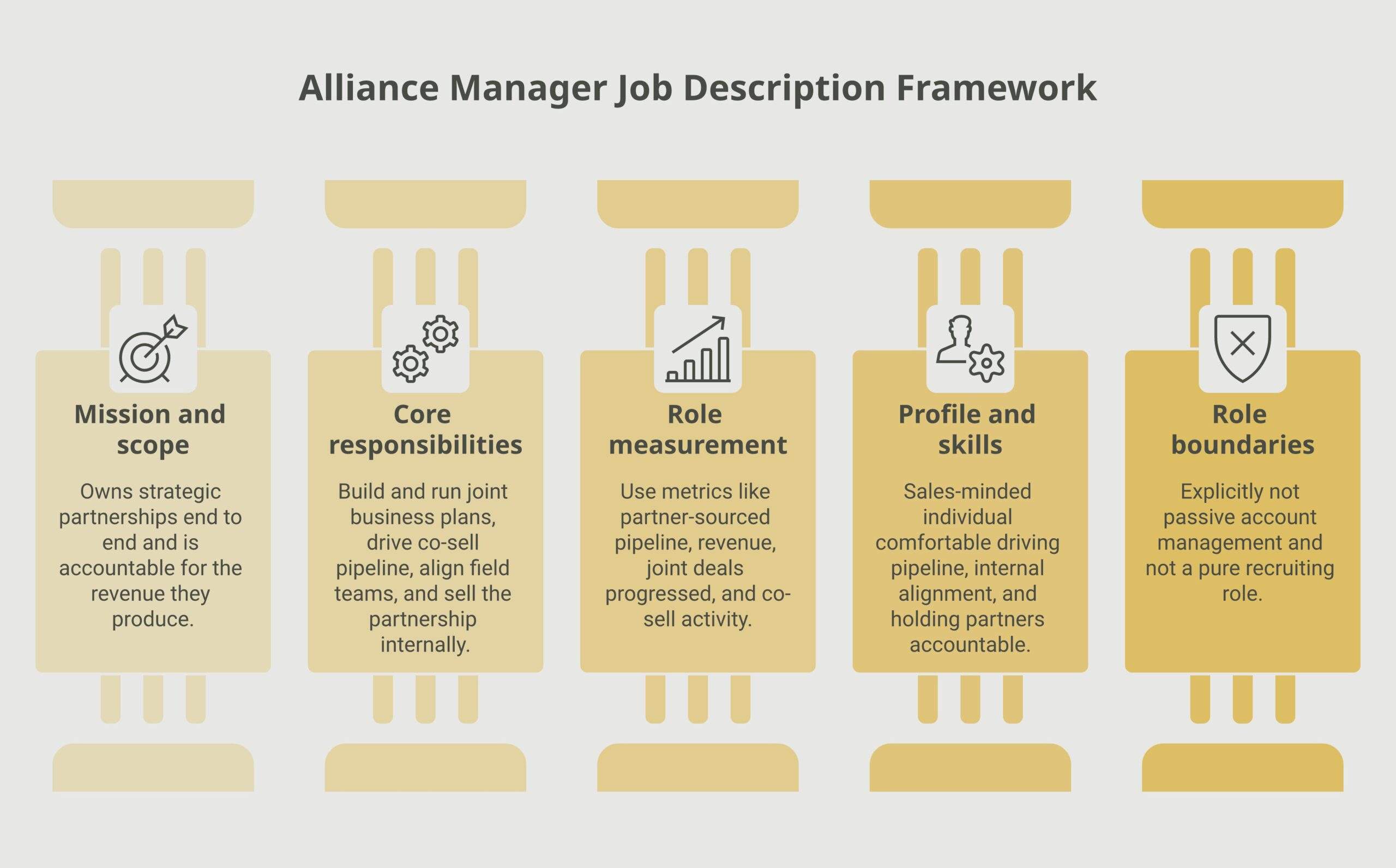
- Mission and scope: State that the role owns a set of strategic partnerships end to end and is accountable for the revenue they produce, and name roughly how many and what kind. Scope is what separates an alliance manager from a channel manager who owns many transactional partners.
- Core responsibilities: List the real work: build and run the joint business plan, drive co-sell pipeline with the partner, align both companies’ field teams, and sell the partnership internally. Concrete responsibilities filter for operators over relationship keepers.
- How the role is measured: Name the metrics, such as partner-sourced and partner-influenced pipeline and revenue, joint deals progressed, and co-sell activity, not soft measures like relationship health alone. The metrics are what a serious candidate reads first.
- Required profile and skills: Describe the person: sales-minded, comfortable driving pipeline and running internal alignment, able to hold a partner accountable and to sell the partnership to their own leadership. This is where you screen out pure relationship managers.
- What the role is not: Make explicit that this is not passive account management and not a pure recruiting role. Saying what the job is not is often the fastest way to stop the wrong candidates from applying and the wrong hiring managers from miscalibrating.
Common pitfalls in an alliance manager job description
- Writing pure relationship language: A description built on rapport, communication, and stakeholder management with no revenue accountability hires a relationship keeper. If the outcomes are missing, you attract people who are strong at the parts that do not drive pipeline.
- Confusing it with a channel manager role: Alliance managers own fewer, deeper strategic partnerships; channel managers run many transactional partners. Blurring the two produces a description that fits neither and a hire who is set up to fail at whichever the job actually needed.
- No named metrics: A description that never states how the role is measured leaves both the candidate and the future manager guessing. Without metrics, the role drifts toward activity, and reviews become arguments about what success even was.
- Overloading the duty list: A description that lists twenty responsibilities signals that the company has not decided what the role is for. Name the few that matter, because a focused role is easier to hire for and to hold accountable.
- Ignoring internal selling: Alliance managers spend much of their time getting their own field team to work the partnership. A description that omits internal selling misses one of the hardest and most important parts of the job, and hires someone who cannot do it.
What this looks like in practice
A company kept hiring alliance managers who were warm, well-liked, and produced almost no pipeline, then blamed the individuals. The real problem was the job description, which read like an account management role: build relationships, be the point of contact, ensure partner satisfaction, with no mention of revenue or co-sell. It attracted exactly the profile it described.
The team rewrote it. The mission named ownership of three to five strategic partnerships and accountability for the partner-sourced pipeline they generated. The responsibilities led with building the joint business plan and driving co-sell, and explicitly included selling the partnership to the internal field team. The measurement section named partner-influenced pipeline and joint deals progressed. A short “what this role is not” section ruled out passive account management. The next hire came in sales-minded, treated the partnerships like a pipeline to build rather than relationships to maintain, and the alliances started producing. Nothing about the candidates had changed; the description had started screening for the right person.
Forecastable’s POV on the alliance manager job description
Our position is that most alliance manager job descriptions hire for the wrong job. They read like account management with a partnerships label, and they attract people who are excellent at keeping partners happy and mediocre at making them produce. The fix is not more duties; it is accountability. A description that names revenue as the outcome, co-sell as the work, and internal selling as a core skill filters for operators, and the operators are who turn a signed alliance into pipeline.
That is the frame we would apply to any partnerships role. Write the description backward from the outcome you will hold the person to, make the metrics explicit, and be willing to say what the role is not. The best alliance managers are closer to a sales leader who happens to sell through partners than to a relationship manager who happens to carry a number, and the job description should make that unmistakable before a single candidate applies.
Hiring is the front of a program that has to be measured end to end. Forecastable is a partnerships operating platform that connects partner conversations and actions to CRM pipeline and revenue, the flywheel of Conversations to Actions to Pipeline to Revenue, so an alliance manager’s work can be tied to the pipeline it produces. That connection is what lets you hold the role to the accountability the job description promised.
Any third-party tools, firms, or benchmarks referenced here are independent and mentioned for context, not as endorsements. Adapt any role description to your own program, partner mix, and stage before hiring against it.
Frequently asked questions
What does an alliance manager do? An alliance manager owns a small set of strategic partnerships end to end, building the joint business plan, driving co-sell pipeline with the partner, aligning both field teams, and selling the partnership internally. The role is accountable for the revenue those partnerships produce, not just their health.
How is an alliance manager different from a channel manager? An alliance manager owns fewer, deeper strategic partnerships and is measured on the revenue they generate. A channel manager typically runs many transactional partners such as resellers. The scope and the depth of each relationship are the main differences, and the job description should make which one you are hiring for clear.
What should an alliance manager job description include? A mission that names revenue accountability and scope, concrete responsibilities led by joint planning and co-sell, explicit metrics such as partner-sourced and partner-influenced pipeline, a sales-minded required profile, and a short statement of what the role is not. Those elements filter for operators over relationship keepers.
How should an alliance manager be measured? On partner-sourced and partner-influenced pipeline and revenue, joint deals progressed, and co-sell activity with their partners, rather than on relationship health alone. Naming the metrics in the description tells serious candidates what success looks like and keeps future reviews grounded.
What skills matter most for an alliance manager? Sales instincts, the ability to drive and forecast pipeline, and the skill of internal selling, getting their own field team to actually work the partnership. Rapport matters, but on its own it produces goodwill rather than revenue, which is why the profile has to lead with the operator skills.
What is the biggest mistake in these job descriptions? Writing them as account management roles built on relationship language with no revenue accountability. That attracts candidates who are strong at the parts that do not drive pipeline, and it sets up the hire and the program to underperform.
Next step
If your alliance managers are well-liked and produce little pipeline, the problem may be the job description hiring for relationships instead of revenue. Write it backward from the outcome, name the metrics, and say what the role is not. Start your growth journey now to build a partner motion where every role is tied to the pipeline it produces. The partner program hub frames how the roles fit the broader program.
Uncover Your Growth Potential
Schedule a Discovery Call