Partnership Job Titles: A Guide to the Roles

What are partnership job titles?
Short answer: Partnership job titles are the labels for the roles that build and run a company’s partner program, from a partner manager who owns day-to-day relationships up to a Chief Partner Officer who owns the strategy and the number. They exist to signal scope and seniority, and the catch is that the same title means very different things at different companies, so the title alone tells you less than the responsibilities behind it.
Titles in partnerships are unusually inconsistent. A “partnerships manager” at one company runs a few strategic alliances; at another it manages a hundred resellers. The label is a starting point, not a definition.
The useful question is not which title to use, it is what the role is actually accountable for, because in partnerships the responsibility behind the title varies far more than the title itself.
Why partnership job titles matter in 2026
The reason partnership job titles matter in 2026 is that partnerships is professionalizing, and unclear titles cause real problems in hiring, leveling, and pay. When a company cannot say precisely what a “partner manager” owns versus a “director of partnerships,” it hires the wrong level, sets the wrong comp, and creates confusion about who is accountable for what. As the function grows, that ambiguity gets expensive.
That matters more now because more companies are building senior partnerships leadership, and the Chief Partner Officer title is growing fast as ecosystems become a primary revenue channel. A clear ladder from individual contributor to executive lets a company hire deliberately, level fairly, and give people a path. A muddled one makes every partnership hire a negotiation over what the title even means.
The reframe is that a title is a promise about scope and accountability, and it only helps if the promise is defined. The value is not the label; it is the shared understanding of what the person owns. A company that maps its partnership titles to real responsibilities hires and levels cleanly; one that borrows titles without defining them imports the confusion.
How partnership job titles actually map to roles
Partnership job titles map to roles along two axes: seniority, from individual contributor to executive, and focus, such as channel, alliances, business development, or partner operations. Understanding both is how you read a title correctly. The parts below are the common roles and what they typically own.
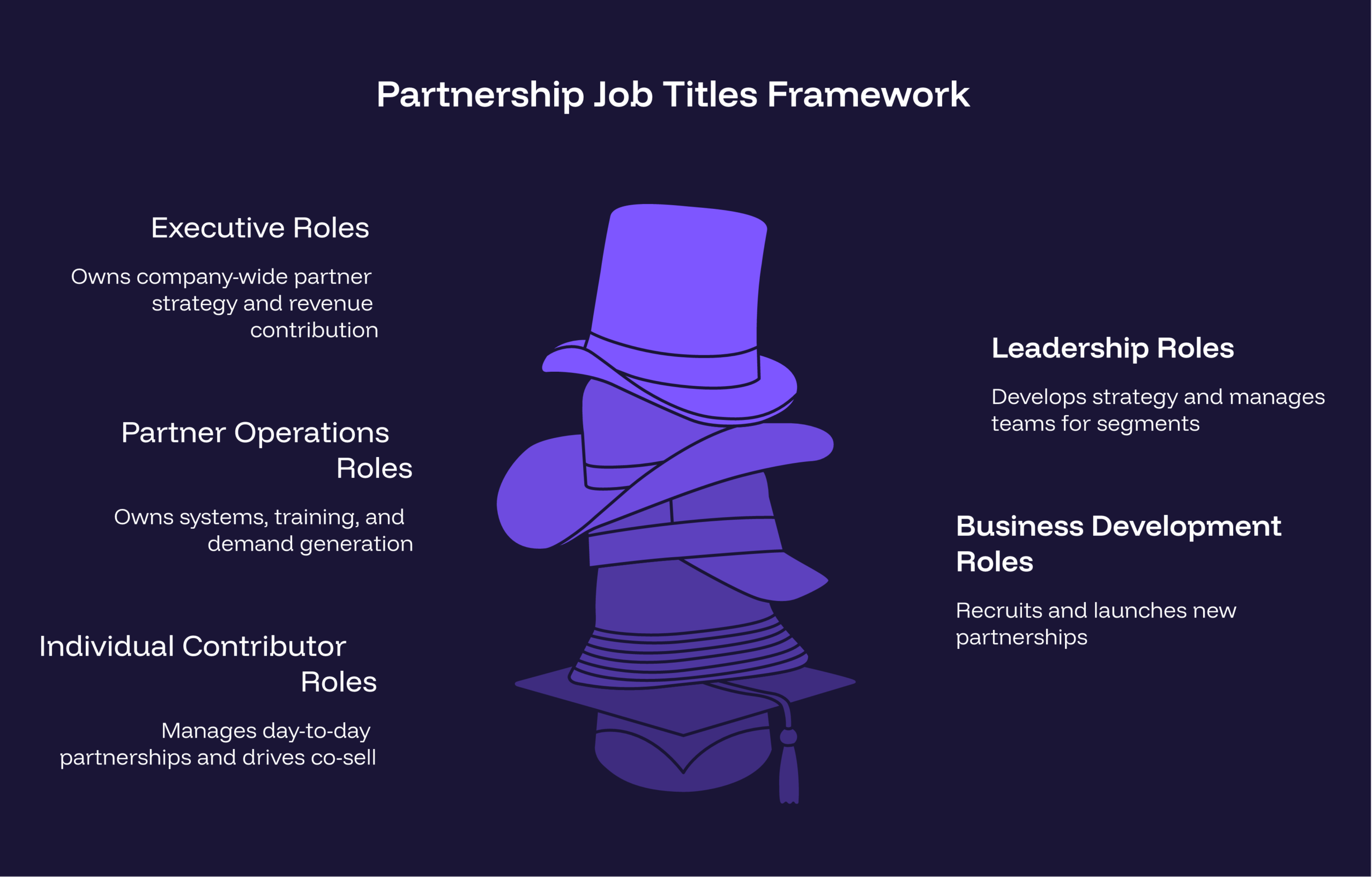
- Individual contributor roles: Partner manager, channel manager, and alliance manager own the day-to-day of specific partnerships, driving co-sell and pipeline. The focus word matters: channel managers run many transactional partners, alliance managers own a few strategic ones, and partner managers vary by company.
- Business development and partner-specific roles: Partner development managers and business development roles focus on recruiting and launching new partnerships rather than running existing ones. The distinction between building partnerships and running them is often where titles blur.
- Partner operations and enablement roles: Partner operations, partner enablement, and partner marketing titles own the systems, training, and demand behind the program rather than individual relationships. As programs scale, these roles become essential and their titles proliferate.
- Leadership roles: Director and VP of partnerships own strategy and teams for a segment or the whole function, accountable for the partner number. The step from IC to leader is a real change in scope, from owning relationships to owning outcomes and people.
- Executive roles: The Chief Partner Officer, or a head of partnerships at the executive level, owns the partner strategy company-wide and its contribution to revenue. This title has grown quickly as partnerships becomes a primary channel, and it signals partnerships has a seat at the top table.
Common pitfalls with partnership job titles
- Assuming a title means the same everywhere: The biggest trap is reading a title literally across companies. A “partnerships manager” can be a junior relationship owner or a senior alliance operator depending on the company, so always check the responsibilities behind the label.
- Inflating titles to attract candidates: Handing out director or VP titles to hire faster distorts leveling and creates problems later when the scope does not match the title. Title inflation is a short-term win and a long-term mess.
- Blurring channel and alliance roles: Channel and alliance work are different, many transactional partners versus a few strategic ones. Using the titles interchangeably hires the wrong profile for the motion and confuses accountability.
- Ignoring the operations roles: Focusing only on relationship-owning titles and neglecting partner operations, enablement, and marketing leaves the program without the systems and demand it needs to scale. The support roles matter as much as the front-line ones.
- No leveling framework: Without a defined ladder from IC to executive, every hire and promotion becomes an ad hoc negotiation. A leveling framework tied to responsibilities is what makes titles fair and comparable.
What this looks like in practice
A company scaling its partner program had a “partnerships manager,” a “partner lead,” a “head of alliances,” and a “partnerships director,” and no one could say how they ranked or differed. Two of them thought they owned the same partners, comp was inconsistent, and a strong candidate turned down an offer because the title seemed junior relative to the scope described. The titles had grown organically and defined nothing.
The team built a simple ladder. It defined each level by responsibility: ICs owning relationships and pipeline, a leadership tier owning strategy and the number for a segment, and a single executive owner of the function. It matched the focus words to the motion, using channel manager for the reseller side and alliance manager for the strategic side, and named the partner operations and enablement roles explicitly. With the ladder in place, hiring got faster because the level and scope were clear, comp lined up with responsibility, and internal confusion about who owned what mostly disappeared. The fix was not renaming everyone; it was tying each title to a defined scope.
Forecastable’s POV on partnership job titles
Our position is that in partnerships the title is nearly meaningless without the responsibilities attached, and treating the label as if it were self-explanatory causes most of the hiring and leveling pain. The function borrowed its titles from sales and business development without standardizing them, so a title carries a rough hint of seniority and a lot of ambiguity about scope. The companies that hire and level well are the ones that define what each title owns, not the ones that pick fashionable labels.
That is the frame we would apply to building a partnerships org. Start from the responsibilities and the motion, then attach titles that signal the right scope and seniority, and build a leveling framework so the titles are comparable and fair. Match the focus word to the work, keep the operations and enablement roles visible, and resist title inflation. The growth of the Chief Partner Officer title is a good sign that partnerships is being taken seriously; the goal is to make every title below it just as well defined.
Clear roles are the front of a program that has to be measured end to end. Forecastable is a partnerships operating platform that connects partner conversations and actions to CRM pipeline and revenue, the flywheel of Conversations to Actions to Pipeline to Revenue, so whatever the title, the role’s work can be tied to the pipeline it produces. That connection is what makes a title accountable rather than decorative.
Any third-party tools, firms, or benchmarks referenced here are independent and mentioned for context, not as endorsements. Adapt any titling or leveling framework to your own program and stage before adopting it.
Frequently asked questions
What are the common partnership job titles? They range from individual contributor roles such as partner manager, channel manager, and alliance manager, through partner operations, enablement, and marketing roles, up through director and VP of partnerships, to the executive Chief Partner Officer. Each signals a scope and seniority, though the specifics vary by company.
What is the difference between a channel manager and an alliance manager? A channel manager typically runs many transactional partners such as resellers, while an alliance manager owns a few deep strategic partnerships and is accountable for their revenue. The focus of the role differs, so the titles should not be used interchangeably even though both sit at the IC level.
What does a Chief Partner Officer do? A Chief Partner Officer owns the company-wide partner strategy and its contribution to revenue at the executive level. The title has grown quickly as partnerships becomes a primary channel, and it signals that the function has a seat at the leadership table rather than reporting several layers down.
Why are partnership job titles so inconsistent? Partnerships borrowed its titles from sales and business development without standardizing them, so the same label means different things at different companies. A title carries a rough sense of seniority but little precise information about scope, which is why the responsibilities behind it matter more than the label.
How should a company structure its partnership titles? Start from the responsibilities and the motion, attach titles that signal the right scope, and build a leveling framework so titles are comparable across the team. Match the focus word to the work, name the operations and enablement roles, and avoid inflating titles to hire faster.
Which partnership role should you hire first? It depends on the motion, but most early programs start with a hands-on partner or alliance manager who can build and run the first relationships, before adding operations, enablement, and leadership as the program scales. The right first title follows from what the program most needs owned.
Next step
If your partnership titles grew organically and no one can say how they rank or differ, hiring and leveling will keep costing you time and good candidates. Define each title by responsibility and build a simple ladder from IC to executive. Start your growth journey now to build a partner org where every role is tied to the pipeline it produces. The partner program hub frames how the roles fit the broader program.
Uncover Your Growth Potential
Schedule a Discovery Call