Partner Program Certification: What It Is and Why

What is partner program certification?
Short answer: Partner program certification is a structured way to verify that a partner’s people can actually sell, implement, or support your product to a defined standard, and to reward that proven competence with a badge, a tier, or access to better economics. It turns “we have a partnership” into “these named individuals at the partner are qualified,” which is the difference between a logo on a slide and a partner who can carry a deal.
The point is not the certificate. The point is what the certificate is supposed to guarantee: that when this partner puts someone in front of your shared customer, that person knows what they are doing.
Why partner program certification matters in 2026
The reason partner program certification matters in 2026 is that programs are being asked to show partner quality, not just partner quantity, and certification is the mechanism that makes quality legible. A program with two hundred signed partners and no way to say which ones can actually deliver is carrying mostly dead weight. Certification separates the partners who invested in learning your product from the ones who signed and disappeared, which is exactly the signal leadership needs when deciding where to spend enablement dollars.
That matters more now because customers increasingly ask whether a partner is certified before they let that partner touch an implementation. A certification standard protects the customer experience, which protects your brand, which is why the best programs tie real access and economics to it rather than handing out badges for watching a video.
The reframe is that partner program certification is a competence guarantee, not a completion trophy. If the certification only proves someone clicked through a course, it guarantees nothing. If it proves someone can run a discovery call or a deployment to your standard, it becomes something a customer and your own sales team can rely on.
How partner program certification actually works
Partner program certification works by defining a standard, teaching to it, testing against it, and attaching real consequences to passing. Each stage has to be built deliberately, or the certification becomes a box-check. The parts below are the components to design, in order.
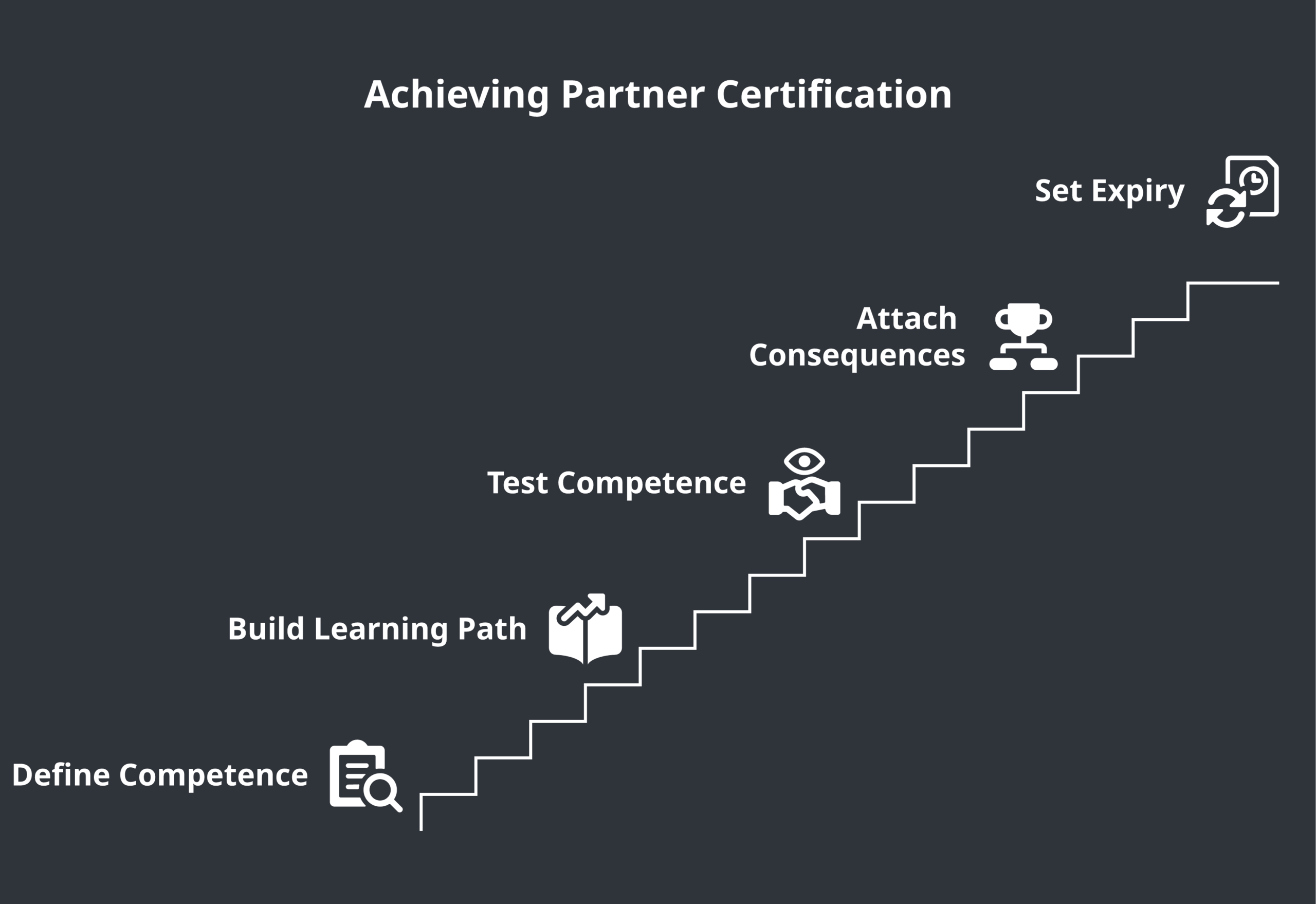
- Define the competence standard: Decide what a certified person must be able to do, sell your product, scope an implementation, or support it, in observable terms. The standard is the whole foundation, and a vague one produces a meaningless badge.
- Build the learning path: Create the enablement that gets a partner’s person from zero to the standard, mixing product training, motion training, and practice. The path should teach to the standard you defined, not to a generic product overview.
- Test against the standard: Assess real competence, through a scenario, a mock deal, or a graded exercise, not just a multiple-choice quiz. The test is what makes the certification mean something, so it has to check the thing the standard names.
- Attach real consequences: Tie certification to access, tier status, deal-registration eligibility, or better economics. Certification with no reward gets ignored, and certification that unlocks something real gets pursued.
- Set expiry and recertification: Products change, so certifications should lapse and require refresh. A credential that never expires slowly certifies people on a version of your product that no longer exists.
Common pitfalls when building partner program certification
- Certifying completion, not competence: A badge for finishing a video course proves attention, not ability. If the test does not check whether the person can do the job, the certification guarantees nothing to your customer or your sales team.
- No reward attached: Certification that unlocks nothing gets ignored. Partners invest time only when the credential earns them access, tier movement, or better economics, so the consequence has to be real.
- A standard nobody can observe: “Understands the product” is not a standard you can test. Define competence in observable terms, like running a discovery call or scoping a deployment, or the assessment has nothing to measure.
- Never expiring: A certification that lasts forever certifies people on an old version of your product. Build in expiry and recertification so the credential stays honest as the product evolves.
- Certifying the company, not the people: A partner logo is not competent; specific people are. Certify named individuals so you know exactly who at the partner can carry a deal, rather than assuming the whole firm can.
What this looks like in practice
A worked example: a software company had a partner program with a “certified partner” tier that meant a partner admin had watched an onboarding webinar. Customers kept complaining that certified partners botched implementations, because the certification proved nothing about implementation skill. The badge had become a liability, since it promised a competence the program had never actually tested.
The company rebuilt the certification around observable competence. It defined what a certified implementer had to be able to do, in specific deployment terms, built a learning path that taught to exactly that, and replaced the webinar-completion check with a graded implementation exercise a partner had to pass. It then tied certification to something real: only certified implementers could be assigned to customer deployments, and partners with more certified people moved up a tier with better economics. Partners who had collected the old badge for free now had to earn the new one, and the ones who invested rose to the top. Customers stopped complaining, because a certified partner was now a proven one, and the company’s own sales team started requesting certified partners by name. The certificate finally meant what everyone had assumed it meant all along.
Forecastable’s POV on partner program certification
Our position is that partner program certification is worth building only if it guarantees competence a customer can rely on. A certification that proves completion is theater, and worse than nothing, because it promises a quality the program never verified. The value is entirely in whether passing the certification means the person can actually do the job to your standard.
The way we would build it is standard-first and consequence-backed. Define what a certified person must be able to do in observable terms, teach precisely to that, test the real skill rather than course completion, and attach access and economics so partners have a reason to invest. Then let it expire, because a product that keeps changing needs a credential that keeps up. A certification built this way becomes an asset your sales team and your customers trust; built any other way, it is a badge that erodes the confidence it was meant to create.
Forecastable is a partnerships operating platform that connects partner conversations and actions to CRM pipeline and revenue, the flywheel of Conversations to Actions to Pipeline to Revenue. We are a category authority on running partner-led growth, so we care that certification tracks real competence tied to partner production, because a program that rewards proven ability with access is a program that turns certified partners into producing ones.
Any tools or frameworks referenced here are independent third-party context, and mentioning them is not an endorsement. Design any certification against your own product, delivery standard, and partner base before rolling it out.
Frequently asked questions
What is partner program certification? Partner program certification is a structured way to verify that a partner’s people can sell, implement, or support your product to a defined standard, and to reward that proven competence with a badge, tier, or better economics. It certifies named individuals, not just the partner logo.
How is certification different from partner onboarding? Onboarding introduces a partner to your program and product. Certification verifies that specific people at the partner have reached a competence standard and can be trusted to carry a deal or a deployment. Onboarding is the start; certification is the proof.
What makes a partner certification meaningful? An observable competence standard, an assessment that tests the real skill rather than course completion, and a real reward for passing. Certification that only proves someone finished a video guarantees nothing; certification tied to demonstrated ability and real access does.
Should partner certifications expire? Yes. Products change, and a certification that never lapses slowly certifies people on an outdated version. Build in expiry and recertification so the credential stays honest and keeps partners current as the product evolves.
What should certification unlock? Something partners want: deal-registration eligibility, tier status, assignment to customer deployments, or better economics. A credential with no consequence gets ignored, while one that unlocks real access or margin gets pursued and earned.
Do you certify the partner company or the people? The people. A company logo is not competent; specific individuals are. Certifying named people tells you exactly who at each partner can carry a deal or run a deployment, which is far more useful than a firm-level badge.
Next step
If your certified-partner tier means nothing more than a completed webinar, the fix is to rebuild it around observable competence and attach real access to passing. Start your growth journey now to turn certification into proof your customers and sales team can trust. The partner program hub covers how certification fits the wider program.
Uncover Your Growth Potential
Schedule a Discovery Call