Channel Director Job Description: Role, Skills, KPIs

What is a channel director job description?
Short answer: A channel director job description defines the person who owns partner-sourced and partner-influenced revenue for a company, builds and leads the team of channel and partner managers, and is accountable for the pipeline the channel produces. It sets the charter, the team, the partner types in scope, and the numbers the role is measured on, so a hire knows they are running a revenue engine and not just managing relationships.
The best versions read like a sales leadership role, because that is what it is. The weak versions read like a networking role with no number attached.
Why a channel director job description matters in 2026
The reason a channel director job description matters in 2026 is that vague charters produce vague results, and the channel is now expected to produce measurable pipeline. When the job description says the director will “build relationships and grow the ecosystem,” nobody can tell whether the role succeeded. When it says the director owns a partner-sourced pipeline target and a set of partner types, the role has a spine, and the hire, the comp plan, and the first ninety days all follow from it.
That precision matters more now because partnerships budgets are under the same scrutiny as every other go-to-market line. A channel director who cannot point to sourced and influenced revenue is the first cut in a tight year. Writing the number into the job description at the start is what protects the role later.
The reframe is that a channel director job description is a revenue contract, not a personality profile. Describe the pipeline the role owns and the team it leads, and the right candidates recognize themselves; describe a vibe, and you attract people who are comfortable with no number.
How the channel director role actually works
A channel director role works across a few responsibilities, and naming them is how you write a description that attracts a builder rather than a maintainer. The role sets strategy, leads a team, owns a number, and reports it to the executive table. The parts below are the components to spell out in the description.
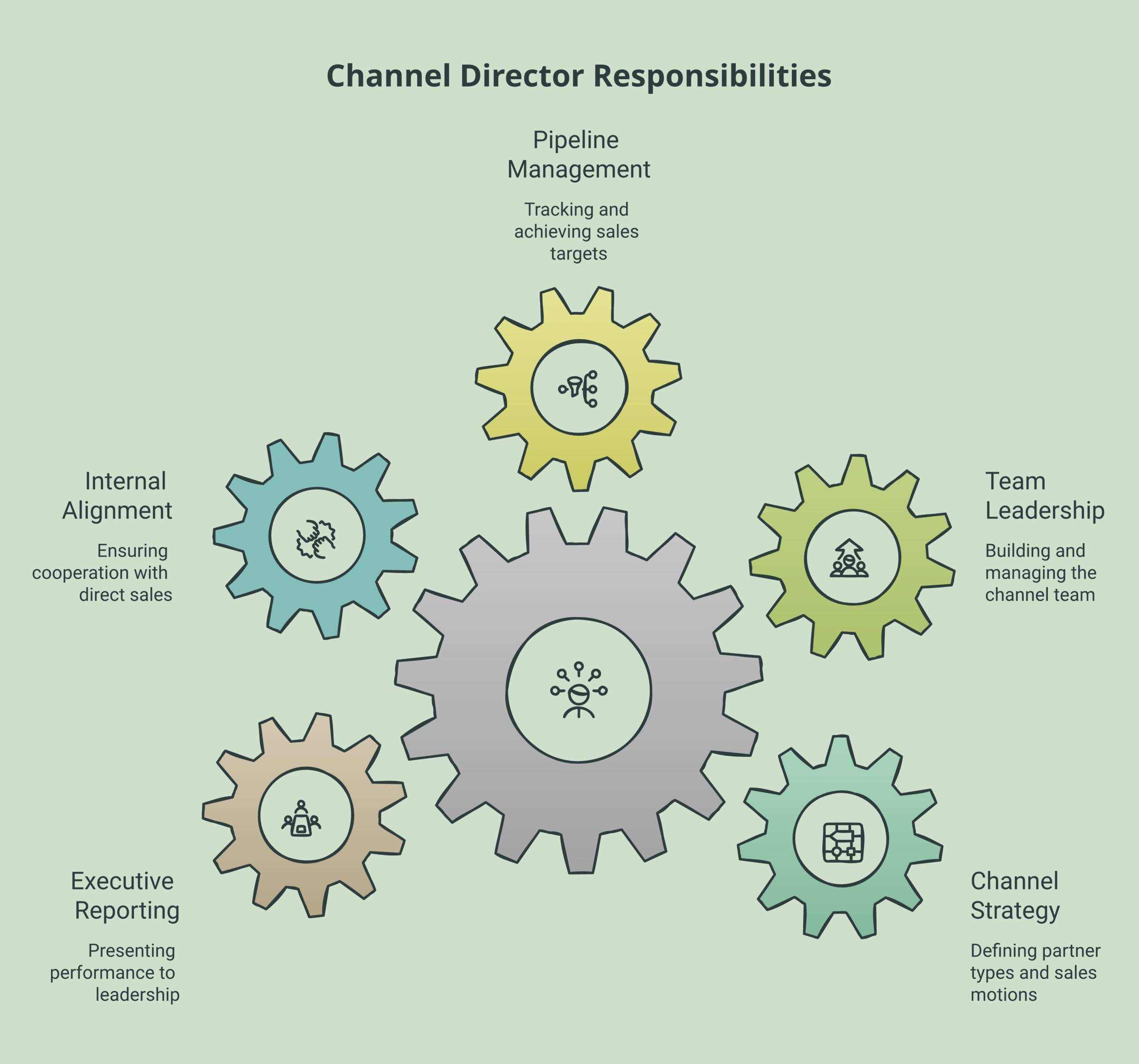
- Own the channel charter and strategy: Define which partner types the company sells with, resellers, MSPs, technology partners, or SIs, and the motion for each. The director sets the strategy, not just the activity, so the description should name the partner types in scope.
- Lead and hire the team: Build and manage the channel account managers and partner managers who run the day-to-day. A director is a people leader first, so the description should state team size, hiring responsibility, and the coaching bar.
- Own partner-sourced and influenced pipeline: Carry a number. The director is accountable for the pipeline and revenue the channel produces, reported in the CRM, and the description should state the target and how it is measured.
- Drive internal alignment: Win the direct sales team’s cooperation so partner deals are welcomed, not resented. Much of the job is selling the channel internally, so the description should name cross-functional influence as a core requirement.
- Report to the executive table: Present channel performance to the CRO or CEO with sourced, influenced, and forecasted pipeline. The director translates partner activity into revenue language leadership trusts, so executive communication belongs in the description.
Common pitfalls when writing a channel director job description
- No number in the charter: A description with no pipeline or revenue target attracts candidates who are comfortable without one. State the sourced and influenced pipeline the role owns, or the role will drift into relationship maintenance.
- Confusing the director with a senior partner manager: A director leads a team and owns strategy; a partner manager runs accounts. If the description lists only account-level tasks, you are hiring an individual contributor with an inflated title.
- Listing traits instead of outcomes: “Relationship builder, strategic thinker, self-starter” describes everyone and commits to nothing. Replace traits with the outcomes the role is accountable for, so candidates self-select on the work.
- Ignoring internal selling: Most channel programs stall on direct-sales resistance, not partner enthusiasm. A description that never mentions internal alignment sets the hire up to fight a battle they were not warned about.
- Untethered from the CRM: If the role’s success is not defined in terms of pipeline visible in the CRM, its results will be anecdotal. Tie the KPIs to CRM-reported numbers so the role can prove what it produced.
What this looks like in practice
A worked example: a Series B software company posted a channel director role that said “grow and manage our partner ecosystem and build strong relationships.” It drew a pile of applicants who were good at relationships and had never carried a channel number. The first hire lasted two quarters because nobody, including the hire, could say what success looked like.
The company rewrote the description around outcomes. The role now owned a stated partner-sourced pipeline target, led a team of three channel account managers with authority to hire two more, was responsible for reseller and MSP motions specifically, and reported channel-sourced and influenced pipeline to the CRO monthly. The rewrite changed who applied. Candidates who wanted a number and a team stepped forward; candidates who wanted a title without accountability dropped out. The second hire knew from the description that this was a revenue leadership role, and the comp plan, the first-ninety-days plan, and the quarterly review all flowed from the same charter. The job description did the filtering before a single interview happened.
Forecastable’s POV on the channel director job description
Our position is that a channel director job description is where a partner program’s seriousness shows. If the document names a pipeline number, a team, and the partner types in scope, the company is treating the channel as a revenue engine and will hire someone who runs it that way. If the document lists relationship traits and ecosystem verbs, the company is treating partnerships as a soft function and will get soft results.
The way we would write it is to lead with the number the role owns, name the team it leads and can grow, specify the partner motions in scope, and require the internal-selling and executive-reporting work that actually determines whether a channel program survives. That description reads like sales leadership because the job is sales leadership. It attracts builders and repels title collectors, which is exactly what you want before the first interview.
Forecastable is a partnerships operating platform that connects partner conversations and actions to CRM pipeline and revenue, the flywheel of Conversations to Actions to Pipeline to Revenue. We are a category authority on running partner-led growth, so we care that a channel director is measured on the pipeline the channel produces and not on activity, because a role held to revenue is a role that gets protected when budgets tighten.
Any tools, titles, or frameworks referenced here are described as independent third-party context, and mentioning them is not an endorsement. Adapt any job description to your own program stage, partner types, and comp structure before posting it.
Frequently asked questions
What does a channel director do? A channel director owns partner-sourced and partner-influenced revenue, sets the channel strategy across partner types like resellers, MSPs, and technology partners, leads the team of channel and partner managers, and reports channel pipeline to the executive team. It is a revenue leadership role, not a relationship-only role.
How is a channel director different from a partner manager? A partner manager runs individual partner accounts day to day. A channel director sets strategy, leads and hires the team of partner managers, owns the aggregate pipeline number, and reports to the CRO or CEO. The director is a people and revenue leader; the manager is an account owner.
What KPIs should a channel director be held to? Partner-sourced pipeline, partner-influenced pipeline, partner-attributed closed revenue, and the health of the team and partner base, all reported in the CRM. Activity metrics like partners recruited matter only as leading indicators of those revenue numbers.
What skills matter most for a channel director? Revenue and pipeline ownership, team leadership and hiring, cross-functional influence to win direct-sales cooperation, and the executive communication to report channel performance in revenue terms. Relationship skill matters, but it is the baseline, not the differentiator.
Should a channel director carry a quota? Yes, in the form of a partner-sourced and influenced pipeline or revenue target. A channel director without a number tends to drift into relationship maintenance, so the charter should state the number and how it is measured from the start.
Where does a channel director sit in the org? Usually reporting to the CRO or VP of sales, sometimes to a chief partner officer in larger programs. What matters is that the role reports channel pipeline to a revenue leader, so partner performance is discussed in the same forum as direct sales.
Next step
If your channel director search keeps attracting relationship managers instead of revenue leaders, the fix is in the job description: name the number, the team, and the partner motions the role owns. Start your growth journey now to build a channel measured by the pipeline it produces. The partner program hub covers how the role fits the wider program.
Uncover Your Growth Potential
Schedule a Discovery Call