Partner Certification Tracking: A Practical Guide

What is partner certification tracking?
Short answer: Partner certification tracking is the practice of recording which of a partner’s reps have completed your training, what level they reached, and whether that certification is still current, so the program knows who is actually qualified to sell or deliver. It is the record-keeping layer under partner enablement, and it matters because a certification you cannot track is a certification you cannot tie to results or trust when it counts.
Tracking is not the same as enabling. Enablement teaches the partner; tracking records the state and keeps it current. Both are needed, but the tracking is what makes the enablement measurable.
The useful question is not how many partners you certified, it is whether certification changes how those partners perform, because a tracked credential that does not affect outcomes is just a database.
Why partner certification tracking matters in 2026
The reason certification tracking matters in 2026 is that programs are being asked to prove enablement works, and you cannot prove it without knowing who is certified and what they produced. When a partnerships leader is questioned on whether training drives revenue, the answer requires connecting certification status to pipeline and deal outcomes, which is impossible if the certification data lives in scattered spreadsheets or nowhere at all.
That matters more now because partner bases are larger and credentials expire. A rep certified two years ago on a product that has changed three times is not qualified, and without tracking the expiry, the program cannot tell. Tracking keeps the picture honest: who is current, who lapsed, and who never trained, so investment goes to the partners and reps that keep their qualification real.
The reframe is that certification tracking is only worth doing if certification is tied to something that matters, such as tier status, deal-registration eligibility, or lead routing. Tracking a credential that unlocks nothing produces a tidy record and no behavior change. The tracking earns its keep when the status has consequences.
How partner certification tracking actually works
Partner certification tracking works by defining what certification means, recording who holds it at what level, keeping it current as it expires, and tying the status to program consequences and outcomes. The discipline is connecting the record to real effects, not just storing it. The parts below are the model to run.
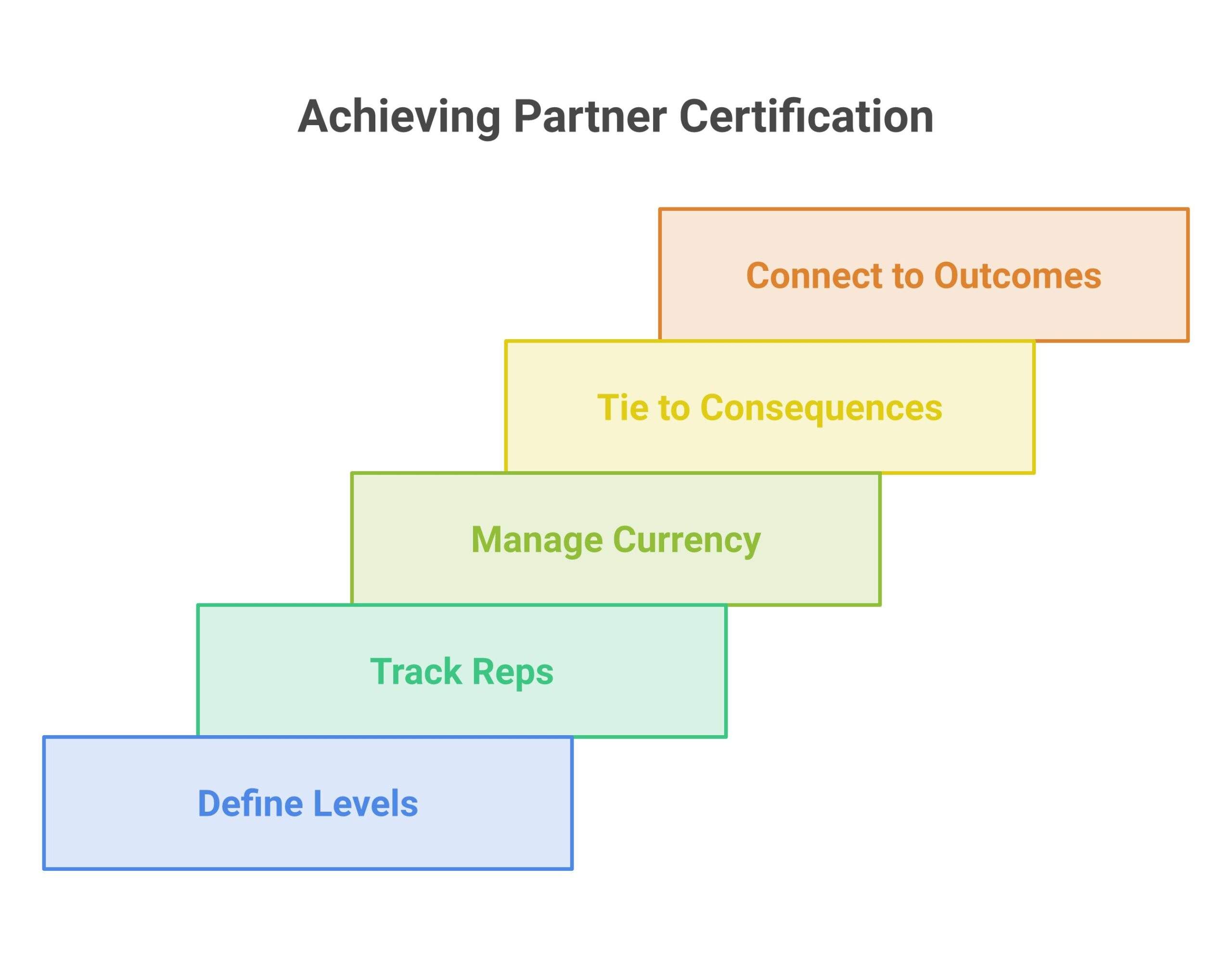
- Define certification levels and requirements: Decide what each certification level requires and what it qualifies a rep to do. A credential with no clear meaning cannot be tracked usefully, because there is nothing definite to record or trust.
- Record who holds what: Track certification at the rep level, not just the partner level, since a partner is only as qualified as the individuals selling and delivering. Rep-level tracking is what makes routing and eligibility decisions accurate.
- Manage currency and expiry: Track when certifications expire and prompt recertification as products and messaging change. Currency is what keeps the record honest; a lapsed credential that still reads as current misleads the whole program.
- Tie status to consequences: Connect certification to tier progress, deal-registration eligibility, lead routing, or margin, so the credential unlocks something real. Consequences are what make partners pursue and maintain certification.
- Connect certification to outcomes: Relate certification status to pipeline and deal results so the program can show whether trained reps actually produce more. This is the measurement that proves enablement works or reveals that it does not.
Common pitfalls with partner certification tracking
- Tracking a credential that unlocks nothing: The most common failure is certifying and tracking reps without tying the status to any consequence. If certification does not affect tier, routing, or eligibility, partners have no reason to pursue it and the tracking changes no behavior.
- Certifying the partner, not the reps: Recording that a partner company is certified hides the fact that only one of its ten reps trained. Track at the rep level, because the individuals are who sell, and partner-level tracking overstates real capability.
- Ignoring expiry: A certification that never expires drifts out of date as products change. Without currency tracking, the record shows qualified reps who are actually two versions behind, which is worse than no record because it is trusted.
- Never linking to outcomes: Tracking who is certified without ever checking whether certified reps produce more leaves the program unable to prove enablement works. If you cannot connect certification to results, you cannot defend the investment.
- Manual tracking that rots: Certification data kept by hand in spreadsheets falls out of date fast and becomes untrusted. If the record is not maintained where the program can rely on it, people stop using it and revert to guessing.
What this looks like in practice
A partnerships team ran a solid certification curriculum but tracked completion in a spreadsheet that one person updated occasionally. Nobody trusted it, so certification had no bearing on which partners got leads or which deals they could register. Reps trained, forgot, and the credential meant nothing. The team rebuilt the tracking around consequences: certification was recorded at the rep level, tied to an expiry, and made a requirement for deal-registration eligibility and for routing inbound leads to a partner.
Once the status unlocked something real, behavior changed. Partners pushed their reps to certify and recertify because it gated leads and registration, so the trained population grew and stayed current. The team then compared registered-deal outcomes between certified and uncertified reps and could finally show that certified reps converted at a higher rate, which justified the enablement spend. The tracking mattered not because it was tidy, but because certification status carried consequences and connected to outcomes.
Forecastable’s POV on partner certification tracking
Our position is that certification tracking is worthless as bookkeeping and valuable as a control. Recording who trained is easy and pointless on its own. The value appears only when the tracked status governs something a partner cares about, such as lead routing, registration eligibility, or tier, and when the program can connect certification to whether reps actually produce more. A certification database that unlocks nothing and proves nothing is administrative theater.
That is the frame we would apply to any enablement measurement. Define what certification qualifies a rep to do, track it at the rep level with real expiry, tie it to consequences that make partners pursue it, and connect the status to pipeline and deal outcomes so you can prove the training works. If you would not change any program decision based on a partner’s certification status, you are tracking a credential that does not matter, and the fix is to give it consequences, not a better spreadsheet.
Certification tracking is one input into a program that has to be measured end to end. Forecastable is a partnerships operating platform that connects partner conversations and actions to CRM pipeline and revenue, the flywheel of Conversations to Actions to Pipeline to Revenue, so a partner’s enablement state can be related to what that partner actually produces. That connection is what turns certification from a record into evidence that enablement drives revenue.
Any third-party tools, firms, or benchmarks referenced here are independent and mentioned for context, not as endorsements. Evaluate any certification design against your own program and motion before rolling it out.
Frequently asked questions
What is partner certification tracking? Partner certification tracking is recording which of a partner’s reps have completed your training, at what level, and whether it is still current, so the program knows who is actually qualified. It is the record-keeping under enablement and is what makes training measurable and tie-able to results.
Should you track certification at the partner or rep level? At the rep level. A partner company is only as qualified as the individuals who sell and deliver, so recording that the company is certified hides whether one rep or ten actually trained. Rep-level tracking is what makes routing and eligibility decisions accurate.
How do you make certification tracking actually change behavior? Tie the tracked status to consequences partners care about, such as tier progress, deal-registration eligibility, lead routing, or margin. When certification unlocks something real, partners pursue and maintain it. When it unlocks nothing, tracking changes nothing.
How do you handle certification expiry? Track when each certification expires and prompt recertification as products and messaging change. Currency keeps the record honest, because a lapsed credential that still reads as current misleads the program worse than having no record at all.
How do you prove certification drives revenue? Connect certification status to pipeline and deal outcomes, then compare production between certified and uncertified reps. If certified reps convert at a higher rate, the tracking justifies the enablement spend. If they do not, the data tells you the training needs to change.
Do small programs need certification tracking? If certification carries any consequence, yes, even a lightweight record helps. The point is not the sophistication of the system but whether the status is current, rep-level, and tied to something real. A small program can do that in a simple tool as long as it is trusted and maintained.
Next step
If you certify partners but the status sits in a spreadsheet that governs nothing, the training is unmeasured and the credential is meaningless. Tie certification to consequences, track it at the rep level, and connect it to outcomes so you can prove it works. Start your growth journey now to build a partner motion where enablement state connects to real production. The partner program hub frames how enablement fits the broader program.
Uncover Your Growth Potential
Schedule a Discovery Call