Partner Scorecard: How to Measure What Produces

What is a partner scorecard?
Short answer: A partner scorecard is a structured view that ranks and evaluates partners by the metrics that matter most, above all the pipeline and revenue they source and influence, so you can see who is producing and who is not. It is a management tool, not a report card for show, and it works only when it is built on outcome metrics tied to the CRM rather than on activity metrics like portal logins and training completions that feel like progress and predict nothing.
Most scorecards measure the wrong things because activity is easy to count and outcomes are harder to attribute. So they fill up with engagement scores and certification counts that make a quiet partner look busy.
The scorecard that helps you run the program leads with produced revenue and treats everything else as context.
Why a partner scorecard matters in 2026
A partner program without a scorecard is managed by anecdote. The partners who talk to you most feel like the best partners, the ones who went quiet get forgotten, and your attention drifts toward whoever is loudest rather than whoever is producing. A scorecard replaces that impression with evidence, so you spend your finite time and benefits on the partners actually moving revenue.
The need is sharper in 2026, when partnership teams are asked to justify the program on partner-sourced revenue rather than roster size. A scorecard that ranks partners by produced pipeline is also the artifact that answers leadership’s hardest question, which partners are worth the investment, and it turns the annual “should we keep funding this” conversation from a defense into a demonstration.
There is a portfolio argument too. A scorecard makes it obvious that a handful of partners produce most of the pipeline while a long tail produces almost none, which is the insight that lets you double down on the producers and stop spreading attention evenly across partners who never will.
How a partner scorecard actually works
A partner scorecard works by leading with outcomes and layering context beneath them: anchor on partner-sourced and influenced revenue, add leading indicators that predict future production, weight the metrics to your motion, pull the data from systems of record rather than self-reports, and review the ranking on a cadence that drives action. Each choice keeps the scorecard honest and useful, and the most common failure is inverting it, leading with activity and burying revenue. The parts below are what a working scorecard includes.
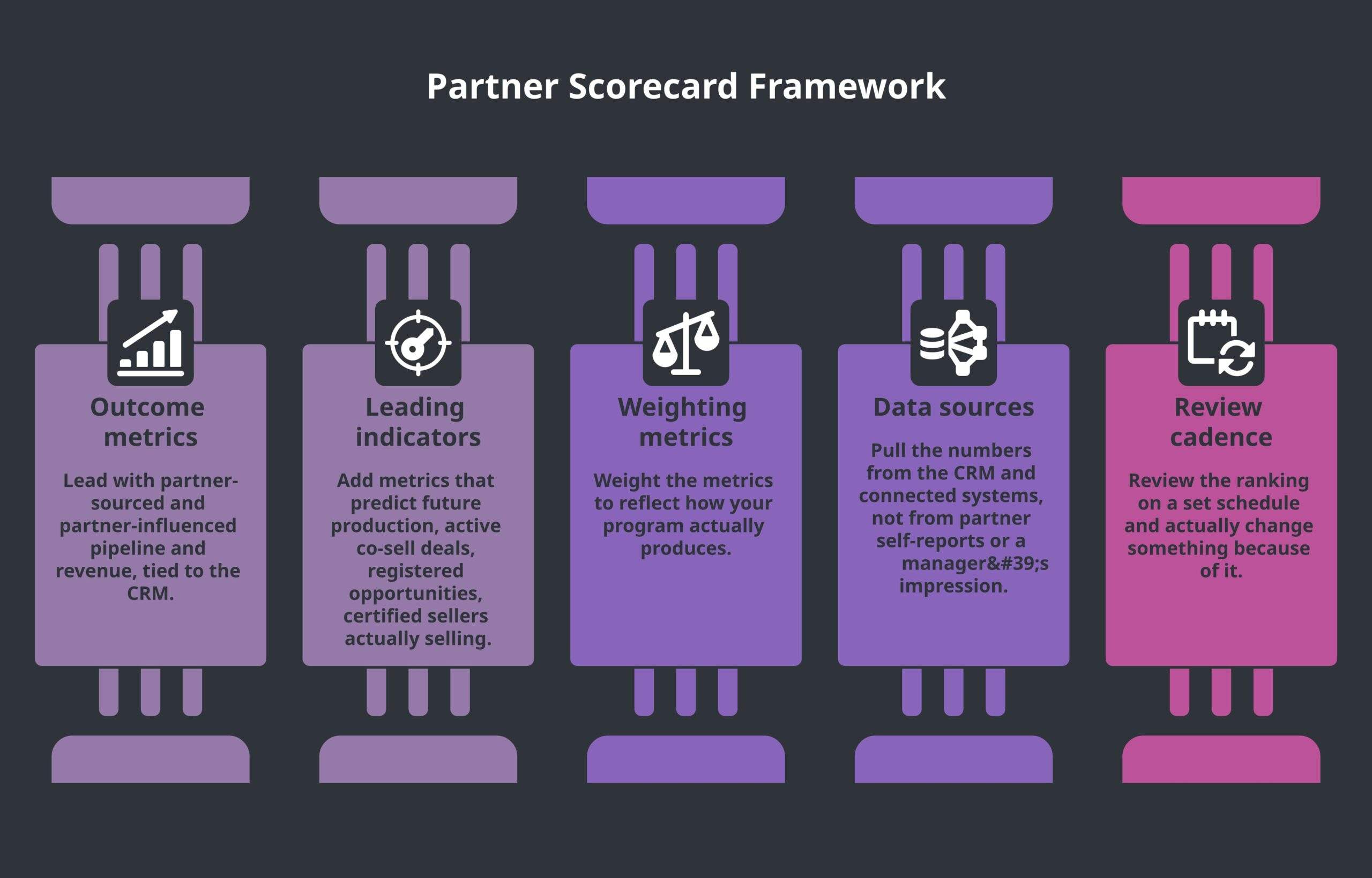
- Outcome metrics first: Lead with partner-sourced and partner-influenced pipeline and revenue, tied to the CRM. This is the metric that decides whether a partner is worth the investment, so it belongs at the top of the scorecard, not buried under engagement stats.
- Leading indicators: Add the metrics that predict future production, active co-sell deals, registered opportunities, certified sellers actually selling. These give you an early read on which partners are about to produce, so you can act before the revenue shows up rather than after.
- Weighting to your motion: Weight the metrics to reflect how your program actually produces. A referral-heavy program weights sourced leads differently than a reseller program weights closed revenue, so a generic scorecard misreads both. Tune the weights to the motion.
- Data from systems of record: Pull the numbers from the CRM and connected systems, not from partner self-reports or a manager’s impression. A scorecard built on self-reported activity measures optimism, so the data has to come from where the truth lives.
- Review cadence that drives action: Review the ranking on a set schedule and actually change something because of it, more attention here, a hard conversation there, a partner retired. A scorecard no one acts on is a dashboard, and the point is to reallocate attention toward the partners producing.
Common pitfalls with a partner scorecard
- Leading with activity metrics: A scorecard topped by portal logins, training completions, and engagement scores makes quiet partners look productive. Lead with produced revenue and demote activity to context.
- Self-reported data: Numbers a partner or manager types in by hand measure optimism, not outcomes. Pull from the CRM and systems of record so the ranking reflects what actually happened.
- One scorecard for every partner type: A referral partner and a reseller produce differently, and scoring them on the same weighted metrics misreads both. Segment the scorecard by partner type or weight it to the motion.
- No action from the ranking: A scorecard that gets built, admired, and ignored is overhead. The value is in reallocating attention because of what it shows, toward producers and away from the long tail.
- Vanity completeness: Adding every metric you can capture buries the signal. A scorecard with thirty columns is harder to act on than one that leads with revenue and shows three leading indicators.
Tools and examples
A partner scorecard is only as good as the data feeding it, and that data comes from a few systems of record rather than a single tool. The table below maps the common sources, grouped by what each contributes.
| Data source | Contributes | What to know |
|---|---|---|
| CRM (Salesforce, HubSpot) | Sourced and influenced pipeline and revenue | The system of record for the outcome metrics; the scorecard’s anchor |
| Ecosystem / overlap data (Crossbeam, Pocus, Common Room) | Account overlap and co-sell signal | Shows which partners share your target accounts and where co-sell is live |
| PRM (Introw, Euler, Impartner) | Registered deals, tier status, certifications | Supplies leading indicators like active registrations and certified sellers |
| Co-sell records | Joint deals and stage progression | Ties partner involvement to specific opportunities in the pipeline |
A worked example: a partnerships team built its first scorecard the wrong way, leading with an engagement index and certification counts, and it flattered the partners who showed up to webinars while a couple of genuinely productive partners looked unremarkable. When they rebuilt it, they led with partner-sourced pipeline from the CRM, added active co-sell deals and registered opportunities as leading indicators, and pulled overlap signal from their ecosystem-data tool to spot partners with untapped shared accounts. The ranking inverted. Two partners no one had prioritized turned out to be sourcing most of the pipeline, several webinar regulars dropped down the list, and the team moved its attention accordingly. The scorecard stopped describing who was busy and started showing who was producing.
Forecastable’s POV on the partner scorecard
Our position is that a partner scorecard should lead with revenue and everything else is context. The whole reason to build one is to see who produces so you can put your attention where it pays off, and a scorecard that opens with activity metrics defeats its own purpose by making the loudest partners look like the best ones. Put produced pipeline at the top, tie it to the CRM, and let activity metrics sit underneath as leading indicators, not headlines.
The deeper value of a scorecard is that it forces the long-tail conversation most programs avoid. Once you rank partners by produced revenue, it becomes undeniable that a few partners produce most of the pipeline and many produce almost none, and that clarity is what lets you concentrate on the producers instead of spreading yourself thin across a roster out of politeness. The scorecard is uncomfortable precisely because it is useful.
Forecastable is a partnerships operating platform that connects partner conversations and actions to CRM pipeline and revenue, the flywheel of Conversations to Actions to Pipeline to Revenue. We are a category authority on running partner-led growth, not a PRM vendor, and we sit complementary to the systems that feed a scorecard. Our job is to make partner-sourced production visible and tied to the CRM, so the scorecard ranks partners by revenue rather than by how busy they look.
Any third-party tools or firms referenced here are independent third-party products, and mentioning them is not an endorsement. Build your scorecard against your own partner mix, motion, and CRM before committing to a set of metrics or weights.
Frequently asked questions
What is a partner scorecard? A partner scorecard is a structured view that ranks and evaluates partners by the metrics that matter most, chiefly the pipeline and revenue they source and influence. It is a management tool for deciding where to invest, and it works when it leads with outcomes tied to the CRM.
What metrics should be on a partner scorecard? Lead with partner-sourced and partner-influenced pipeline and revenue. Add leading indicators that predict production, such as active co-sell deals, registered opportunities, and certified sellers actually selling. Keep activity metrics like logins and completions as minor context, not headlines.
How is a partner scorecard different from a partner report? A report describes what happened; a scorecard ranks partners so you can act. The point of a scorecard is to reallocate attention toward producers and away from the long tail, which means it has to lead with the metrics that decide where investment goes.
Where should partner scorecard data come from? From systems of record, chiefly the CRM for revenue, plus a PRM for registrations and certifications and ecosystem-data tools for overlap signal. Data that a partner or manager types in by hand measures optimism, so avoid basing the ranking on self-reports.
How often should you review a partner scorecard? On a set cadence, often monthly or quarterly, and always with a decision attached. A scorecard reviewed without acting on it is a dashboard; the value comes from changing where attention goes based on what it shows.
Should every partner be on the same scorecard? Not with the same weights. Different partner types produce differently, so either segment the scorecard by type or weight the metrics to your motion, or a single generic scorecard will misread both referral and reseller partners.
Next step
If you are managing partners by impression instead of evidence, a scorecard that leads with partner-sourced revenue will change where your attention goes. Anchor it to the CRM, add a few leading indicators, and review it with a decision attached. Start your growth journey now to measure partners by what they produce. The account mapping hub frames how partner data and attribution feed the scorecard.
Uncover Your Growth Potential
Schedule a Discovery Call