Sales Partner Insights: Turning Data Into Action

What are sales partner insights?
Short answer: Sales partner insights are the conclusions you draw from partner activity data that actually change what you do next, such as which partners to invest in, which deals need help, and where the channel is producing. They are the difference between a dashboard you look at and a decision you make.
Most teams have partner data and very few partner insights. Data is what a partner did; an insight is what you should do about it. The whole value sits in that translation, and most programs never make it.
Why sales partner insights matter in 2026
Sales partner insights matter because partner programs are now expected to defend themselves with evidence. The era of reporting partner counts and event attendance is over; leadership wants to know what the channel sourced, influenced, and is likely to produce next quarter. Insight is what turns a pile of partner activity into that answer, and the programs that cannot produce it are the ones that lose budget.
In 2026 the volume of partner signals has also outgrown manual review. Between deal registrations, co-sell motions, overlap data, and CRM activity, no partner manager can read it all and spot the pattern that matters. Insight is the act of compressing that noise into the few things worth acting on, and without a system for it the most important signal, a stalling strategic deal or a suddenly active partner, gets lost in the volume.
There is also a speed argument. An insight is only worth acting on while the window is open. Learning in a quarterly review that a partner went quiet is a postmortem; learning it the week it happens is an intervention. The teams that win treat partner insight as something close to real time, because the value of knowing a deal is slipping decays by the day.
How sales partner insights actually work
Sales partner insights are produced by a pipeline that turns raw partner activity into a decision. The components below are the steps that have to connect for data to become action.
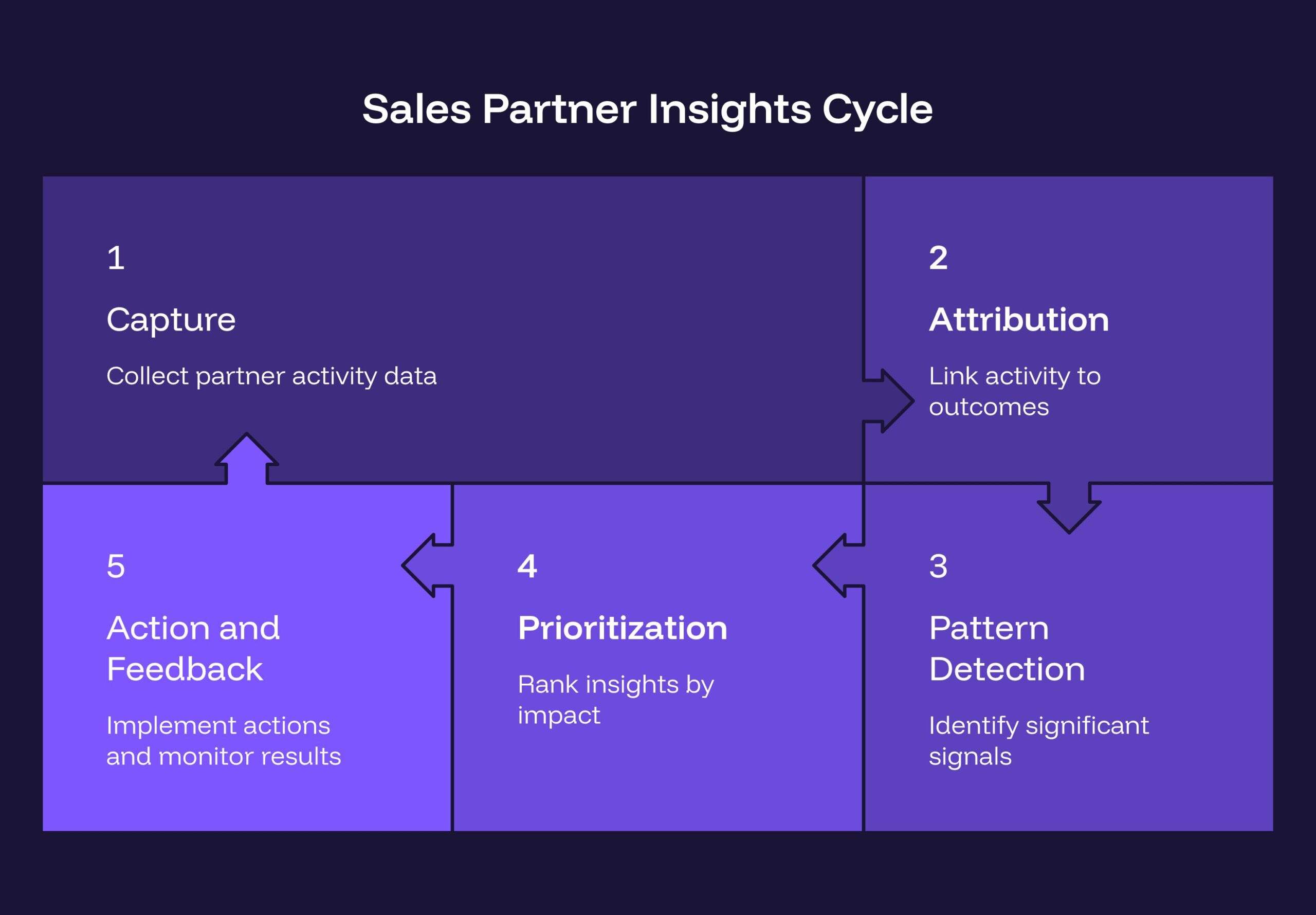
- Capture: Pull partner activity from where it actually lives, including CRM deal records, registrations, and co-sell touches. Insight built on partial capture inherits the blind spots of whatever you left out.
- Attribution: Connect each partner action to a pipeline and revenue outcome so you can tell what the partner actually moved. Without attribution, activity is just motion you cannot value.
- Pattern detection: Find the few signals that matter, such as a partner whose activity dropped, a deal stalled past its stage norm, or a partner outproducing their tier. This is the compression step that turns volume into a short list.
- Prioritization: Rank what to act on by impact and time sensitivity, because not every signal deserves a response and the urgent ones decay fastest. An insight nobody acts on in time is just a fact.
- Action and feedback: Route each prioritized insight to a person and a next step, then watch whether the action changed the outcome. The loop only pays off when the insight reliably becomes a move.
Common pitfalls in sales partner insights
- Dashboards nobody acts on: A beautiful partner dashboard that drives no decision is a cost, not an asset. If looking at it never changes a next step, it is reporting theater.
- Activity without attribution: Counting partner touches without tying them to pipeline tells you partners are busy, not whether they are productive. Unattributed activity flatters the lazy and hides the slipping deal.
- Insight that arrives too late: A signal surfaced in a quarterly review is a postmortem. The same signal in the week it happens is an intervention, and the value is almost entirely in the timing.
- Drowning in signals: Surfacing every data point with no prioritization is the same as surfacing none, because the manager cannot tell the urgent from the ambient. Compression is the job.
- No owner for the action: An insight with no named owner and next step dies on the slide. The loop closes only when someone is accountable for the move.
What this looks like in practice
A program reviewed partner performance quarterly from a deck of activity charts. The charts showed partners were active, but never showed which deals were slipping or which partners had quietly stopped producing, so problems surfaced as misses rather than as warnings. By the time the review named a stalled strategic deal, the customer had already chosen another path.
The change was to make insight continuous and attributed. Partner activity was pulled from the CRM and deal records, each action tied to a pipeline outcome, and a short weekly list surfaced only the signals that needed a response: a strategic deal past its stage norm, a top partner gone quiet, a partner outproducing their tier. Where activity lived in a partner platform such as Introw or Euler, it fed the same view rather than a separate report. Each item had an owner and a next step, so the program shifted from explaining misses after the quarter to preventing them during it.
Forecastable’s POV on sales partner insights
Our position is that an insight you do not act on is not an insight, it is a fact you collected. The entire purpose of partner data is to change a decision, and any reporting layer that does not reliably produce a next step is overhead dressed as analytics. Judge your partner reporting by the actions it triggers, not by how it looks.
We also think attribution is the load-bearing piece most programs skip. Without connecting partner activity to pipeline and revenue, every insight is built on motion, and motion flatters the busy partner while hiding the productive one. The teams that get this right wire partner action to CRM outcomes first, because everything downstream, the patterns, the priorities, the decisions, is only as honest as that link.
Finally, insight has a shelf life. The signal that a deal is slipping or a partner is disengaging is worth the most the week it appears and almost nothing a quarter later. The programs that turn data into action treat partner insight as a live feed they respond to, not a report they assemble, because the value is in catching the moment while you can still change it.
Forecastable is a partnerships operating platform. Any third-party tools named here are independent third-party products, and naming them is not an endorsement of one over another. Decide which sales partner insights matter most for your own partners, motion, and program.
Frequently asked questions
What are sales partner insights?
They are the conclusions you draw from partner activity data that change what you do next, such as which partners to invest in and which deals need help. An insight is distinct from raw data because it implies an action.
How are sales partner insights different from partner reporting?
Reporting shows what happened; insight tells you what to do about it. A report can be complete and still drive no decision, while an insight exists only when it points to a next step.
What data feeds sales partner insights?
CRM deal records, deal registrations, co-sell touches, and overlap data, all tied to pipeline and revenue outcomes. The key is attribution, which connects each partner action to the result it produced.
Why do partner dashboards often go unused?
Usually because they show activity without attribution and surface every signal without prioritization, so the manager cannot tell the urgent from the ambient. A dashboard that never changes a decision is reporting theater.
How quickly should sales partner insights surface?
As close to real time as you can manage, because the value of a signal decays fast. Knowing a deal is slipping the week it happens is an intervention; knowing it in a quarterly review is a postmortem.
Who should act on sales partner insights?
Every prioritized insight needs a named owner and a next step. Without an owner, even a sharp insight dies on the slide and the loop from data to action never closes.
Next step
If you have partner dashboards but still get surprised by misses, the problem is that your data never becomes a decision in time. Forecastable helps partnerships teams attribute partner activity to CRM pipeline and surface the few signals worth acting on while the window is still open. Start your growth journey now to turn partner data into decisions instead of decks. The partner program hub frames how insight fits the wider program.
Uncover Your Growth Potential
Schedule a Discovery Call