Partner Overlap: Finding the Accounts You Share

What is partner overlap?
Short answer: Partner overlap is the set of accounts that both you and a partner are working, have closed, or are prospecting at the same time, surfaced by comparing the two companies’ account lists. It is the raw material of co-sell, because the accounts you share are the ones where a joint motion has a real reason to exist.
Without overlap data, a partnership is a guess. Two companies sign an agreement, hold a kickoff, and then struggle to find deals to work together, because neither knows where their customer bases actually intersect. Overlap turns that guessing into a list. It tells you which of the partner’s customers are your prospects, which of your customers are their prospects, and which accounts you are both already inside, which is exactly where the fastest joint wins live.
The plain way to picture it is a Venn diagram of two account lists. The middle, the shared accounts, is where co-sell plays run. The two outer sections, where one company has a customer the other does not, are where each partner can open a door for the other. Overlap is what makes both of those moves visible instead of theoretical.
Why partner overlap matters in 2026
Co-sell has become the dominant partner motion, and co-sell without overlap data is improvisation. Partner teams are expected to produce sourced and influenced pipeline, and the first question that produces pipeline is “where do our customer bases meet.” A program that cannot answer that question with a current list is running its co-sell on hallway conversations, which does not scale and does not forecast.
The second force is privacy and tooling. Comparing two companies’ customer lists used to mean emailing spreadsheets, which was slow, error-prone, and a data-sharing risk. The account-mapping platforms that now mediate this comparison let two companies find their overlap without either side exposing its full list, which removed the friction that kept overlap analysis rare. The data is now cheap to get, so the programs that do not use it are choosing to.
The third force is prioritization. A partner manager with thirty partners and limited time has to decide where to spend it, and overlap is the cleanest prioritization signal available. A partner with two hundred shared open opportunities is a different investment from a partner with three, and overlap is what makes that difference visible. In a year where every hour of partner time is scrutinized, overlap is how you spend it where the deals are.
How partner overlap actually works
Surfacing and acting on overlap runs through a clear sequence, and each step turns raw list comparison into a co-sell motion. The data is the start; the action is the point.
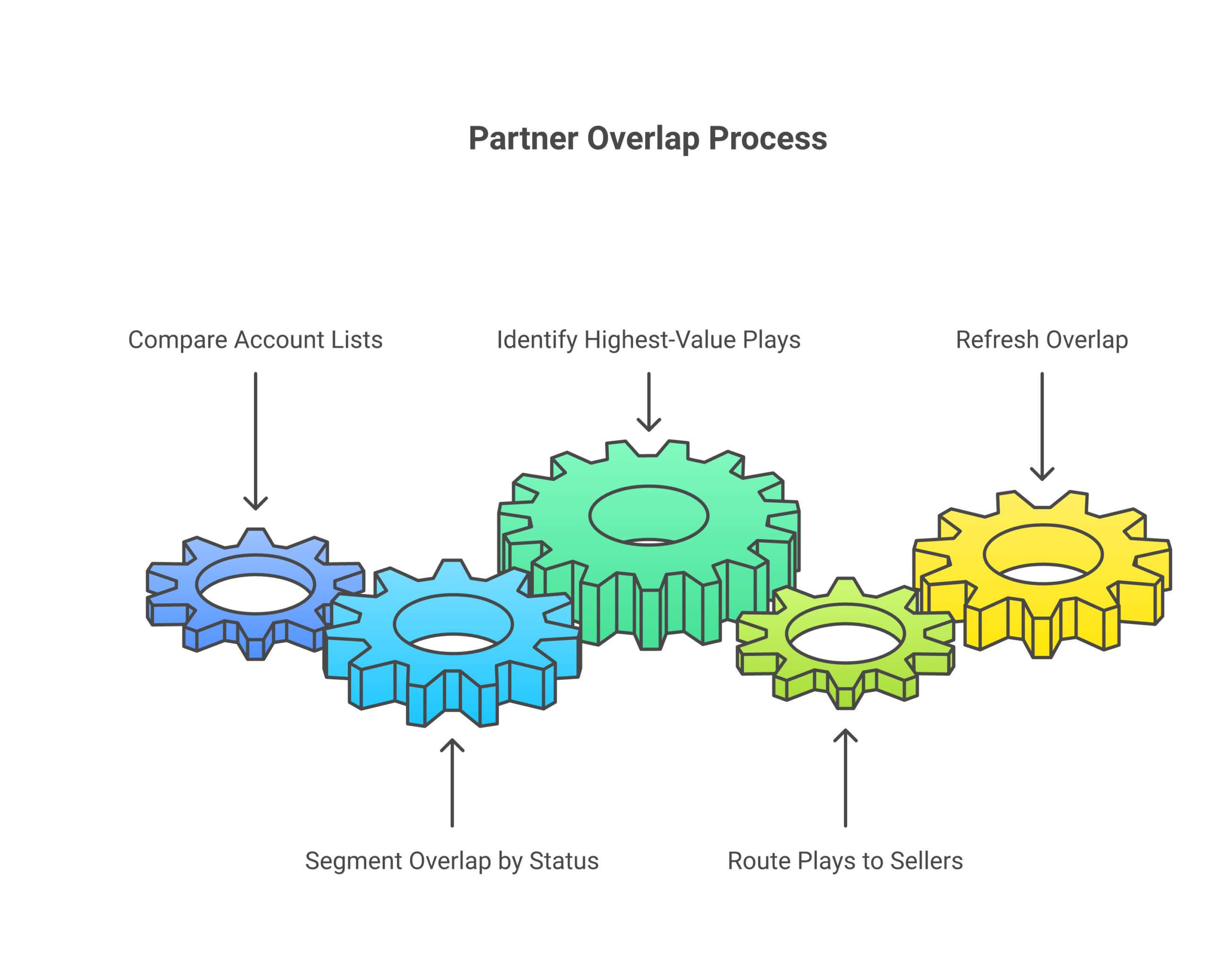
- Compare the two account lists: The two companies map their customer and prospect lists against each other, today almost always through an account-mapping platform that protects both sides’ data. The output is the shared set and the two net-new sets. This comparison is the mechanical heart of overlap.
- Segment the overlap by status: Not all shared accounts are equal. Split them into shared customers, accounts where one is a customer and the other is prospecting, and accounts where both are in an open deal. Each segment implies a different play, so the segmentation is what makes the list actionable rather than just interesting.
- Identify the highest-value plays: Within the segments, find the accounts where a joint motion has real leverage, an open deal where the partner has the executive relationship, or a shared customer ripe for expansion. Prioritizing by value rather than working the whole list is what keeps the motion focused.
- Route the plays to the right sellers: Each prioritized account has to reach the specific rep on each side who owns it, with the context of why it overlaps and what the play is. Overlap that never reaches the deal owner is a report nobody acts on, so the routing is where most programs lose the value.
- Refresh the overlap on a cadence: Account lists change constantly as deals open, close, and churn, so a one-time overlap analysis is stale within a quarter. A recurring refresh keeps the shared-account list current and feeds the co-sell motion continuously rather than once.
The cycle reruns on a regular cadence, and the overlap list becomes a living input to the co-sell pipeline rather than a slide built once for a partnership kickoff.
Common pitfalls in partner overlap
- Treating overlap as the goal instead of the input: A clean overlap report is not a result; it is the start of one. Programs that celebrate finding two hundred shared accounts and never route a single play have done the easy half. The value is in the action, not the analysis.
- Skipping the segmentation: A flat list of shared accounts hides the plays. A shared customer, a one-sided prospect, and a jointly open deal each need a different motion, so an unsegmented overlap list sends sellers in with no plan. Segment by status before you act.
- Overlap that never reaches the rep: The most common failure is overlap surfaced by the partner team and never routed to the deal owners who could act on it. A report that sits in the partnerships function is invisible to the sellers who close. Route the plays to the named rep on each side.
- Working overlap once and never refreshing it: Account lists move, so a single overlap analysis decays quickly. A program that maps overlap at kickoff and never again is acting on a stale picture within a quarter. The refresh cadence is what keeps overlap useful.
- Confusing overlap volume with partner value: A large shared-account count is not automatically a good partner. Two hundred shared accounts that neither side can move is worth less than ten shared open deals where the partner has the relationship. Weigh overlap by actionable value, not raw count.
Tools and examples
Overlap is surfaced through account-mapping platforms that let two companies compare lists without exposing their full data. The right one depends on whether you need pure overlap mapping or overlap plus buying signals.
| Tool | What it does for overlap | Best for |
|---|---|---|
| Crossbeam | Maps two companies’ account lists into shared and net-new sets through a mutual data network, with the partner’s consent on both sides | Programs that want broad ecosystem overlap mapping with many partners at once |
| Pocus | Surfaces overlap alongside product and buying signals, so shared accounts come with intent context | Teams that want to prioritize shared accounts by signal, not just by presence |
| Common Room | Combines overlap with community, product, and engagement signals to find warm shared accounts | Programs blending partner overlap with first-party signal to time the play |
A worked example: a software vendor mapped overlap with a regional reseller through an account-mapping platform and found a hundred and forty shared accounts. They segmented them into ninety shared customers, thirty accounts where the reseller had a customer relationship the vendor was prospecting, and twenty jointly open deals. They prioritized the twenty open deals, routed each to the named rep on both sides with a one-line play, and left the ninety shared customers for a later expansion motion. Of the twenty open deals, the reseller’s executive relationships helped advance nine that the vendor had been stuck on, and three closed inside the quarter. The overlap report did not close anything; the routed plays did.
Forecastable’s POV on partner overlap
Overlap is the most overrated and underused data in partnerships at the same time. It is overrated because programs treat the report as the achievement, generating impressive shared-account counts that never turn into a single routed play. It is underused because the same programs never push the overlap to the sellers who could act on it. The data is necessary and nowhere near sufficient, and the gap between the two is where most co-sell motions quietly fail.
The real leverage in overlap is the net-new sets, not the shared middle. Everyone looks at the accounts both companies already touch, which are valuable but crowded. The accounts where your partner is a trusted vendor and you are not present at all are the doors that only the partnership can open, and they are where co-sell produces revenue that direct selling never would have reached. A program that mines only the shared middle leaves the most valuable part of the overlap untouched.
The honest limit is that overlap data is only as good as the action system behind it. A program with perfect overlap mapping and no routing, no segmentation, and no refresh cadence will produce less than a program with a rough overlap and a disciplined motion to act on it. The platform makes the data easy; it does not make the program work. Buy the action before you obsess over the analysis, because the analysis without the action is a tidy report that closes nothing.
Forecastable is a partnerships operating platform; the tools above (Crossbeam, Pocus, Common Room) are independent third-party platforms, and naming them is not an endorsement of any specific deployment over another. Evaluate each against your own motion.
Frequently asked questions
How do you find partner overlap without sharing your full customer list?
Through an account-mapping platform that mediates the comparison, so each company uploads its list and the platform surfaces only the shared and net-new accounts both sides have agreed to reveal. Neither company sees the other’s full list.
What is the difference between overlap and account mapping?
Account mapping is the broader practice of aligning two companies’ account data; overlap is the specific output, the accounts that appear on both lists. Overlap is the result that account mapping produces.
Which overlap is most valuable, shared customers or net-new?
It depends on the motion, but the net-new accounts, where your partner has a relationship and you are absent, are often the most valuable, because they are doors only the partnership can open. The shared middle is valuable but more crowded.
How often should overlap be refreshed?
On a regular cadence, because account lists change as deals open and close. A quarterly refresh is a common minimum, and programs running active co-sell often refresh more frequently so the play list stays current.
Does partner overlap require a platform?
In practice, yes, for any meaningful scale. Manual list comparison is slow, error-prone, and a data-sharing risk, which is why account-mapping platforms became the standard way to surface overlap safely.
Why does overlap data so often go unused?
Because the report is the easy part and the routing is the hard part. Programs generate the overlap and never push the plays to the sellers who own the accounts, so the data sits in the partnerships function and closes nothing.
Next step
If you have an account-mapping platform but your overlap reports never reach the reps who own the accounts, the move this week is to take one partner’s shared-account list, segment it by status, and route the top ten plays to the named seller on each side.
Start your growth journey now to turn overlap data into a routed co-sell motion, or read the orientation on account mapping for the broader operating model.
Uncover Your Growth Potential
Schedule a Discovery Call