Partner Account Mapping: A 2026 Operating Guide

What is partner account mapping?
Short answer: partner account mapping is the operating practice of comparing your account list to a partner’s account list, segmenting the results, prioritizing the segments by relationship depth and in-market signal, and routing the prioritized accounts into the seller’s weekly workflow. It is the operating motion that turns overlap data into pipeline. In 2026, it is the most leverageable activity in modern partnerships and the one most often run as a slide-deck exercise.
The account mapping hub holds the broader operating context. A working partner account mapping motion has three properties. It is recurring: the four stages run on a published cadence (typically weekly into the seller workflow), not as a one-time project. It is prioritized: the team produces a small, prioritized list rather than a comprehensive but unactionable one. And it is attribution-aware: each mapped account carries the metadata needed to support partner-sourced or partner-influenced credit later.
Three adjacent terms get conflated. Overlap data is the input; partner account mapping is the operating motion that uses it. Account mapping at the team-or-territory level is the broader practice that includes partner account mapping as one input. Joint pipeline planning is the downstream activity that consumes the mapped accounts and produces a co-sell pipeline plan.
Why partner account mapping matters in 2026
Partner account mapping is the highest-leverage operating motion in modern B2B partnerships. Programs that run it well produce partner-sourced pipeline that compounds because every sales cycle starts with partner-warmth identified. Programs that run it as a one-time campaign produce slide decks and quarterly reports.
Three forces sharpened the question in 2026. First, sellers in well-run partner programs now expect partner-warm signal in their CRM at the start of every week, which surfaces the gap between programs that run a cadence and programs that do not. Second, finance leadership demands the partner number be forecastable, which is impossible without a recurring mapping motion. Third, ecosystem-data platforms made the data layer cheap, which means the differentiator shifted to the operating layer.
The operating case has three layers. Sellers who get a weekly list of accounts where a partner has warmth start every Monday with leverage that direct-only sellers do not have, and the compounding effect is structural. Partner-touched deals forecast more accurately than direct-only deals at the same stage, so a partner-mapped pipeline is a more forecastable pipeline. And partners who see their data turn into joint deals stay engaged in the partnership and commit additional resources; partners who see their data ignored disengage within two to three quarters.
How partner account mapping actually works
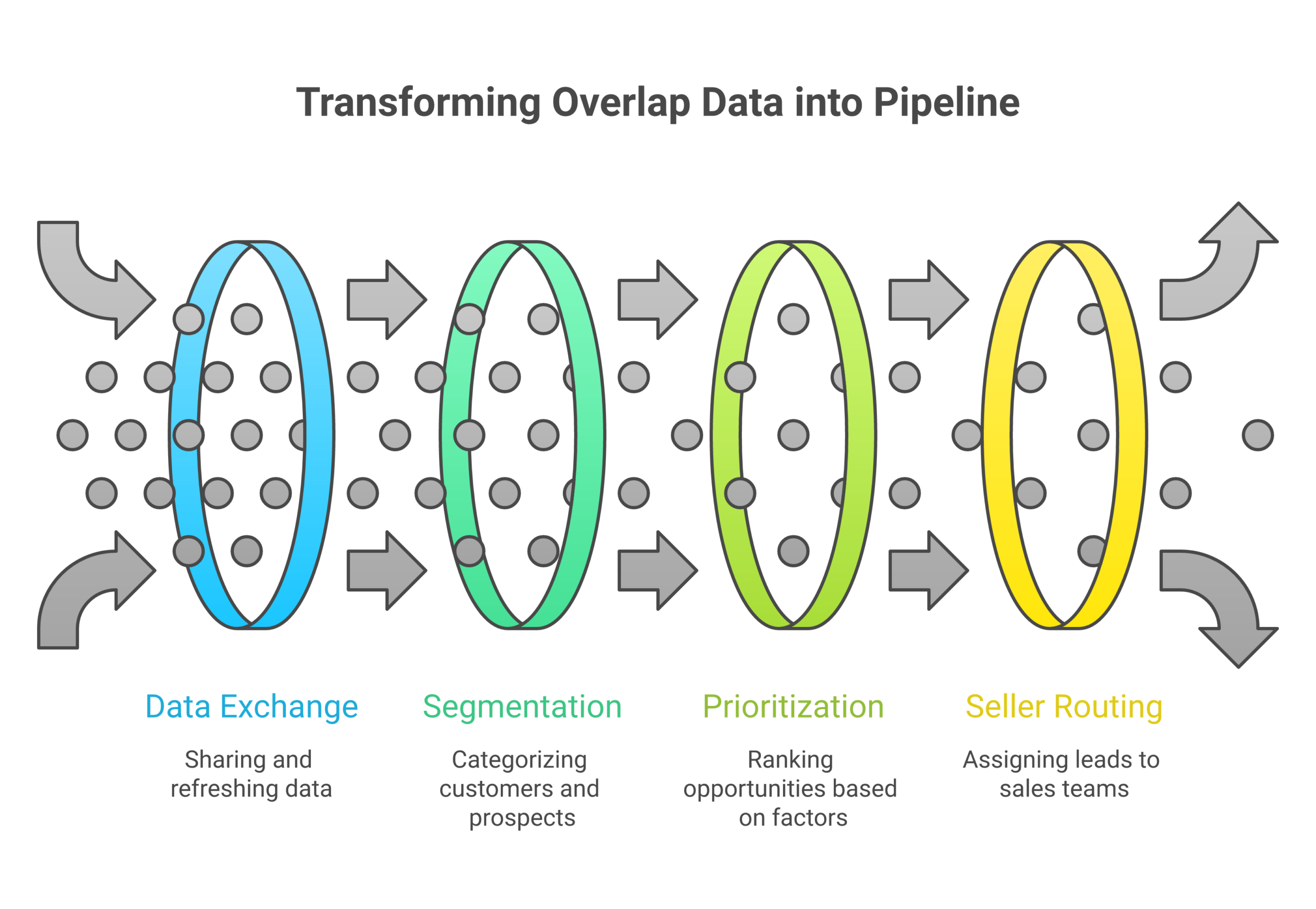
Four stages compound into a pipeline-producing motion. The order matters: data exchange establishes the comparison, segmentation organizes the results, prioritization makes the list actionable, and seller routing puts the prioritized accounts into the workflow. Skip a stage and the motion reverts to a one-time export.
- Data exchange: both partners agree on a data structure (account name, ID, customer or prospect state, key metadata) and exchange via spreadsheet, secure file share, or platform (Crossbeam, Reveal, PartnerTap). The exchange protocol matters; teams that argue about data structure for two months are not yet doing partner account mapping. (See overlap data for the source comparison.)
- Segmentation: the combined list is segmented into shared customers, shared prospects, one-sided customers, and one-sided prospects. The one-sided segments are usually the largest by account count and the largest contributor to new pipeline; many teams over-index on shared customers and under-index on one-sided.
- Prioritization: each segment is prioritized by relationship depth, in-market signal, ICP fit, and strategic importance. The prioritization layer distinguishes pipeline-producing mapping from slide-deck mapping; without it, the seller gets an unmanageable list.
- Seller routing: the prioritized accounts are routed into the seller’s CRM, Slack, or sales-enablement layer on a recurring cadence (weekly is typical). The routing is the system; without it, the prioritized list lives in the partner team’s tools and never reaches the seller workflow.
The four stages have to run on a recurring cadence, not a one-time project. Most partnerships teams run stages 1 and 2 once, run stage 3 with insufficient prioritization, and skip stage 4 entirely. The result is overlap data trapped in a partner-team tool, sellers cold-prospecting into accounts where partner warmth was available, and a quarterly slide that summarizes the gap without closing it.
Common pitfalls
Five repeating failures show up across partner account mapping efforts. All five are operating-cadence issues rather than data-quality issues.
- One-time export, no cadence: teams run the mapping once, produce a slide deck, and never refresh. The data is stale within a quarter, and no operating system is built on top.
- Shared-customer fixation: teams focus on the shared-customer segment (the smallest segment) and ignore the larger one-sided segments where the actual new pipeline lives.
- Prioritization gap: teams hand sellers a list of 3,000-plus accounts with no prioritization layer. Sellers do not know where to start; the list dies in a CRM tag.
- Seller-routing gap: the mapping data lives in the partner team’s platform and never makes it into the seller’s CRM or daily workflow. Sellers do not see it; sellers do not use it.
- Partner-side activation gap: the vendor team works the data internally without ever activating the partner-side seller team. The most productive partner account mapping motion involves partner-side seller talking to vendor-side seller; without that, the data is half-leveraged.
The fix for most of these is the same: design the four stages as a recurring system before launching the program. Programs that get this right see partner-sourced pipeline become a structural contributor within two to three quarters.
Tools and examples
Partner account mapping operates across three tooling layers. The right stack is a function of program maturity, not vendor preference.
| Layer | What it does for partner account mapping | Examples |
|---|---|---|
| Data exchange | Captures the overlap between two or more partner lists on a recurring basis | Crossbeam, Reveal, PartnerTap, bilateral spreadsheet |
| Prioritization | Layers in-market signal, ICP fit, and relationship depth to make the list actionable | Intent data (Bombora, 6sense), CRM signal, partner-ops analyst |
| Seller routing | Surfaces prioritized accounts into the seller’s CRM, Slack, and weekly workflow | Salesforce custom fields, Slack alerts, sales-enablement integration |
A worked example: a mid-stage SaaS company runs Crossbeam for its top fifteen active partners, layers intent data from Bombora, and routes a weekly top-50 prioritized account list into Salesforce as a “partner-warm” custom field and Slack notification. The partner ops analyst owns the data and prioritization layers; sales operations owns the CRM routing. AEs see partner-warmth as a first-class signal in their Monday pipeline review. Within three quarters, partner-sourced pipeline becomes a forecastable share of the company’s new revenue, and the partner program produces a forecastable number that finance trusts.
Forecastable’s POV
The honest test for partner account mapping is whether the seller is acting on the mapped list inside a working week, with a real customer conversation that uses partner-warmth as a starting point. Programs that meet that test produce partner-sourced pipeline that compounds; programs that do not produce overlap data trapped in a partner-team tool, regardless of which platform sits underneath.
The most common failure I see is the inverse, programs that pick the platform first and assume the cadence will follow. The cadence rarely follows. The platform is the accelerator, not the system. Programs that ship a cadence on a spreadsheet and one bilateral exchange first, then upgrade to a platform when the cadence is producing pipeline, end up with both. Programs that buy the platform first end up reconfiguring it through two or three procurement cycles before finally building the cadence the platform was supposed to serve.
The second move is to stop anchoring mapping work on the shared-customer segment. Most partner account mapping programs over-index on shared customers because the segment feels safest. The bigger pipeline opportunity is in the one-sided segments, the vendor’s customers that the partner does not have, and the partner’s customers that the vendor does not have. Programs that re-anchor on the one-sided segments often see partner-sourced pipeline double within two quarters.
The third move is to make the partner-side activation explicit. The most productive partner account mapping motion is partner-side seller talking to vendor-side seller about specific named accounts, not partner-ops talking to vendor-partner-ops about overlap statistics. Programs that build the seller-to-seller activation layer outperform programs that stop at the ops-to-ops layer, every time. It is the cheapest unlock in the partnership stack and the most overlooked.
Forecastable is an independent third-party professional services company. Our evaluations of partner account mapping design are based on publicly-available information as of May 2026 and our own client experience.
Frequently asked questions
What is partner account mapping? Partner account mapping is the structured process of comparing two partners’ account lists, segmenting the results, prioritizing the segments by relationship depth and in-market signal, and routing the prioritized accounts into the sellers’ weekly workflow.
What is the difference between partner account mapping and overlap data? Overlap data is the input. Partner account mapping is the four-stage operating motion (data exchange, segmentation, prioritization, seller routing) that turns overlap data into pipeline.
How often should partner account mapping run? Continuous routing into the seller workflow on a weekly cadence is typical for mature programs. Data refresh can be monthly or continuous depending on platform; segmentation and prioritization should refresh at least monthly.
Which segment of the mapping is the most valuable? The one-sided segments (the vendor’s customers that the partner does not have, and the partner’s customers that the vendor does not have) are usually the largest by account count and the largest contributor to new partner-sourced pipeline.
Do I need Crossbeam to do partner account mapping? No. Bilateral spreadsheet exchange and technographic inference produce mapping data without a multilateral platform. Multilateral platforms are typically faster and easier to maintain at scale across multiple partners.
Who should own partner account mapping inside the company? Partner ops or partnerships team owns the data and prioritization layers; sales operations owns the routing into CRM and seller workflow. The handoff is where most programs lose momentum.
Next step
Audit the four stages of your partner account mapping motion against the weekly cadence. If data exchange exists but the seller workflow does not see the output, the routing stage is missing. If the list is comprehensive but unprioritized, the prioritization layer is missing. Fix the missing stages before changing platforms.
Talk to our team about designing a partner account mapping system that actually produces pipeline →
The account mapping hub holds the broader context on where partner account mapping fits inside the partner motion.
Uncover Your Growth Potential
Schedule a Discovery Call