Partner Enablement Plan Template: How to Use It

What is a partner enablement plan template?
Short answer: A partner enablement plan template is a reusable structure that lays out what a partner’s sellers will learn, by when, and how you will measure it, so enablement runs to a schedule instead of good intentions. It turns a vague promise to support a partner into a dated plan with owners. Used well, it makes enablement repeatable across every partner you sign.
The template is not the enablement itself. It is the frame that forces you to decide the messaging, the practice, the deal support, and the milestones before a partner starts, so nothing important gets skipped.
Why a partner enablement plan template matters in 2026
A partner enablement plan template matters because enablement without a plan quietly does not happen. Everyone agrees a new partner should be enabled, and then the quarter fills with deals and the partner’s reps never get trained. A written template makes enablement a scheduled commitment rather than a good intention, which is the difference between a partner who sells and one who lapses.
In 2026, with partner programs expected to show a return, a repeatable enablement plan is how you scale beyond your first few partners without quality collapsing. The template lets any partner manager run a consistent enablement motion, so the tenth partner gets the same rigor as the first. Without it, enablement depends on whichever manager happens to be diligent.
The template also creates accountability. When the plan names milestones, owners, and dates, it is obvious when enablement is falling behind and who owns fixing it. A plan you can point to is a plan you can hold people to, and that visibility is what keeps enablement from slipping.
How a partner enablement plan template actually works
A partner enablement plan template works by laying out the enablement motion in sections a manager fills in per partner: goals, content, practice, support, and milestones. The components below are the sections a usable template contains.
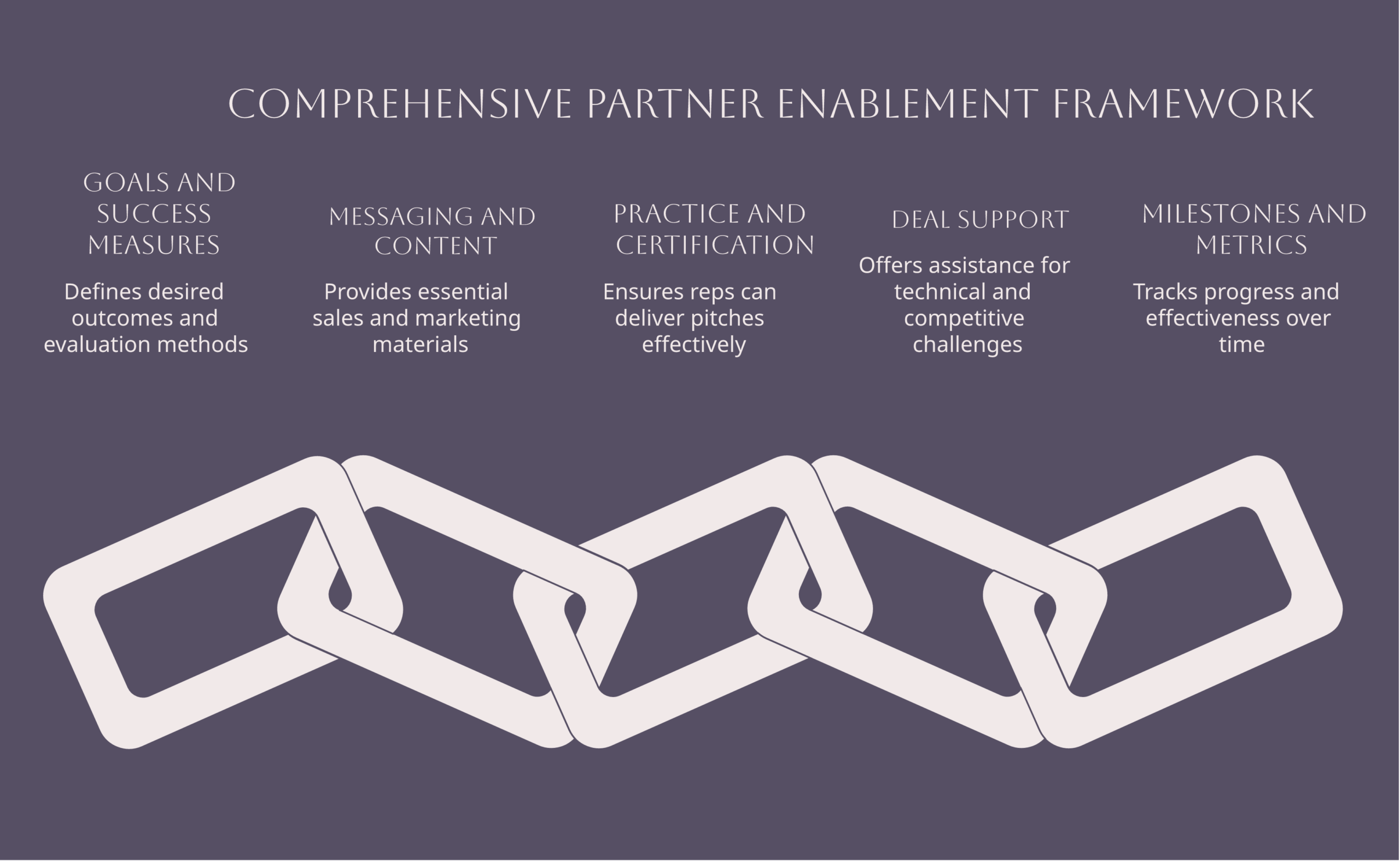
- Goals and success measures: What this partner should be able to do and produce, and how you will know, stated up front so the plan aims at an outcome.
- Messaging and content: The specific pitch, demo, battle cards, and materials this partner’s reps need, listed so nothing gets improvised later.
- Practice and certification: The rehearsals and checks that confirm reps can deliver the pitch live, scheduled with dates, not left as an aspiration.
- Deal support: Who the partner calls when a deal turns technical or competitive, and how that support is requested, defined before the first deal.
- Milestones and metrics: The dated checkpoints and the pipeline and activation measures that show whether enablement is working, reviewed on a cadence.
Common pitfalls with a partner enablement plan template
- Filling it in and filing it: A completed template that nobody revisits is paperwork. The plan works only if the milestones are reviewed and the dates are enforced.
- Content without practice: Templates that list materials but skip rehearsal sections produce informed reps who still cannot sell. Practice must be a scheduled section.
- No owner per section: A plan where everything is owned by everyone gets done by no one. Each section needs a named owner and a date.
- Same plan for every partner: Copying one filled template across partners ignores that a reseller and an ISV need different enablement. Use the template as a frame, not a script.
- Goals with no measure: Sections that state intentions without success measures cannot tell you if enablement worked. Tie the plan to activation and pipeline.
What this looks like in practice
A worked example of a partner enablement plan template in use: a partner manager signed a new reseller and, instead of the usual scramble, filled in a one-page template. The goals section said the partner’s two reps should be able to run the pitch and demo live within thirty days and source their first opportunity within sixty. The content section listed the exact pitch, the short demo, and one battle card. The practice section scheduled two rehearsals with dates. The deal support section named the specialist and how to reach them. The milestones section set a thirty-day certification check and a sixty-day pipeline review, each with an owner. Because the plan had dates and owners, the enablement actually happened, and the partner sourced its first deal on schedule. The lesson was that a partner enablement plan template works when it is treated as a live schedule with owners, because the value is in forcing the commitments and then keeping them.
Forecastable’s POV on a partner enablement plan template
Our position is that a template is only as good as the discipline of using it, and most enablement plans fail not for lack of a template but for lack of follow-through. The frame is easy; enforcing the milestones and dates is the hard part that actually enables the partner. If the plan gets filled in and filed, you have documentation, not enablement. Treat the template as a running schedule you review, not a form you complete.
We also believe the template should force a per-partner decision, not a copy-paste. The instinct is to fill one plan and reuse it, which quietly applies a reseller motion to an ISV and enables no one well. A good template makes the manager choose the messaging, practice, and support that fit this partner, because the whole point is to run a consistent process while adapting to a partner’s actual motion.
Forecastable is a partnerships operating platform focused on connecting partner conversations and actions to CRM pipeline and revenue. We do not provide the template; we make the outcomes it promises measurable, so the activation and pipeline your milestones target show up in the forecast. The plan schedules the enablement; visibility tells you whether it produced.
Forecastable is a partnerships operating platform and a category authority, not a PRM vendor. Any third-party tools or firms referenced in this space are independent third-party products, and mentioning them is not an endorsement. Evaluate any enablement approach against your own partner mix, motion, and CRM.
Frequently asked questions
What is a partner enablement plan template?
It is a reusable structure that lays out what a partner’s sellers will learn, by when, and how you will measure it, so enablement runs to a schedule with owners rather than as a good intention.
What sections should a partner enablement plan template include?
Goals and success measures, messaging and content, practice and certification, deal support, and milestones with metrics, each with an owner and a date.
How is an enablement plan different from an onboarding checklist?
Onboarding is the initial path to a first deal; an enablement plan covers the ongoing capability building, including practice, deal support, and reinforcement past onboarding.
Should you use the same template for every partner?
Use the same template as a frame, but fill it differently per partner, because a reseller and an ISV need different messaging, practice, and support.
How do you keep an enablement plan from being ignored?
Give each section an owner and a date, and review the milestones on a cadence. A plan with enforced dates gets done; a filed one does not.
How do you measure whether the plan worked?
By partner activation and the pipeline the partner produces against the plan’s milestones, tracked in CRM, not by whether the template was completed.
Next step
If new partners keep going un-enabled because the quarter fills up, a partner enablement plan template makes enablement a scheduled commitment with owners and dates. Fill it per partner, review the milestones, and measure activation and pipeline. Start your growth journey now to make enablement outcomes visible in the forecast. The partner program hub frames how a partner enablement plan template connects to onboarding, roles, and attribution.
Uncover Your Growth Potential
Schedule a Discovery Call