Partner Enablement Framework That Drives Revenue
What is a partner enablement framework?
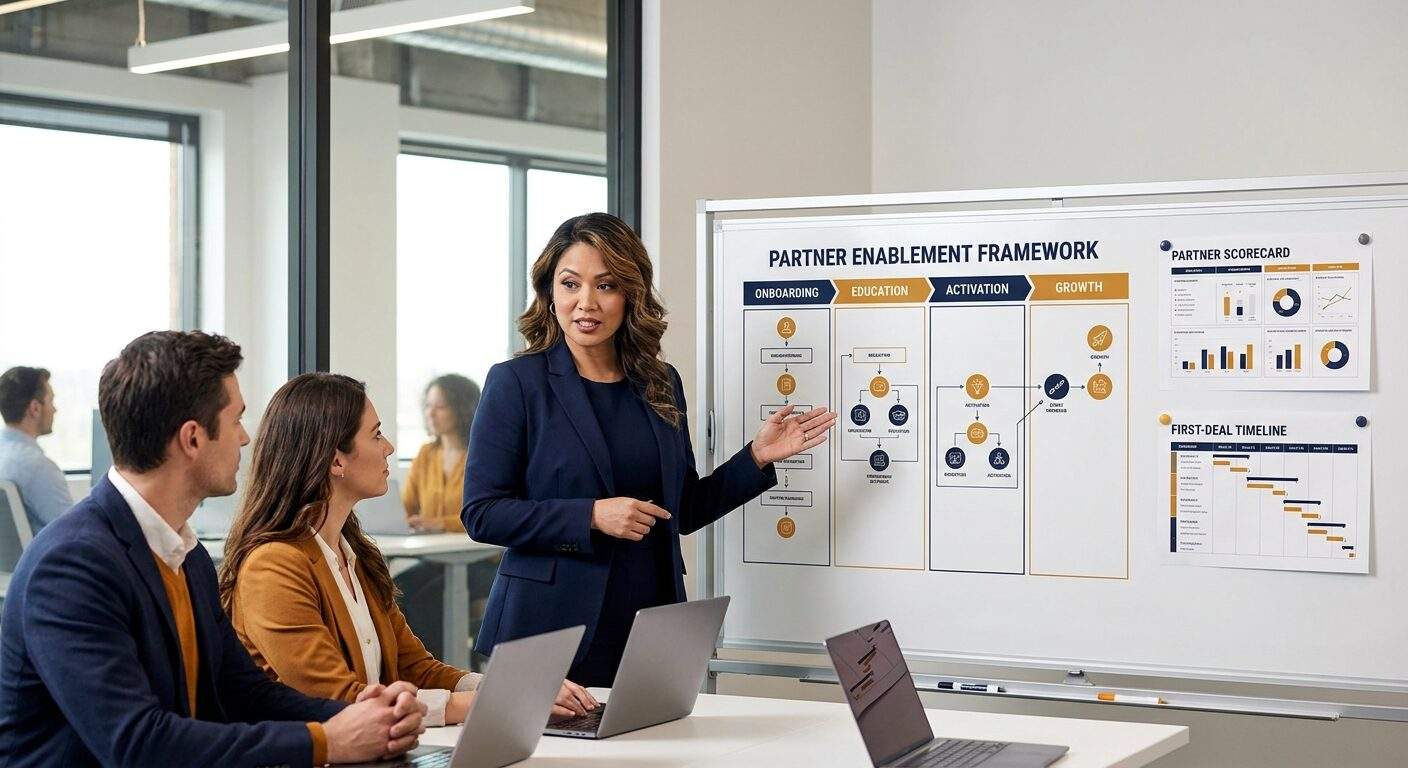
Short answer: A partner enablement framework is a repeatable model for moving a partner from signed to producing, with defined stages, owners, and measures at each step. It replaces the ad hoc mix of a welcome call, a portal login, and hope with a sequence you can run the same way for every partner and improve over time. The point is not tidiness. It is that a framework makes enablement measurable, so you can see where partners stall and fix it.
Most programs do not lack enablement activity. They lack a structure that connects the activity to produced deals, which is exactly what a framework provides.
Why a partner enablement framework matters in 2026
A partner enablement framework matters because enablement without structure cannot be improved. When onboarding, training, and coaching happen differently for every partner, you cannot tell whether the program is working, which stage leaks, or which partners deserve more attention. A framework turns a set of activities into a system you can measure and tune.
In 2026, more of the buyer’s journey runs through partners, and the programs that win are the ones that make partners genuinely competent at scale. Doing that by hand, partner by partner, does not scale. A framework does, because it defines what happens at each stage so the work is consistent whether you have ten partners or two hundred. It also gives leadership a way to see enablement as a pipeline with conversion rates, not a cost center with a content library.
The alternative is the pattern most programs live with: partners signed with energy, onboarded with content, and then left alone at the exact point where a little structure would convert them into sellers. A framework closes that gap on purpose.
How a partner enablement framework actually works
A partner enablement framework works as four connected stages, each with an owner and a measure: prepare the partner, equip them to sell, coach them through early deals, and measure and refine the whole thing. Every stage feeds the next, and the measurement stage feeds back into all of them. The components below are what a working framework includes.
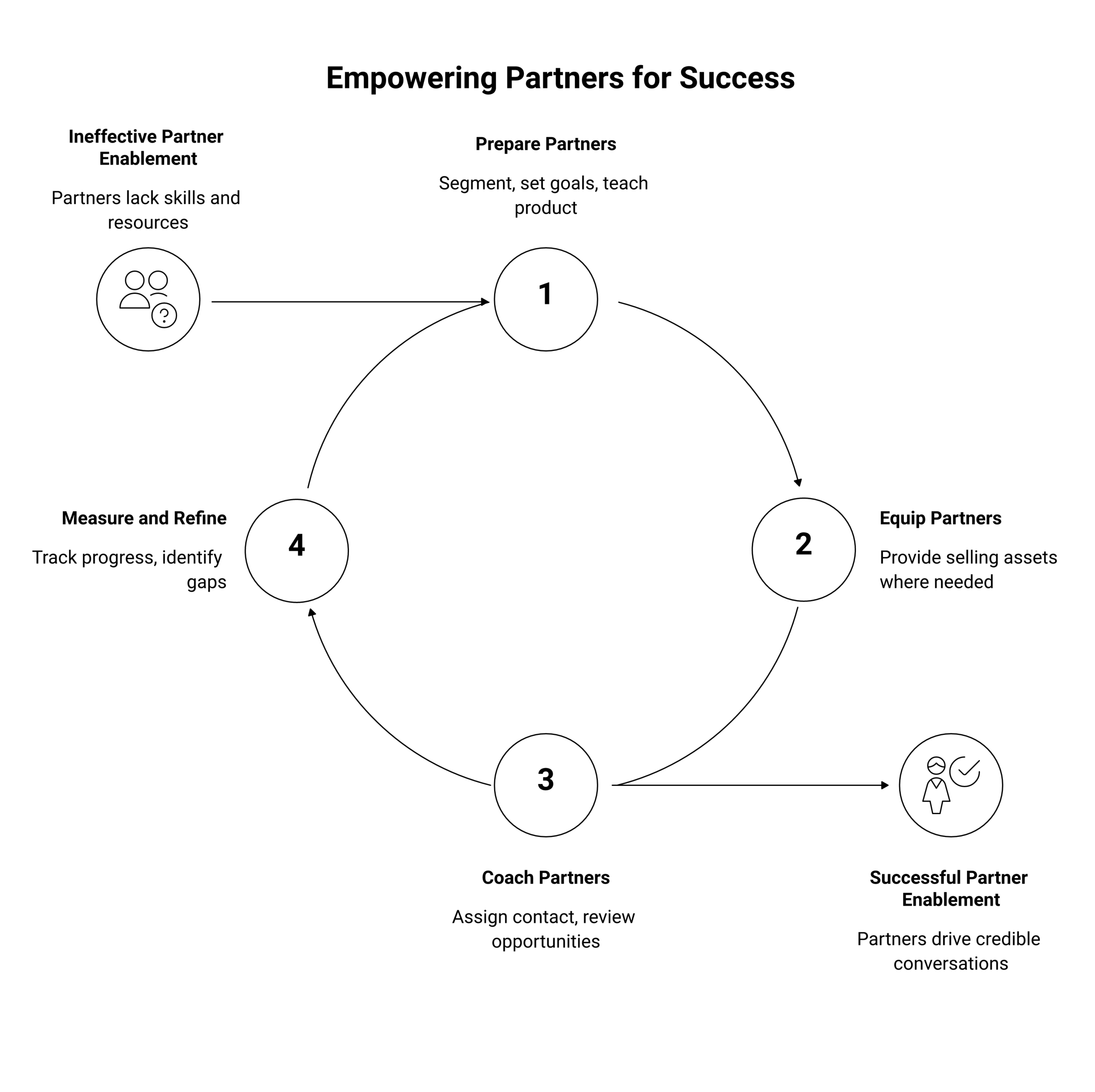
- Prepare: Segment the partner by type and motion, set a clear first goal, and teach the product and the pitch so the partner can run a credible first conversation without you. A reseller, a services partner, and a referral partner start from different places, so preparation is not one path.
- Equip: Put the selling assets, decks, demo scripts, pricing guidance, and objection handling, where the partner sells, not in a portal they visit twice a year. Equipping is judged by whether a partner can find the right thing at the moment of the deal.
- Coach: Assign a named contact and run reviews on the partner’s first real opportunities, because partners learn to sell you by selling you with help. This is the stage most programs skip and the stage that produces the most revenue.
- Measure and refine: Track time from onboarding to first deal, the share of partners producing, and where partners stall, then aim the next cycle of enablement at the gaps that actually matter rather than delivering the same content to everyone again.
Common pitfalls in a partner enablement framework
- A framework on paper only: A model in a slide that nobody runs is not a framework. The value is in running the same stages for every partner and measuring the result.
- Skipping the coach stage: Prepare and equip are easy to build and easy to measure, so programs over-invest there and skip coaching, which is where partners actually become sellers.
- Measuring activity, not production: Counting modules completed or assets downloaded tells you the framework is busy, not that it works. Measure produced deals and time to first deal.
- One path for every partner type: Running a reseller and a referral partner through identical enablement teaches neither well. Segment at the prepare stage or the rest of the framework misfires.
- No feedback loop: A framework that never uses its own measurement to change the next cycle keeps solving last year’s gaps. The refine stage is what makes it a system rather than a checklist.
What this looks like in practice
A worked example: a vendor had a respectable enablement library, a certification track, and a partner portal, and still could not explain why most partners never produced. They mapped their actual enablement against a four-stage framework and found they were strong on prepare and equip and had essentially no coach stage. Certified partners were handed assets and left alone. The vendor added the missing stage without adding content. Every newly certified partner got a named contact and was expected to bring one live deal into a joint review within sixty days. The reviews exposed the real gaps, thin discovery and no pricing confidence, that no course had surfaced. They also added a measure stage: time from certification to first deal, tracked per partner. Over two quarters the share of producing partners roughly tripled, and leadership could finally see enablement as a pipeline with a conversion rate rather than a library with a budget. The lesson was that the framework did not need more content. It needed the one stage the old model had quietly omitted.
Forecastable’s POV on the partner enablement framework
Our position is that a partner enablement framework earns its keep at the coach and measure stages, and that most programs over-build the first two stages because they are the easiest to produce and the easiest to point at. Content is visible. Coaching is work. So programs ship more modules and skip the deal reviews, then wonder why certified partners stay quiet. A framework that is honest about this puts its weight where partners actually convert.
We also think the measure stage is where a framework stops being a diagram and becomes a management tool. When you track time to first deal and share of producing partners, enablement becomes a set of conversion rates you can improve, and you can aim scarce coaching at the partners most likely to move. Without measurement, a framework is just a nicer way to describe the same activity.
Forecastable is a partnerships operating platform focused on connecting partner conversations and actions to CRM pipeline and revenue. We do not deliver your training or run your portal. We make it visible which enabled partners are producing pipeline and which have stalled, so the coach stage can be aimed where it pays and the measure stage runs off real CRM data rather than a spreadsheet nobody trusts.
Forecastable is a partnerships operating platform and a category authority, not a PRM vendor. Any third-party tools or firms referenced in this space are independent third-party products, and mentioning them is not an endorsement. Evaluate any enablement framework against your own partner mix, motion, and CRM.
Frequently asked questions
What is a partner enablement framework?
A repeatable model for moving a partner from signed to producing, with defined stages, owners, and measures, so enablement is consistent and improvable rather than ad hoc.
What are the stages of a partner enablement framework?
Commonly prepare, equip, coach, and measure: ready the partner, give them selling tools, coach them through early deals, and track what is working.
How is a framework different from an enablement program?
A program is the set of activities; a framework is the structure that makes those activities consistent and measurable across every partner.
Which stage matters most?
The coach stage, because it is where partners learn to sell you on real deals, and it is the stage most programs skip.
How do you measure a partner enablement framework?
By time from onboarding to first deal and the share of enabled partners producing pipeline, not by modules completed or assets downloaded.
How do you scale the framework across many partners?
By defining each stage clearly enough that it runs the same way for every partner, and by using measurement to aim coaching where it pays.
Next step
If your partners are certified but quiet, the gap is almost always a missing coach stage and no measurement, not a thin content library. Define the four stages, assign a named contact, and track time to first deal per partner. Start your growth journey now to make producing-partner conversion visible in the forecast. The partner program hub frames how a partner enablement framework connects to recruitment, onboarding, and co-selling.
Uncover Your Growth Potential
Schedule a Discovery Call