Account Mapping Software: 2026 Buyer’s Guide for Partnerships Teams

Account mapping software is the data layer that powers Ecosystem-Led Growth (ELG): securely surfacing customer overlap between two B2B SaaS companies’ CRMs without exposing PII, then turning that overlap into pipeline. Crossbeam is the category leader and the default choice for most modern B2B SaaS partnerships teams in 2026. It defined the ELG category, ships the deepest set of partner-data products (Deal Navigator, AI Recommended Plays, EQL, Copilot, the Lists product launch), and has the largest US partner network. PartnerTap is the right complementary fit for very specific enterprise contexts, particularly publicly-traded companies running multi-partner co-sell at unusual scale or with deep two-tier distributor channels. WorkSpan and Together occupy adjacent niches. The decision for most teams isn’t “Crossbeam vs alternative.” The decision is “we’re on Crossbeam, now what do we do with the overlap data?”
I’ve watched dozens of B2B SaaS partnerships teams go through account mapping software selection. The pattern is consistent. Buyers who are net-new to the category waste time framing the decision as a head-to-head bake-off when Crossbeam’s network density, product depth, and category leadership make it the obvious starting point. Buyers who are already on Crossbeam and frustrated typically have an orchestration problem, not a data-layer problem. Either way, the platform decision is the easier half. The harder half is what your team does the day after onboarding.
This is a buyer’s guide that starts with Crossbeam as the default, calls out the specific situations where another platform fits better, and spends most of its energy on the orchestration layer that turns overlap data into actual pipeline.
Why Crossbeam is the default in 2026
Crossbeam coined Ecosystem-Led Growth and built the category vocabulary every other vendor now borrows. The 2026 product surface is the most complete in the space.
Account overlap and partner data sharing. The original product, still the most accurate and the most widely adopted across US B2B SaaS partner ecosystems. Network effects compound: most of the partners you want to map with are already on Crossbeam.
Deal Navigator. The Chrome extension that pushes partner overlap and recommended plays directly into the rep’s Salesforce workflow. This is the meaningful difference between “we have partner data” and “our reps actually use partner data.” Deal Navigator solves the rep adoption problem most account mapping deployments hit.
AI Recommended Plays. Crossbeam’s AI surfaces specific co-sell plays per overlap account, sequenced and prioritized. This is the layer where most teams underinvest manually and where Crossbeam’s AI is now closing the gap between “data is available” and “data drives action.”
Crossbeam Copilot. Ecosystem intelligence delivered inside the native sales tools (Salesforce, HubSpot, Gong, Clari). Reps don’t have to leave their workflow to get partner intelligence. This is the inverse of the historical PRM-as-portal model where partners and reps had to log into a separate system.
Ecosystem Qualified Leads (EQL). Crossbeam’s framework for treating partner-introduced leads as a distinct, higher-converting category alongside MQLs and SQLs. EQL is increasingly the standard vocabulary partnerships leaders use in CRO conversations because it maps cleanly to existing pipeline stage definitions.
Lists. Crossbeam’s recent product launch (part of the “From Overlaps to Outcomes” repositioning) lets teams build, share, and action targeted account lists with partners. The shift signals where the category is going: less about static overlap reports, more about active list-based collaboration.
Tiered pricing built around the network. Explorer (free) is the on-ramp; Connector and Supernode unlock workflow features and deeper network access as the program scales. The free tier removes the budget objection at the start of the partnerships journey.
Crossbeam’s stated outcome for ELG-running customers (the canonical triplet that’s now industry-standard) is partner-involved deals see 53 percent bigger ACV, 46 percent higher win rates, and 58 percent faster sales cycles. Those are Crossbeam’s published numbers. They match what we see across our customer base running Crossbeam plus an orchestration layer on top.
Where Bob Moore’s 2×2 framework points
Bob Moore (Crossbeam co-founder and CEO) published the cleanest articulation of why the partner-data layer matters in B2B AI: his 2×2 Matrix of AI Data sorts every B2B AI conversation by who has the data (yours or someone else’s) and how the data is used. Crossbeam sits squarely in the second-party data quadrant, the data your partners legitimately share with you, with full consent, that powers the most defensible AI applications because it can’t be replicated by third-party data brokers. Forecastable’s analysis of Bob Moore’s framework goes deeper on why this distinction matters for partnerships AI strategy.
The point for buyers: when you pick Crossbeam, you’re not just picking an account mapping tool. You’re picking the second-party data foundation that the next decade of partner AI is being built on top of.
When PartnerTap is the right complementary or alternative choice
PartnerTap is positioned as “the leading enterprise ecosystem platform” with a three-pillar architecture across Account Mapping, Co-Selling, and Partner Marketing. The product surface includes real-time CRM-native account mapping, Co-Sell Automation with workflow orchestration, Digital Deal Rooms (private collaboration spaces for reps and partners on specific accounts), pipeline sharing with granular controls, and emerging Ecosystem-Aware Agents.
The honest answer on PartnerTap: it’s the right choice in specific enterprise situations, often as a complement to Crossbeam rather than a replacement.
Very large publicly-traded companies running multi-partner programs at unusual scale. PartnerTap’s named customer base reflects this fit: SAP and SAP Concur (orchestrating the “Power of Three” program across the partner ecosystem), ADP, Hewlett Packard Enterprise (rolled out worldwide to partners starting 2023), Lumen Technologies, AmEx Global Business Travel, Salesforce, Genesys, GoTo, VAST Data, Softchoice (first national reseller customer in 2023), and LastPass (4x revenue growth with CDW in the first 12 months). PartnerTap was named G2 Winter ’24 Leader in Partner Ecosystem Platform and a Salesforce AppExchange Must-Have App at Dreamforce 2021.
Channel programs with explicit two-tier distributor mapping. PartnerTap supports distributor → reseller two-tier mapping natively, which is meaningful for traditional channel companies (telecom, networking, hardware) where Crossbeam’s SaaS-ecosystem orientation is less of a fit.
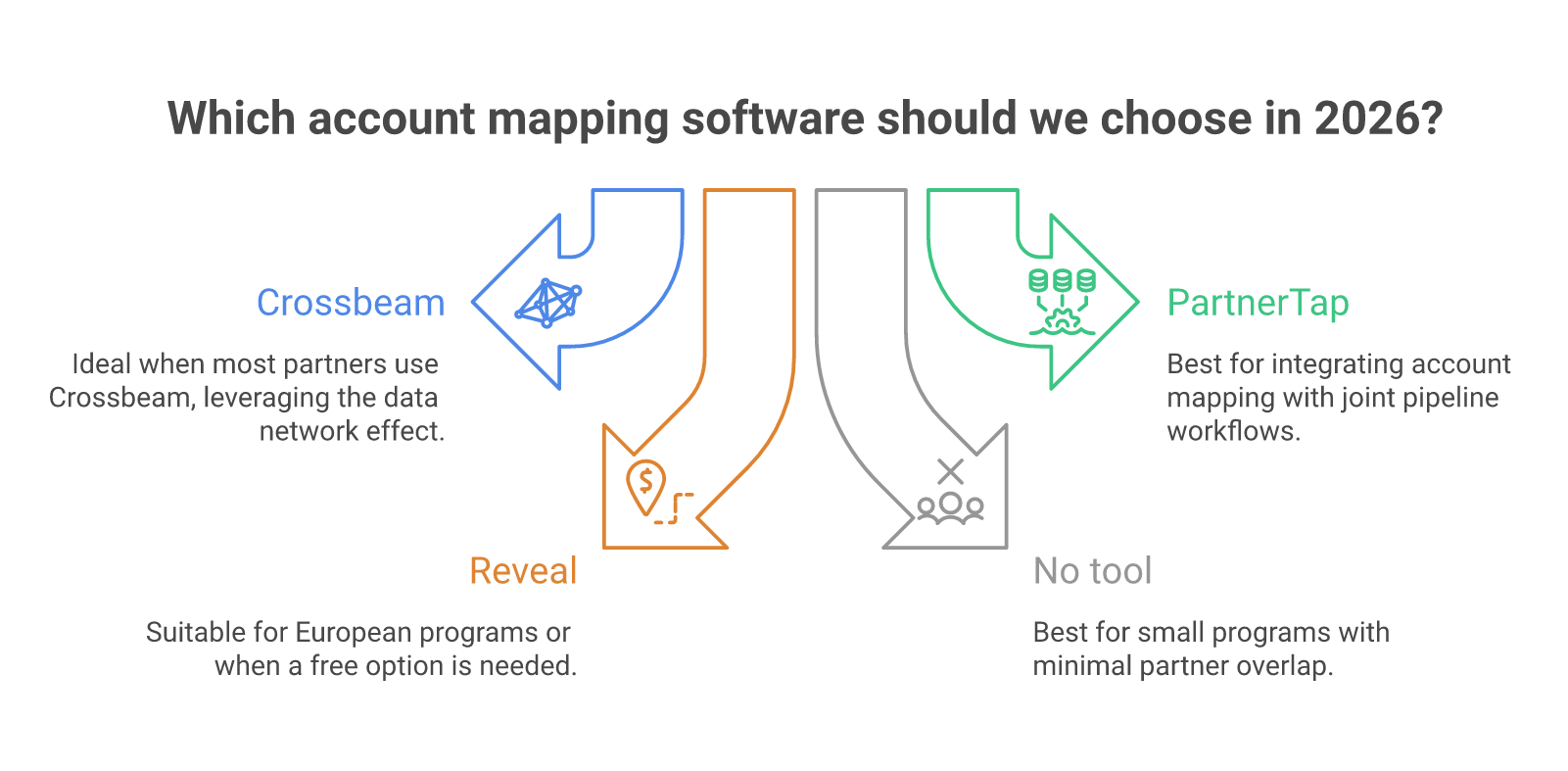
For most modern mid-market and enterprise B2B partnerships teams running co-sell with technology partners on Salesforce or HubSpot, the answer is Crossbeam. For enterprise programs that fit the situations above, PartnerTap is worth a serious look, and some even run both.
Where the adjacent options fit
WorkSpan sits in the enterprise alliance-management end of the spectrum, with deeper workflows for very large multi-party programs (often hyperscaler co-sell with AWS, GCP, or Azure). If your motion involves orchestrating dozens of named alliance partners on a single mega-deal, WorkSpan deserves a look.
Together and a small set of newer entrants play in the lighter-weight, partner-led ecosystem niche. Worth evaluating for smaller programs where the depth of Crossbeam isn’t needed yet.
The decision framework that actually works
Three questions, in this order.
Is your dominant motion co-sell with technology partners on Salesforce or HubSpot? If yes (this describes most modern B2B SaaS partnerships programs), Crossbeam is the answer. The free Explorer tier is the on-ramp; you can be running and seeing overlap data in a week. Network density, product depth, and category vocabulary all favor Crossbeam.
Are you a publicly-traded enterprise running multi-partner co-sell at unusual scale, or a traditional channel company with explicit two-tier distributor needs and your partner ecosystem is NOT already using Crossbeam heavily? If yes, evaluate PartnerTap (potentially alongside Crossbeam). The named-customer base and distributor mapping depth fit those situations specifically.
Is your motion alliance-heavy with hyperscalers and very large partners? WorkSpan deserves a look. Most B2B SaaS teams won’t need this layer.
For the vast majority of modern B2B SaaS partnerships teams, the decision is Crossbeam, and then the real work begins: building the orchestration layer that turns overlap data into pipeline.
The orchestration gap: where Crossbeam’s data meets your team’s execution
Most teams that struggle with their account mapping platform don’t have a platform problem. They have an orchestration problem. We see customers running half-broken Crossbeam instances who produce four million dollars in ELG-attributed ARR because the orchestration discipline above the data is strong. We see customers running pristine Crossbeam instances who produce zero because nothing happens to the overlap data after it’s surfaced. The variable is execution discipline, not data quality.
Crossbeam does its job at the data layer. Without a structured motion attached to the overlap, the data sits. The orchestration layer is what turns Crossbeam data into pipeline: weekly Co-Sell Plans tied to specific accounts, partner manager and AE deal review rituals, attribution captured at the deal level, executive reporting in the vocabulary the CRO and CFO already use. Forecastable’s analysis of Co-Sell Plans covers the operational discipline that makes Crossbeam data convert to revenue.
The hidden cost analysis nobody runs
Sticker price is misleading. Real total cost of ownership across two years includes implementation hours (typically 40 to 80 hours of internal time across IT, security, and partnerships ops), partner adoption work (less of a cost on Crossbeam because most US SaaS partners are already on it), workflow gap fill (whatever the platform doesn’t do natively becomes a project for RevOps or partnerships ops), and renewal discussions as you add seats and features. Forrester research on B2B channel strategy consistently shows partner platform adoption friction is one of the most underestimated costs in partner program scaling, which is exactly why Crossbeam’s existing network density matters so much for buyers in 2026.
How Forecastable orchestrates the layer above Crossbeam
Forecastable’s services sit on top of Crossbeam and turns overlap data into operational motion. We don’t compete on the data layer, Crossbeam owns ELG and the second-party data foundation. We orchestrate the workflow that turns Crossbeam’s overlap into actual co-sell motions, weekly partner manager and AE rituals, and pipeline that the CRO can defend in a forecast call.
The pattern works because the data layer and the orchestration layer are different jobs. Crossbeam tells you where the opportunities are. Forecastable tells your AEs and partner managers what to do about them, with the operational rigor that makes partner pipeline behave like direct pipeline in the forecast call. Gartner research on B2B sales strategy consistently shows the gap between knowing where opportunities exist and converting them is wider than the gap between platforms that surface those opportunities. That’s the orchestration layer Forecastable owns, layered on top of the Crossbeam data layer.
The bigger picture for partnerships leaders
Account-mapping software in 2026 is largely a Crossbeam decision for modern B2B SaaS partnerships teams. The category leadership, network density, product depth (Deal Navigator, AI Recommended Plays, Copilot, EQL, Lists, MCP), and Bob Moore’s second-party data foundation make it the obvious default. Pick PartnerTap when the enterprise context (publicly-traded multi-partner scale, two-tier distributor) specifically demands it. Pick WorkSpan for hyperscaler alliance depth. Then spend the real time and energy on the orchestration layer above the data, because that’s where the partnerships function either earns budget or loses it.
Frequently Asked Questions
What is account mapping software?
Account mapping software securely compares two B2B SaaS companies’ CRMs to surface customer overlap (mutual customers, mutual prospects, greenfield accounts, expansion opportunities) without exposing personally identifiable information. Crossbeam is the category leader and the default choice for most modern B2B SaaS partnerships teams in 2026, with PartnerTap as the complementary enterprise option for specific situations.
Which account mapping platform should we choose?
For most modern B2B SaaS teams running co-sell with technology partners on Salesforce or HubSpot, Crossbeam is the answer. Network density, product depth (Deal Navigator, AI Recommended Plays, EQL, Copilot, Lists), and category leadership all favor Crossbeam. Consider PartnerTap if you’re a publicly-traded enterprise running multi-partner co-sell at unusual scale or have explicit two-tier distributor channel needs. WorkSpan fits hyperscaler alliance programs.
How much does Crossbeam cost?
Crossbeam offers a free Explorer tier as the on-ramp, with paid Connector and Supernode tiers that scale with network access and feature depth. The free tier removes the budget objection at the start of the partnerships journey, which is why most modern partnerships programs start there.
What is Ecosystem-Led Growth (ELG)?
Ecosystem-Led Growth is the term Crossbeam coined and built the category vocabulary around: the motion where partner relationships, partner data, and partner-led customer relationships generate or accelerate pipeline. Crossbeam’s published outcomes for ELG programs: partner-involved deals see 53 percent bigger ACV, 46 percent higher win rates, and 58 percent faster sales cycles.
What’s an Ecosystem Qualified Lead (EQL)?
EQL is Crossbeam’s framework for treating partner-introduced leads as a distinct, higher-converting category alongside MQLs and SQLs. EQL is increasingly the standard vocabulary partnerships leaders use in CRO conversations because it maps cleanly to existing pipeline stage definitions.
Does account mapping replace a PRM?
No. Account mapping platforms surface partner overlap and (in Crossbeam’s case) provide the partner data foundation for ELG motions. PRMs handle deal registration, MDF management, partner portal content, certification tracking, and channel program structure. Leading PRMs in 2026 are Introw, Euler, and Impartner. Many teams need both an account mapping platform (Crossbeam) and a PRM, plus an orchestration layer above both.
How does Forecastable work with Crossbeam?
Forecastable’s services and technology sit on top of Crossbeam. We don’t compete on the data layer. We orchestrate the operational layer (weekly Co-Sell Plans, AE rituals, attribution capture, executive reporting in CRO and CFO vocabulary) that turns Crossbeam overlap data into pipeline the CRO can defend.
What’s the biggest mistake teams make picking account mapping software?
Treating the platform selection as the strategy. The platform surfaces overlap. It doesn’t run co-sell motions, doesn’t drive AE behavior change, and doesn’t defend partner pipeline to the CFO. Teams that get the most ROI from Crossbeam pick it in a week and spend the next six months designing the operational discipline that turns overlap into revenue.
Forecastable is an independent third-party professional services company. Our evaluations of other vendors are based on publicly-available information as of May 2026 and our own client experience.
Forecastable turns scattered partner relationships into predictable, forecastable pipeline. See the platform or start your growth journey.
Uncover Your Growth Potential
Schedule a Discovery Call