Sales Pipeline Generation: Build It Warm-Channel-First

Short answer
Short answer: Sales pipeline generation is the ongoing work of creating new qualified opportunities across every channel a company can use, from outbound and inbound to events and partner referrals, so the funnel stays full enough to hit the number. It is a portfolio problem, and the mistake most teams make is funding the coldest channel first.
Here is the position. The channels differ wildly in cost and conversion, so the order you build them in decides your unit economics. Build the warm partner channel first and the cold channels have less to carry.
What is sales pipeline generation?
Sales pipeline generation is the set of motions that produce new opportunities and move them into the start of the sales process. It covers outbound prospecting, inbound demand capture, marketing campaigns, events, and partner-sourced referrals. The output is qualified pipeline, measured as new opportunity value created in a period.
The useful way to think about it is as a portfolio of channels, each with its own cost to produce a qualified opportunity and its own conversion rate downstream. A healthy engine is not one channel scaled hard; it is a mix weighted toward the channels that produce qualified pipeline most efficiently. Treating it as a portfolio is what turns pipeline generation from a volume contest into an economics decision.
Why sales pipeline generation matters in 2026
Sales pipeline generation matters because the default engine got more expensive and less effective at the same time. The cold-outbound-plus-paid-demand playbook that carried B2B for a decade now costs more per qualified opportunity every quarter, as inboxes filled and ad auctions tightened. Scaling the old engine harder buys diminishing returns.
The second reason is that coverage stopped being enough. Boards used to accept a pipeline multiple of quota as proof the number was safe, then watched teams with healthy coverage miss anyway. The misses traced back to pipeline quality, which is a generation problem: an engine that produces cheap, low-converting opportunities builds impressive coverage and weak revenue.
In my work with revenue teams, the companies that weather a tight year are the ones that already built a warm channel. When cold costs spike, they lean on partner-sourced pipeline that costs little to produce and converts several times higher, while competitors keep paying more to fill the same funnel with worse deals.
How sales pipeline generation actually works
Sales pipeline generation works best when you sequence channels by economics, warmest and cheapest first, rather than scaling whichever channel is easiest to turn on.
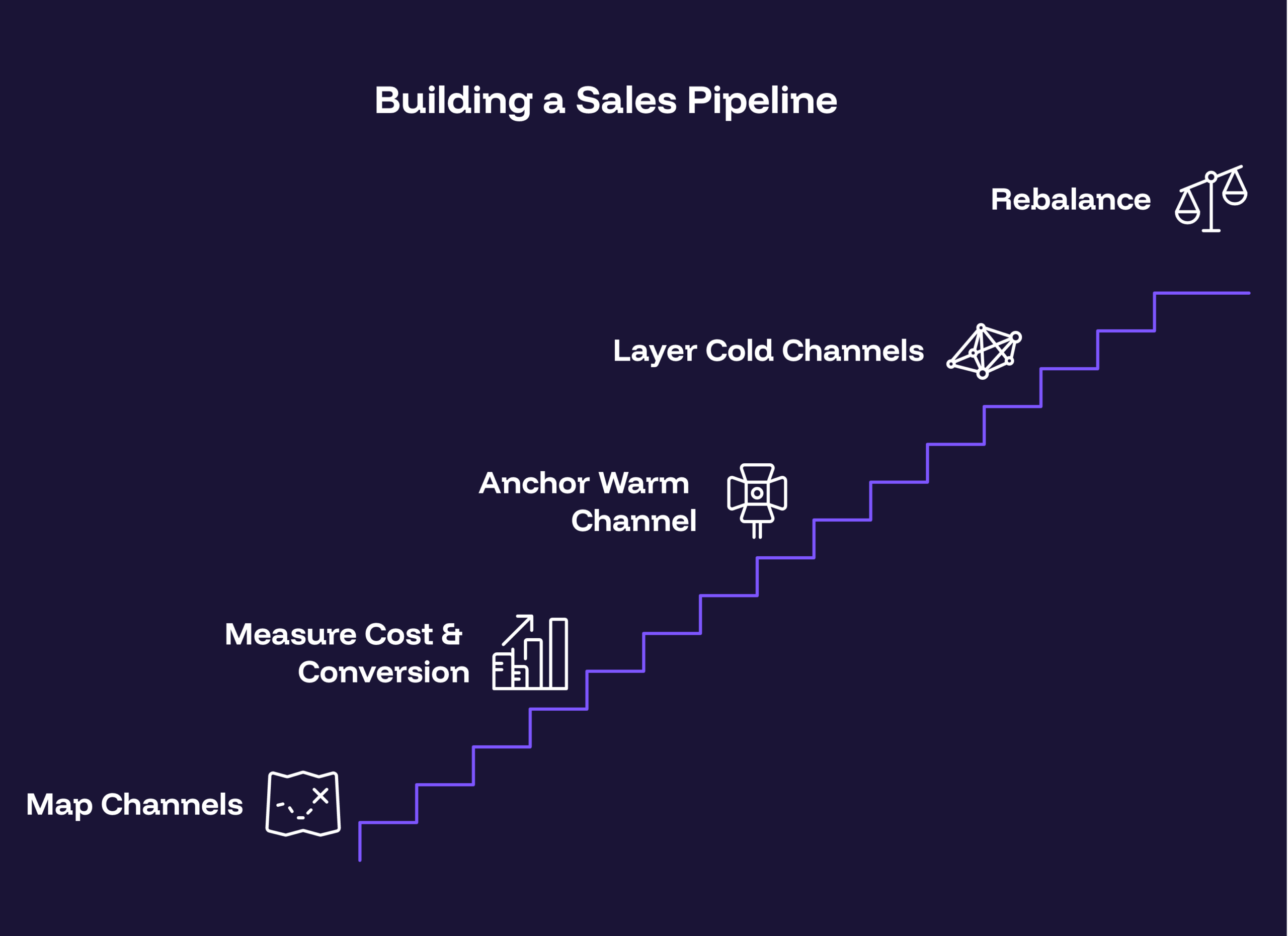
- Map the channels you already have: inventory every source of new opportunities, including the partner referrals that arrive uncounted, because you cannot sequence a portfolio you have not listed and the warm channel is usually the one missing from the list.
- Measure cost and conversion per channel: compute loaded cost per qualified opportunity and downstream win rate for each source, since this is the ranking that should drive where the next dollar goes, not the volume each channel happens to produce.
- Anchor on the warm channel first: build the partner-sourced and referral motion before scaling cold, because warm pipeline is the cheapest to produce and the highest-converting, so every opportunity it creates is one the cold channels do not have to.
- Layer cold channels to fill the gap: size outbound and paid demand to cover the pipeline the warm channels cannot reach, treating them as the expensive capacity you add on top rather than the foundation you start from.
- Rebalance on the numbers, not the habit: review the portfolio each quarter and move budget toward the channels with the best cost per qualified opportunity, because the default is to keep funding the channel you are used to rather than the one that works.
The through-line is sequence. Most engines are built cold-first because cold is the channel a team can control directly, but cold is the most expensive input, so starting there sets the worst possible unit economics for the whole engine.
Common pitfalls
- Scaling cold first: building the engine on outbound and paid demand because they are controllable, which locks in the highest cost per opportunity as the foundation of everything.
- Leaving the warm channel uncounted: letting partner referrals arrive without a source tag, so the cheapest, best-converting channel never appears in the portfolio and never gets funded.
- Chasing coverage over quality: generating pipeline to hit a multiple of quota regardless of conversion, which produces a big number and a weak forecast.
- One-channel dependence: scaling a single source until a platform change or an algorithm shift cuts it off, with no warm channel built to absorb the loss.
- Funding by habit: renewing last year’s channel mix instead of rebalancing on cost per qualified opportunity, so money keeps flowing to the channel the team is comfortable with rather than the one that earns it.
What this looks like in practice
A head of sales needs to double pipeline generation and the instinct is to double the SDR team. The RevOps lead runs the channel economics first. Outbound produces qualified opportunities at 1,200 dollars each and converts at 7 percent. Partner-sourced opportunities cost almost nothing to produce and convert at 31 percent, but they make up only a tenth of the pipeline because nobody has built the motion to generate more of them. Doubling outbound would double the most expensive input the company has.
So they sequence differently. They build a repeatable partner-sourced motion first, which lifts the warm channel from a tenth of pipeline to a third over two quarters, then size outbound to cover the remaining gap. Total pipeline hits the target at a materially lower blended cost, because the engine was rebuilt warm-first instead of scaled cold-first. The lever was never more activity. It was the order of the build.
Forecastable’s POV
Pipeline generation is an economics problem disguised as an activity problem. Teams reach for more SDRs and more ad spend because those are the channels they can turn up directly, and they skip the warm channel because it feels like it depends on relationships they do not control. That instinct builds the most expensive possible engine.
The warm channel is more controllable than it looks once it is instrumented. Partner-sourced pipeline follows a repeatable motion: find overlap with partners, route introductions, and measure what converts. The reason it stays small at most companies is not that it cannot scale, it is that the referrals arrive uncounted and nobody builds on a channel they cannot see. At Forecastable we are a partnerships operating platform that connects partner conversations and actions to CRM pipeline and revenue, so partner-sourced generation is measured in the same engine as outbound and inbound and can be scaled on evidence.
My bet: the teams that build pipeline generation warm-channel-first, and size cold to fill the gap, run a cheaper and more durable engine than the teams scaling cold into a tighter market.
Forecastable is an independent third-party. Any tools, vendors, or third-party figures referenced here are described from public information for the reader’s own evaluation, not as paid placements.
Frequently asked questions
What is sales pipeline generation? It is the work of creating new qualified opportunities across every available channel, measured as new opportunity value created in a period. It spans outbound, inbound, marketing, events, and partner-sourced referrals, and it is best managed as a portfolio of channels ranked by cost and conversion.
How do you generate more sales pipeline? Rank your channels by loaded cost per qualified opportunity and conversion, then fund the efficient ones first. For most teams that means building the partner-sourced channel before scaling outbound, because warm pipeline is cheaper to produce and converts higher.
What is a good pipeline coverage ratio? A common target is three to four times quota, but coverage is only meaningful when weighted by conversion. A lower coverage ratio of high-converting warm pipeline can be safer than a high ratio built from cold deals that rarely close.
Should I build outbound or partner pipeline first? Partner-sourced, where the relationships exist to support it, because it carries the lowest cost per opportunity and the highest conversion. Outbound is the capacity you add on top to cover the gap the warm channel cannot fill.
Why does cold-first pipeline generation hurt unit economics? Because cold outbound and paid demand are the most expensive inputs per qualified opportunity. Building the engine on them sets the highest possible blended cost as the foundation, which every other channel then has to subsidize.
How is partner-sourced pipeline generation measured? By tagging each opportunity to its partner origin and tracking its cost to produce and its downstream conversion in the same system as other channels, so it can be compared and scaled on evidence rather than treated as unpredictable goodwill.
Next step
Before you scale any channel this quarter, rank all of them by loaded cost per qualified opportunity and conversion. Build the cheapest, warmest one first and size the rest to fill the gap.
If your warmest channel is partner-sourced and currently uncounted, that is the engine we help you build. Start your growth journey with Forecastable and we will make partner-sourced generation measurable next to your other channels. Our B2B outbound sales guide covers the cold capacity, and the partner influenced pipeline guide covers how warm pipeline compounds.
Uncover Your Growth Potential
Schedule a Discovery Call