Lead Generation Pricing: What You Pay and What It Hides

Short answer
Short answer: Lead generation pricing is how a vendor or channel charges you for prospects, usually as a monthly retainer, a price per lead, a price per booked meeting, or a cost per click or impression. Each shape moves risk and incentive differently, and the headline price almost never reflects what a customer actually ends up costing you.
Here is the position. The cheapest lead is rarely the cheapest customer. It is a buyer’s job to convert every pricing model into one comparable number, cost per closed customer by source, before signing anything.
What is lead generation pricing?
Lead generation pricing is the commercial model attached to acquiring prospects. It answers a simple question, what do I pay and when, but the models differ in who carries the risk. A retainer puts the risk on you. A pay-per-lead model splits it. A pay-per-meeting guarantee shifts more of it onto the vendor, which they price back into the rate. A cost-per-click model puts volume risk on you and quality risk nowhere.
Pricing is not the same as cost. The price is the number on the contract. The cost is the price divided by the leads that became customers, loaded with the time your team spends chasing the ones that never will. A buyer who compares prices is comparing the wrong number.
Why lead generation pricing matters in 2026
Lead generation pricing matters because the volume era ended. For a decade the model was to buy more leads and let a funnel sort them, and it worked while traffic and attention were cheap. Both got expensive, conversion rates fell, and paying by volume started producing worse unit economics every quarter.
The second shift is scrutiny. Finance now asks demand-gen leaders for cost per acquired customer, not cost per lead, and the two numbers can point in opposite directions. A channel with a low price per lead and a terrible conversion rate loses to a channel with a high price per lead and a strong one. Pricing that is not translated into cost per customer is a trap that looks like a deal.
In my work with revenue teams, the leaders who get burned are the ones who bought the lowest cost per lead and discovered, two quarters later, that those leads converted so poorly the real cost per customer was the highest on the board.
How lead generation pricing actually works
Lead generation pricing works by moving three things around: the price, the risk, and the incentive. Reading a model means asking what each one rewards.
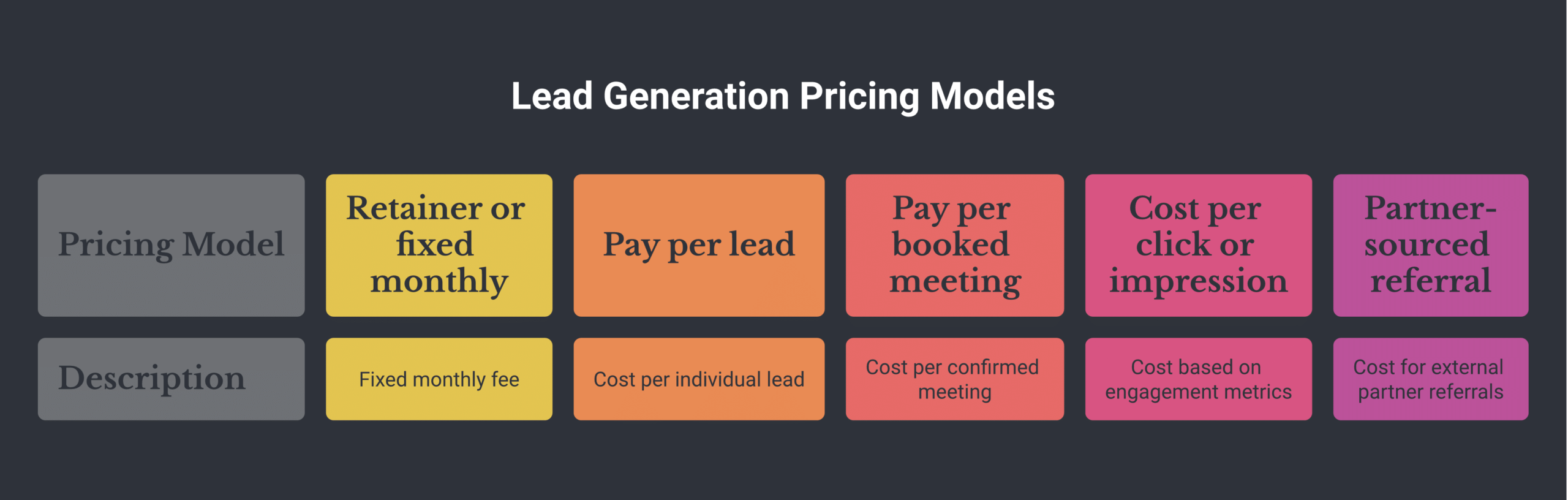
- Retainer or fixed monthly: you pay a flat fee regardless of output, which gives the vendor stable revenue and gives you predictable spend, but it rewards activity over results and leaves you holding all the delivery risk.
- Pay per lead: you pay a set price for each lead delivered, which feels fair until you realize it rewards the vendor for volume, not fit, so the incentive is to send more marginal leads, not better ones.
- Pay per booked meeting: you pay only when a meeting is set, which shifts risk toward the vendor and reads as safer, but the vendor prices that risk in and the incentive becomes booking meetings that happen, not meetings that convert.
- Cost per click or impression: you pay for traffic or exposure and own everything downstream, which is the purest volume model and the one where quality is entirely your problem to instrument.
- Partner-sourced referral: a partner introduces a prospect who already trusts them, so the acquisition cost is low and the conversion rate is high, which is the model finance wishes the others looked like once you measure cost per customer.
The through-line is that every model optimizes to the thing it charges for. Pay for leads and you get leads. Pay for meetings and you get meetings. The only number that aligns a vendor with you is cost per customer, and almost no model charges on it.
Tools and examples
The four common models compare cleanly once you line them up against risk and the real buyer question.
| Pricing model | Who carries the risk | What to watch |
|---|---|---|
| Retainer / fixed monthly | The buyer | Rewards activity, not outcomes; demand a results clause and a source-level conversion report |
| Pay per lead | Shared, tilted to buyer | Rewards volume over fit; set qualification criteria and reject rights in the contract |
| Pay per booked meeting | Mostly the vendor | Rewards meetings that happen, not meetings that close; measure held-to-qualified rate |
| Cost per click / impression | The buyer | Pure volume; quality and conversion are entirely your instrumentation problem |
A worked example. A team compares two offers. Vendor A charges 50 dollars per lead and delivers 400 a month. Vendor B charges 300 dollars per booked meeting and delivers 40. On price per lead, A looks ten times cheaper. Then the team runs it to cost per customer. A’s leads convert at 1 percent, so 20,000 dollars of spend produces 4 customers, or 5,000 dollars each. B’s meetings convert at 15 percent, so 12,000 dollars produces 6 customers, or 2,000 dollars each. The expensive-looking model is less than half the real cost. The only honest comparison was the one neither price tag showed.
Forecastable’s POV
Lead generation pricing is designed to be compared on the wrong axis. Vendors quote the unit they are cheapest on, and buyers compare unit to unit instead of translating everything into cost per customer. The fix is a buyer’s discipline, not a vendor’s honesty: convert every model to loaded cost per closed customer by source before you sign.
Once you do that, the pattern is consistent. Partner-sourced pipeline tends to carry the lowest cost per customer of any channel, because the introduction arrives with trust and the conversion rate reflects it. It rarely shows up on a pricing comparison because no vendor sells it to you as a line item, which is exactly why teams underinvest in it. At Forecastable we are a partnerships operating platform that connects partner conversations and actions to CRM pipeline and revenue, so the cost and conversion of partner-sourced deals sit in the same report as every paid channel, measured the same way.
My bet: the demand-gen leaders who report cost per customer by source, not cost per lead, are the ones who stop overpaying for the cheapest-looking channel they own.
Forecastable is an independent third-party. Any tools, vendors, or third-party figures referenced here are described from public information for the reader’s own evaluation, not as paid placements.
Frequently asked questions
How much does B2B lead generation cost? It depends entirely on the model and the conversion rate behind it. A price per lead can run from tens to hundreds of dollars, a booked meeting from a couple hundred to over a thousand, but the only number that matters is the loaded cost per closed customer, which collapses all of those into something comparable.
Which lead generation pricing model is best? The one with the lowest cost per customer for your motion, which is usually not the one with the lowest headline price. Pay-per-meeting often beats pay-per-lead on real cost, and partner-sourced referral usually beats both once you measure conversion.
Why is cost per lead a misleading metric? Because it ignores conversion. A channel can deliver cheap leads that almost never close and still look like a bargain on cost per lead while being the most expensive source of actual customers you have.
What is a good cost per customer in B2B? There is no universal number; it has to sit comfortably below the customer’s lifetime value and payback target. The useful move is to rank your channels by cost per customer and fund the efficient ones, rather than chase an industry benchmark.
How do I compare lead generation vendors fairly? Convert every quote to loaded cost per closed customer using your own historical conversion by source, add the internal time your team spends qualifying, and compare that single number. Price per lead and price per meeting are not comparable until you do.
Why isn’t partner-sourced pipeline on most pricing comparisons? Because no vendor bills you for it as a unit, so it never appears as a line item. That absence is misleading, since partner-sourced customers are often the cheapest to acquire once you measure the full cost.
Next step
Take your last two quarters of lead spend and recompute every channel as loaded cost per closed customer by source. The ranking will almost certainly differ from your cost-per-lead ranking.
If the cheapest customer turns out to be partner-sourced and invisible on your reports, that is the channel we help you measure and grow. Start your growth journey with Forecastable and we will put partner-sourced cost and conversion next to your paid channels. Our B2B outbound sales guide covers the cold-channel economics, and the partner attribution guide covers how to credit the source correctly.
Uncover Your Growth Potential
Schedule a Discovery Call