Technology Partner: What It Is and How to Work With One

Short answer
Short answer: A technology partner is a company whose product complements yours, where the two of you build joint technical and go-to-market value for shared customers. It matters because the right technology partner extends what your product can do and opens a warm path into accounts they already serve, which is why these relationships anchor most modern partner programs.
The mistake is counting them. A directory of two hundred technology partners with three that actually produce is not a program, it is a logo wall. The value is in the few you activate, not the many you sign.
What is a technology partner?
A technology partner is another software company you align with because your products are better together. Usually that means an integration, sometimes a deeper joint solution, and always a reason for both companies to point customers at the combination. Independent software vendors, platform companies, and complementary application makers are the typical shapes.
The term overlaps with a couple of neighbors worth separating. An integration partner is a technology partner where the relationship is defined by a built product connection: it is the most common concrete form of the broader category. An ISV partner is a technology partner viewed from a platform’s side, where the platform recruits application vendors to build on it. A reseller or channel partner, by contrast, sells your product for margin and is not defined by a technical fit at all. Technology partner is the umbrella for the product-complementary relationship.
The distinction that matters most in practice is fit versus availability. A technology partner is not anyone willing to co-brand. It is a company whose product genuinely complements yours and whose customers overlap with the accounts you want. Partnering on fit produces joint deals. Partnering on availability produces a directory.
Why technology partners matter in 2026
Technology partners matter because buyers assemble stacks, not single products, and the companies whose tools work together own more of the workflow. When your product is part of a joint solution a customer depends on, you are more embedded, harder to replace, and easier to expand. Analyst Jay McBain has estimated that roughly 96% of technology deals are partner-surrounded, which means the other vendors in your customer’s stack are already in most of your deals whether you engage them or not.
The strategic pull is access. A technology partner who already serves an account you are chasing can open a door that cold outbound cannot. That is why partner-sourced pipeline tends to convert faster and win more often: the partner’s existing trust travels with the introduction. Engaged deliberately, a handful of technology partners become one of your most reliable and lowest-cost sources of warm pipeline.
The recurring failure is treating breadth as the goal. Programs chase partner count because it is easy to report, and end up with a long list of signed technology partners and almost no activated ones. Signing a partner is a calendar event. Producing revenue with one is an operating commitment, and the two are constantly confused.
How technology partners actually work
A technology partnership that produces revenue runs on five components. Notice that the integration is only one of them.
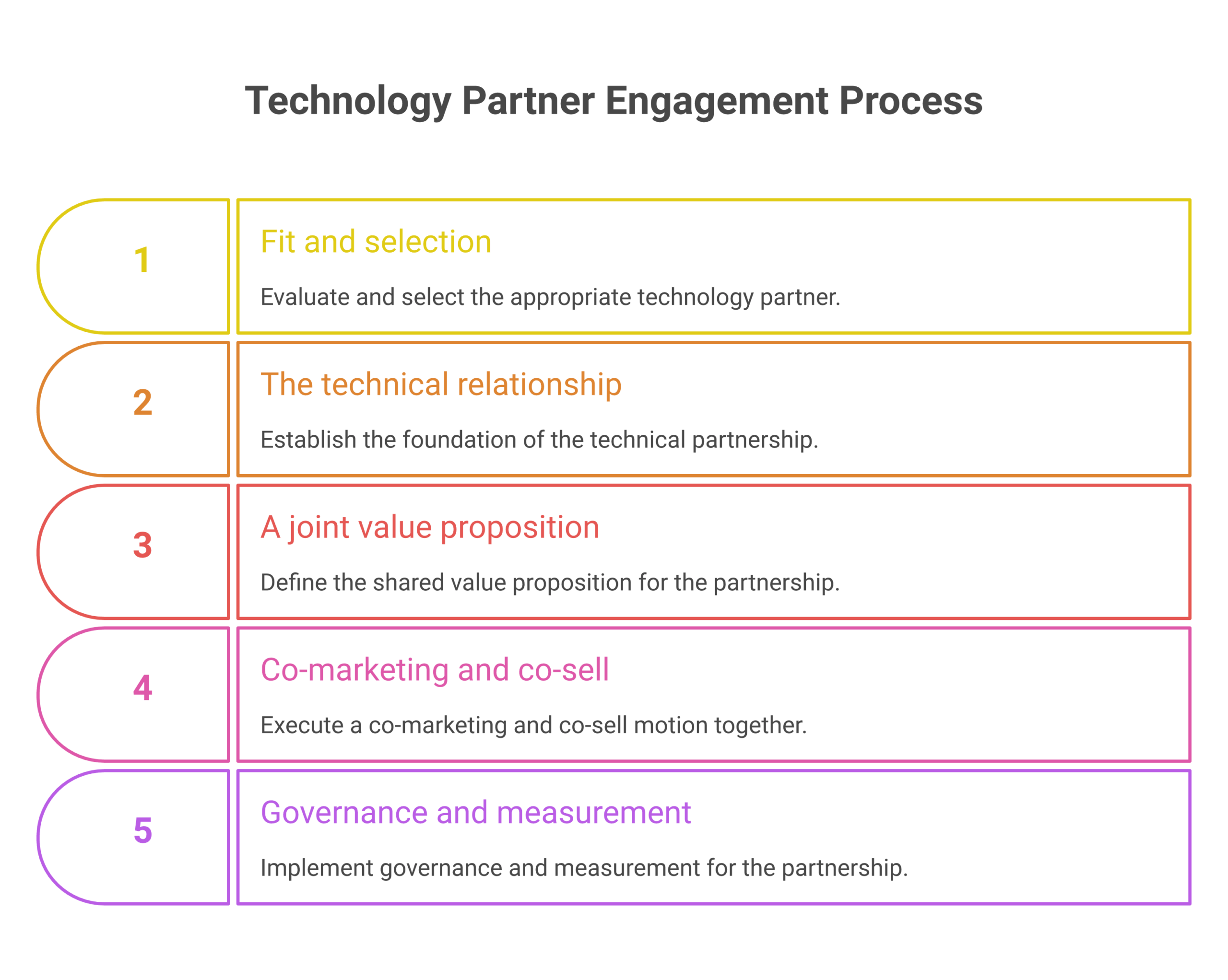
- Fit and selection: choose partners whose product genuinely complements yours and whose customer base overlaps with your targets. Getting this wrong upstream makes every downstream step harder, because you are trying to co-sell a combination customers do not want.
- The technical relationship: build the integration, joint solution, or co-development that makes the two products better together. This is the substance behind the partnership and the reason a customer cares.
- A joint value proposition: state the combined customer outcome in one sentence a rep can say. Without it, the two sales teams have nothing to co-sell and the integration goes undemoed.
- A co-marketing and co-sell motion: define how you generate and work shared demand, through joint campaigns, account mapping, and warm introductions. This is where a partnership stops being a build and starts being pipeline.
- Governance and measurement: assign an owner, run a cadence, and track sourced pipeline. A technology partnership no one owns and no one measures reverts to a logo within two quarters.
The through-line is that the technology creates the reason to partner, and the four components around it decide whether the partnership produces. Companies that stop at the integration get a feature. Companies that run all five get a channel.
Common pitfalls
- Logo collecting: signing dozens of technology partners to show a big ecosystem, while almost none are activated. Partner count is a vanity metric that hides the fact that three partners are doing all the work.
- Integration without go-to-market: shipping the connector and never building the co-sell motion. The products can talk to each other and the sales teams never do.
- Partnering on availability, not fit: saying yes to anyone who asks produces a directory of weak matches instead of a short list of strong ones.
- No owner: a technology partnership that lives between product and partnerships with no single accountable person drifts, because everyone assumes someone else is driving it.
- No measurement: without tracking which partners source pipeline, you cannot tell the productive relationships from the dormant ones, so you keep investing evenly across both.
What this looks like in practice
The version that works starts with classification, not recruitment. Take an ERP company I would model this on: rather than signing every complementary vendor, they split their technology partners into two motions. Systems integrators go into a co-sell and expansion motion, because those firms implement the combined stack and carry deals. Complementary platforms, the HR and finance tools their customers already run, go into a marketplace-integration and API-partnership motion, because the win there is embedded workflow and warm access. Same category, two deliberately different plays, and a short priority list inside each.
From there it is about depth on the few, not breadth on the many. The team picks the three or four technology partners with the strongest fit and the most account overlap, maps shared accounts with each, and runs an actual co-sell cadence: named plays, owners, dates. The other forty signed partners stay warm but do not get equal effort, because equal effort across unequal partners is how programs spread themselves into irrelevance.
The contrast is the ecosystem-page version, where a company lists a hundred technology partners and measures success by how full the page looks. The page converts nothing, because a logo is not a motion. The lesson repeats across programs: the constraint is almost never more partners, it is the discipline to activate and measure the handful you already have.
Forecastable’s POV
Technology partners are where most B2B ecosystems have the most untapped pipeline and the least operating discipline. The instinct is to grow the count, because a bigger directory looks like a bigger program. The reality is that a few activated partners, with real joint value propositions and worked account overlap, produce more than a hundred signed logos ever will. Quality of activation beats quantity of logos, and it is not close.
At Forecastable we build for the activation side. We are a partnerships operating platform focused on connecting partner conversations and actions to CRM pipeline and revenue, the flywheel that runs from conversations to actions to pipeline to revenue. The integration and the directory answer “who are our technology partners.” The work we deliver as part of the service answers the harder question, “which of them are producing, and what are we doing this week to make more of them produce,” run on the Forecastable platform.
My bet: the programs that win will report technology partners by sourced revenue, not by count, and will happily run a smaller ecosystem that produces more. The teams still measuring the size of their partner page are optimizing the wrong number.
Forecastable is an independent third-party. Any tools or vendors named here are described from public information for the reader’s own evaluation, not as paid placements, and Forecastable does not resell them.
Frequently asked questions
What is a technology partner? A technology partner is a company whose product complements yours, where the two of you build joint technical and go-to-market value for shared customers. Independent software vendors, platform companies, and complementary application makers are the common types.
What is the difference between a technology partner and an integration partner? An integration partner is a technology partner where the relationship is defined by a built product connection. Technology partner is the broader term for the product-complementary relationship, and the integration is the most common concrete form it takes.
What is the difference between a technology partner and a channel partner? A technology partner is defined by product fit, where your tools are better together. A channel partner is defined by distribution, where they sell your product for margin. A single company can be both, but the two relationships run on different motions.
How many technology partners should a company have? Fewer than most programs think. A short list of well-activated partners with strong fit and real account overlap produces more than a long directory of signed logos. Depth of activation matters more than count.
How do you measure a technology partnership? Track sourced and influenced pipeline per partner and tie it to CRM. Partner count and ecosystem-page size are vanity metrics. The number that matters is how much pipeline each partner actually sources.
Why do technology partnerships fail? Usually because the integration ships and the go-to-market motion never does, or because the program chases partner count instead of activating the few strong matches. Both produce a directory that does not convert.
Next step
Rank your technology partners by the pipeline they sourced last quarter, not by when you signed them. If most of your partners sourced nothing, the problem is not partner count, it is that no one is running the co-sell motion with the few that fit.
If you want to turn a directory of technology partners into a measured revenue motion, that is exactly what we do. Start your growth journey with Forecastable and we will activate the partners with the most overlap. Our partner program guide covers how technology partners fit the wider motion.
Uncover Your Growth Potential
Schedule a Discovery Call