What Is an ISV Partner? Definition and How They Work

Short answer
Short answer: An ISV partner is an independent software vendor that builds on, integrates with, or sells alongside a larger platform, so the two products work together for shared customers. It matters because ISV partnerships extend a platform’s capabilities and give the software vendor warm access to the platform’s customer base, which is why these relationships anchor most modern software ecosystems.
The common error is filing ISV partners under the wrong label. An ISV is defined by product fit and integration, not by reselling, and treating one like the other misroutes the whole relationship.
What is an ISV partner?
An ISV partner, from independent software vendor, is a software company that partners with a platform by integrating with it or building on top of it. Viewed from the platform’s side, ISV partners are the application vendors it recruits to extend its product and fill its marketplace. Viewed from the software vendor’s side, the platform is the ecosystem it plugs into to reach customers it could not reach alone.
The term is often confused with reseller, and the confusion is costly. A reseller sells your product for margin and is defined by distribution. An ISV partner is defined by product fit: its software complements or integrates with yours, and the value is a better combined product for shared customers. I have sat with teams who admitted they had been thinking about their ISV partners purely as resellers and had done no real partnership work with them, which is exactly how the expansion potential in those relationships goes unrealized.
An ISV partner is also close to, but not identical with, a technology partner. Technology partner is the broad umbrella for product-complementary relationships. ISV partner is that relationship named from a platform’s perspective, where the platform recruits software vendors to build on it. In practice the terms overlap heavily, and what matters is the motion, integration and shared customers, not the label.
Why ISV partners matter in 2026
ISV partners matter because buyers assemble stacks, and the platforms whose ecosystems are richest win more of the workflow. Analyst Jay McBain has estimated that roughly 96% of technology deals are partner-surrounded, and a deep bench of integrated ISV partners is a large part of what surrounds them. The integrations make a platform stickier and open warm paths into accounts the platform and the ISV each already serve.
The strategic pull is expansion. In practice, ISV and integration partners often grow faster and open more expansion opportunity than resellers, because an embedded integration creates ongoing reasons for customers to stay and buy more. A platform that treats its ISV partners as a real partnership motion, not a directory, captures that expansion instead of leaving it on the table.
How ISV partnerships actually work
An ISV partnership that produces runs on four components. The integration is only the first of them.
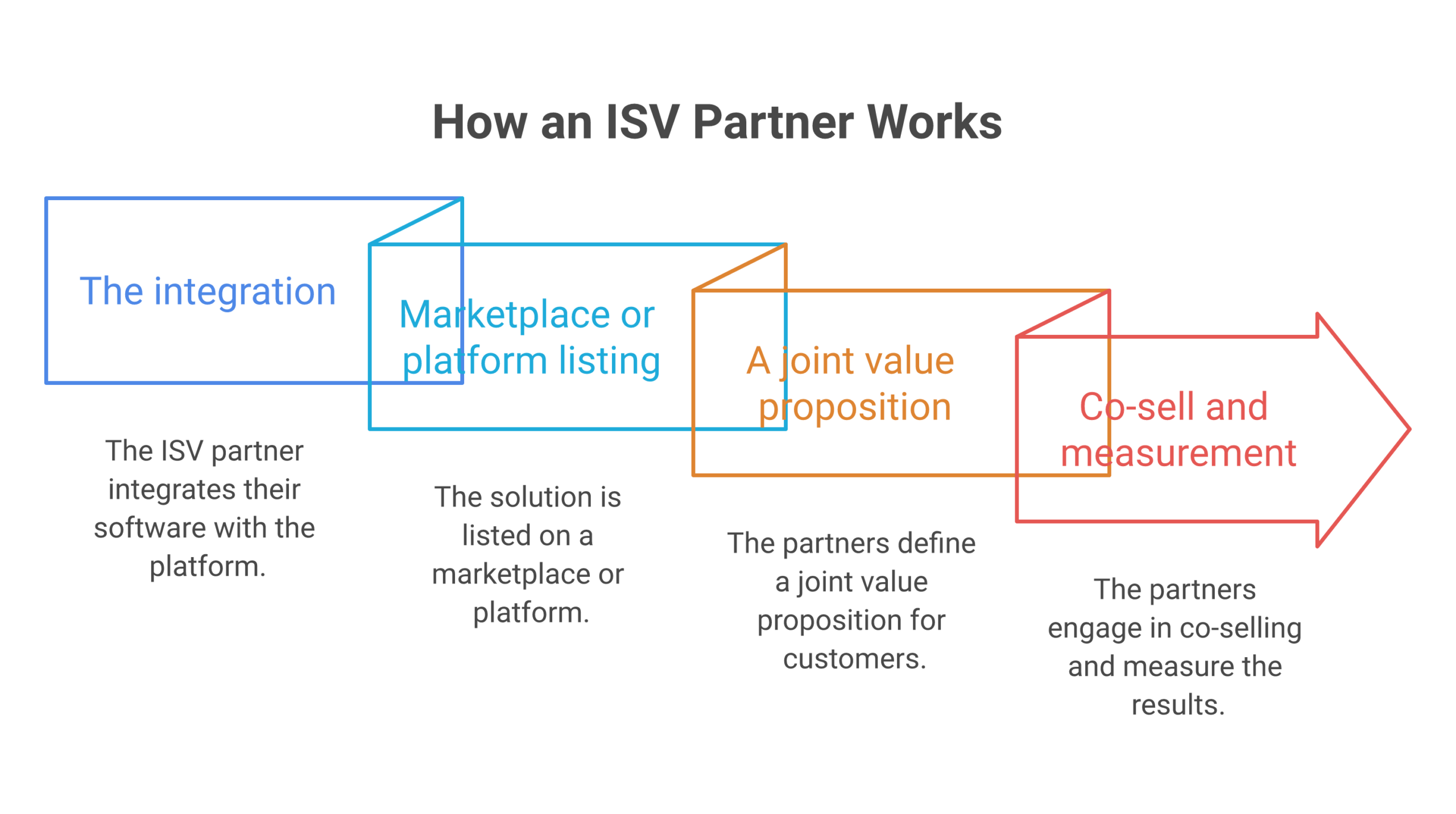
- The integration: the technical connection or build that makes the two products work together. This is the substance of the relationship and the reason a shared customer cares.
- A marketplace or platform listing: the ISV’s presence in the platform’s ecosystem, often transacted through a cloud marketplace, so customers can find and adopt the combination. Distribution follows the listing.
- A joint value proposition: one clear sentence on the combined outcome for a shared customer, so both sales teams have something to co-sell rather than two separate pitches.
- Co-sell and measurement: mapping shared accounts, running warm introductions, and tracking sourced pipeline per partner. This is where an integration stops being a feature and starts being a channel.
The through-line is that the integration creates the reason to partner, and the listing, value proposition, and co-sell decide whether the partnership produces. Platforms that stop at the integration get a longer marketplace; platforms that run all four get expansion revenue.
Common pitfalls
- Filing ISV partners as resellers: treating product-fit partners as distribution partners and doing no real partnership work with them. The expansion potential in the integration goes unrealized.
- Integration without go-to-market: shipping the connector and never building the co-sell motion. The products connect and the sales teams never do.
- Marketplace listing as the finish line: counting the listing as the win and measuring the ecosystem by its size. A full marketplace is not the same as a producing one.
- No measurement: never tracking which ISV partners source pipeline, so the productive integrations are indistinguishable from the dormant ones.
What this looks like in practice
The version that works classifies honestly. A platform team I would model this on realized they had been treating their ISV partners as resellers and had done no partnership work with them at all. Once they reclassified those relationships as integration and expansion partners, mapped shared accounts, and ran an actual co-sell motion with the few strongest, the ISV relationships started producing the expansion the reseller framing had hidden. Same partners, correct label, real motion.
The contrast is the platform that measures its marketplace by listing count. It recruits ISVs, publishes integrations, and reports the number as ecosystem health, while almost none of the listings drive shared pipeline. The lesson repeats: an ISV partnership is an integration plus a go-to-market motion, and the teams that win run the motion instead of counting the listings.
Forecastable’s POV
ISV partners are where platforms most often confuse a full marketplace with a producing ecosystem. The integration and the listing answer “who are our ISV partners.” They do not answer “which of them are producing expansion, and what are we doing to make more of them produce.” That second question is the whole game, and it is a partnership motion, not a directory count.
At Forecastable we build for that motion. We are a partnerships operating platform focused on connecting partner conversations and actions to CRM pipeline and revenue, the flywheel that runs from conversations to actions to pipeline to revenue. The work we deliver as part of the service is activating and measuring the ISV partners that can drive expansion, run on the Forecastable platform.
My bet: the platforms that win will report ISV partners by sourced and expansion revenue, not by marketplace size, and will run their strongest integrations as a real co-sell motion.
Forecastable is an independent third-party. Any tools or vendors named here are described from public information for the reader’s own evaluation, not as paid placements, and Forecastable does not resell them.
Frequently asked questions
What is an ISV partner? An ISV partner is an independent software vendor that integrates with or builds on a larger platform, so the two products work together for shared customers. From the platform’s side, ISV partners are the application vendors it recruits to extend its product and populate its marketplace.
What is the difference between an ISV partner and a reseller? An ISV partner is defined by product fit: its software integrates with or complements yours. A reseller is defined by distribution: it sells your product for margin. Treating an ISV partner as a reseller misroutes the relationship and hides its expansion potential.
What is the difference between an ISV partner and a technology partner? Technology partner is the broad term for any product-complementary relationship. ISV partner is that relationship named from a platform’s perspective, where the platform recruits software vendors to build on it. The terms overlap heavily, and the motion, integration and shared customers, matters more than the label.
How do ISV partners make money? An ISV earns by reaching the platform’s customers through the integration and the marketplace, driving adoption and expansion of its own product. The platform earns a stickier, more capable offering. Some ISV relationships also transact through a cloud marketplace, which handles billing and co-sell.
Why do ISV partnerships fail? Usually because the integration ships and the go-to-market motion never does, or because the platform treats ISV partners as a directory to count rather than relationships to activate. Both produce a full marketplace that sources little shared pipeline.
Next step
Look at how you have classified your ISV partners. If they are filed as resellers or sitting in a marketplace no one activates, you are leaving expansion revenue unworked, and the fix is a real co-sell motion with the few strongest.
If you want your ISV partnerships activated and measured on the expansion they source, that is exactly what we do. Start your growth journey with Forecastable and we will turn integrations into a producing motion. Our partner program guide covers how ISV partners fit the wider ecosystem.
Uncover Your Growth Potential
Schedule a Discovery Call