Referral Partner: What It Is and How to Work With One

Short answer
Short answer: A referral partner is a company or individual who introduces you to prospects in their network in exchange for a fee, without taking part in the sale or the transaction. It matters because a referral partner opens warm doors that cold outreach cannot, but the model only produces when the referral is easy to make and the partner has a reason beyond the fee to make it.
The mistake is thinking the fee does the work. A referral fee gets attention and rarely gets action on its own. The partners who actually refer are the ones for whom referring is simple, low-risk, and tied to something they already care about.
What is a referral partner?
A referral partner is someone who sends you qualified introductions and earns a fee when those introductions become customers, while staying out of the deal itself. They do not sell your product, quote pricing, or contract with the customer. They make the introduction, and you take it from there.
The model sits at the light end of the partner spectrum. A reseller carries the transaction, contracts with the customer, and keeps a margin. A referral partner never touches the transaction, which makes the relationship simpler to set up and lighter to run, but also easier for the partner to forget. The trade is low commitment for lower control.
The distinction worth holding is referral versus reseller, because the choice is often framed as harder than it is. A referral keeps the partner at arm’s length from the sale, which suits partners who do not want to sell. A reseller agreement can actually be cleaner for the customer, one contract, less procurement friction, and puts the partner closer to the deal. Neither is universally right; the fit depends on the partner and how much of the sale they want to own.
Why referral partners matter in 2026
Referral partners matter because a warm introduction outperforms cold outreach by a wide margin. A partner who already has a trusted relationship with a prospect can open a door in one message that your team would spend months trying to open cold. Partner-sourced pipeline tends to convert faster and win more often precisely because the partner’s trust travels with the introduction.
The strategic value is low-cost, high-trust access. A referral program is inexpensive to run relative to a reseller or OEM motion, and it scales with the number of partners who have relationships you want. For many companies, a well-run referral motion is one of the cheapest reliable sources of warm pipeline they have.
The recurring failure is relying on the fee to drive behavior. I have watched programs set a referral fee, announce it, and wait, then wonder why the introductions never came. The fee is necessary and rarely sufficient. For some partners it works; for the highest performers, who are already successful and do not need the money, a referral fee changes nothing, and the activation has to come from somewhere else entirely, usually status, exclusivity, or a genuine benefit to their own customers.
How referral partnerships actually work
A referral partnership that produces runs on five components. The fee is one of them and usually not the one that decides whether referrals happen.
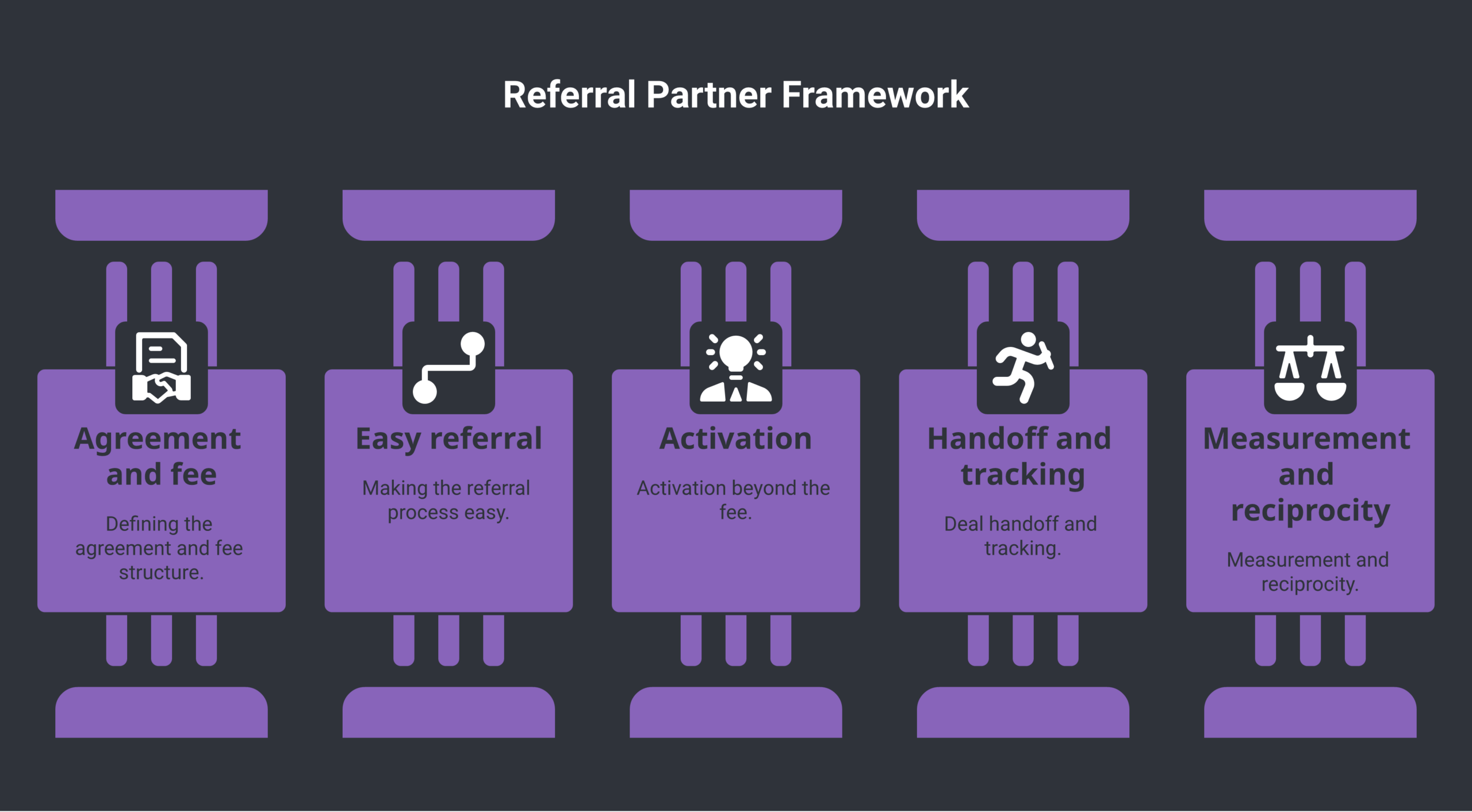
- The agreement and fee structure: define the referral fee and terms clearly, for example a set amount per qualified lead and another on close. The structure has to be simple enough that the partner understands exactly what earns a payout.
- Making the referral easy: give the partner a short messaging template, a clear list of the accounts or profiles you want, and a simple way to submit. Friction kills referrals, so the ask has to be almost effortless.
- Activation beyond the fee: for partners the fee does not motivate, especially high performers, reframe the value as exclusivity, status, or a real benefit to their customers. Position the partnership as selective and advantageous rather than as easy money.
- Deal handoff and tracking: take the introduction cleanly, keep the partner informed, and record the referral so credit is unambiguous. A partner who never hears what happened to their introduction stops making them.
- Measurement and reciprocity: track referrals sourced and closed per partner, and where it fits, send referrals back. Reciprocal relationships produce far more than one-directional ones, because the partner has their own reason to stay engaged.
The through-line is that a referral program is an activation problem, not a pricing problem. The fee sets the terms; whether the partner actually refers depends on how easy you make it and whether they have a reason beyond the money. Programs that set a fee and stop get silence; programs that make referring effortless and worthwhile get introductions.
Common pitfalls
- Relying on the fee alone: setting a referral fee and expecting it to generate introductions. For many partners, and nearly all high performers, the fee is not the motivator, and the referrals never come.
- Making the ask hard: leaving the partner to figure out who to refer and how to phrase it. Every bit of friction between intent and introduction costs you referrals.
- Ignoring what motivates top players: offering money to partners who are already successful and do not need it. They respond to status, exclusivity, and looking good to their own customers, not to a fee.
- Silent handoffs: taking the introduction and never telling the partner what happened. A partner kept in the dark assumes their referral went nowhere and stops sending them.
- No reciprocity: taking referrals without ever sending any back. One-directional relationships fade, while reciprocal ones give the partner a standing reason to keep engaging.
What this looks like in practice
The version that works makes referring effortless and gives the partner a real reason to do it. Take a referral motion I would model this on: the program paid a simple fee, a set amount for a qualified lead and another on close, and paired it with the two things that actually drive action, a short template the partner could send and a specific list of target accounts. The partners who were motivated by the fee referred because the ask was easy and the payout was clear.
The more interesting move was activating the partners the fee did not reach. For high-performing partners who were already successful and indifferent to referral fees, the reframe was status, not money: position the partnership as exclusive and strategically advantageous, we are working with only a few partners in this space, would you like to be one, so the motivation became looking better than their competitors and giving their own customers something valuable. For those partners, the fee was beside the point and the exclusivity did the work.
The contrast is the program that sets a fee, sends one announcement, and waits. The partners who might refer do not know who to send or how, the high performers do not care about the money, and the introductions never materialize. The lesson repeats: a referral program is activation, not pricing, and the teams that win make the referral trivially easy and give each partner a reason that actually fits them.
Forecastable’s POV
Referral partnerships are the cheapest partner motion to start and the easiest to leave dormant. Setting a fee feels like launching a program, and it is only the terms. Whether referrals actually happen depends on activation, making the ask effortless and giving each partner a reason to make it, and that work is where most referral programs quietly fail.
At Forecastable we treat a referral program as an activation motion to be operated, not a fee to be posted. We are a partnerships operating platform focused on connecting partner conversations and actions to CRM pipeline and revenue, the flywheel that runs from conversations to actions to pipeline to revenue. The agreement answers “what does a referral pay.” The work we deliver as part of the service answers “which partners are actually referring, and what makes each of them refer,” on the Forecastable platform. A fee opens the program. Activation fills it.
My bet: the programs that win will activate referral partners by making the ask effortless and matching the motivation to the partner, and will measure referrals sourced rather than fees offered. The teams that post a fee and wait are running a policy, not a program.
Forecastable is an independent third-party. Any tools or vendors named here are described from public information for the reader’s own evaluation, not as paid placements, and Forecastable does not resell them.
Frequently asked questions
What is a referral partner? A referral partner is a company or individual who introduces you to prospects in their network for a fee, without taking part in the sale or the transaction. They make the introduction and hand it off; you run the deal. It is the lightest-commitment partner type.
What is the difference between a referral partner and a reseller? A referral partner introduces a prospect and earns a fee, never touching the transaction. A reseller carries the transaction, contracts with the customer, and keeps a margin. Referring keeps the partner beside the deal; reselling puts them in it.
How much should a referral fee be? Enough to be worth the partner’s attention and simple enough to understand, for example a set amount per qualified lead and another on close. The exact level depends on your economics, but the fee alone rarely drives behavior, so do not expect the number to do the activation for you.
How do you activate a referral partner who does not care about the fee? Reframe the value away from money. For high performers who are already successful, position the partnership as exclusive and strategically advantageous, and emphasize the benefit to their own customers. Status and looking good to their clients motivate these partners far more than a referral fee.
How do you make it easy for a partner to refer? Give them a short messaging template, a specific list of the accounts or profiles you want, and a simple way to submit the introduction. Every step of friction between intent and introduction costs referrals, so the ask should take the partner almost no effort.
How do you measure a referral program? Track referrals sourced and closed per partner, tied to your CRM, and keep partners informed about what happened to their introductions. Fees offered and partners signed are weak proxies. The real measure is active referring partners and the pipeline they source.
Next step
Look at your referral program and ask why each partner would actually refer. If the only answer is the fee, you have a policy, not a program, especially for your best-connected partners, who almost never move on money alone.
If you want referral partners activated, with the ask made effortless and the motivation matched to each partner, that is the operating work we do. Start your growth journey with Forecastable and we will turn a posted fee into sourced introductions. Our partner program guide covers how referral partners fit alongside your other partner types.
Uncover Your Growth Potential
Schedule a Discovery Call