Integration Partners: What They Are and How They Work

Short answer
Short answer: Integration partners are technology companies whose product connects to yours through an API or a prebuilt integration, so your shared customers get combined value from using both. They matter because a working integration is a reason for two vendors to sell together, and a joint account is stickier and easier to expand than a solo one.
Most teams treat the integration as the finish line. It is the starting line. The connector is the easy part; the partnership is the go-to-market work that turns a technical link into sourced pipeline.
What are integration partners?
An integration partner is a company you build a product connection with, usually so data flows between your two tools and a shared customer runs a workflow that neither product could deliver alone. A payroll platform and an accounting platform that sync employee cost data are integration partners. So are a CRM and a calling tool, or a data warehouse and a reporting layer.
The category sits next to two others people often confuse it with. A reseller sells your product for margin. A referral partner points you at a deal for a fee or reciprocity. An integration partner is defined by the product connection first: the relationship exists because the two products are better together, and the selling motion follows from that.
In practice, integration partners split into a few types. Some are large platforms with a marketplace, where being listed is a demand channel in itself. Some are peer tools of similar size where the win is a joint customer story. And some are systems integrators or services firms that implement the combined stack. The motion you run depends on which type you are working with, and the mistake is running the same play against all three.
Why integration partners matter in 2026
Integration partners matter because buyers now expect their tools to work together, and the companies that own the integrations own the workflow. When your product is wired into the systems a customer already runs, you are harder to rip out and easier to grow inside. That is a retention and expansion advantage before it is ever a new-logo one.
The market backdrop reinforces it. Analyst Jay McBain has estimated that roughly 96% of the technology industry’s deal volume is partner-surrounded, meaning another vendor, service, or integration is present in the sale. If nearly every deal already has partners around it, the integrations your customer relies on are among the most reliable warm paths into and out of an account you have.
The catch is the same one that shows up across partnerships: an integration is easy to announce and hard to operate. Publishing a connector and adding a logo to a marketplace produces a listing, not a pipeline. The value shows up only when the two teams actually find their shared accounts and sell into them on purpose.
How integration partners actually work
A real integration partnership runs as five connected pieces of work. Skip any one and the whole thing reverts to a connector nobody sells.
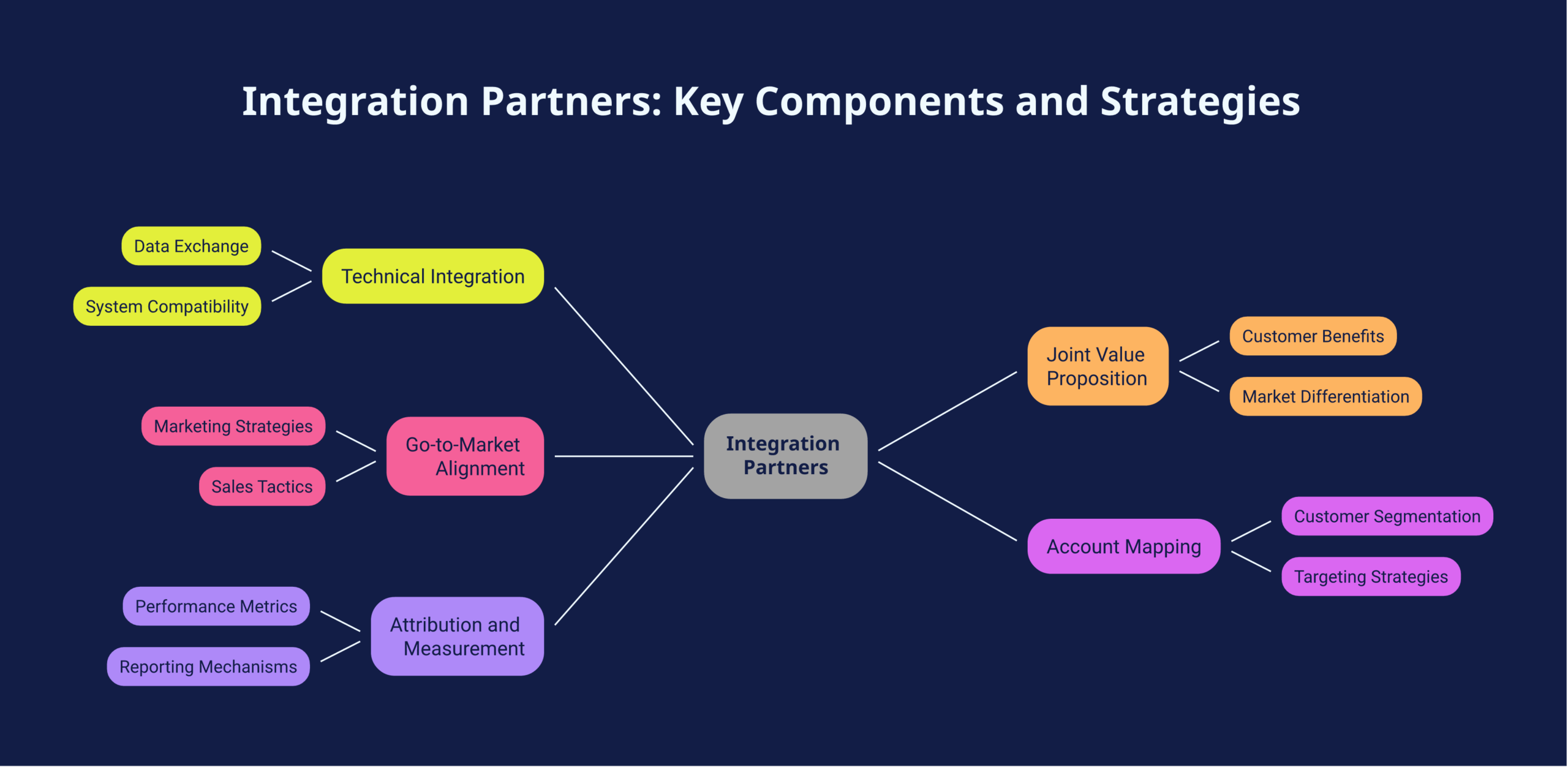
- The technical integration: build and maintain the API connection or prebuilt connector so a shared customer gets a workflow that works and keeps working. This is necessary and it is not sufficient, which is where most programs stop.
- The joint value proposition: state the specific customer problem the combined product solves, in one sentence a rep can say. If neither sales team can explain why the two products together beat either alone, there is nothing to co-sell.
- Go-to-market alignment: decide how the two teams work shared accounts, whether that is co-sell, mutual referrals, or a marketplace listing, and who does what. The type of partner sets the motion.
- Account mapping: compare customer and prospect lists to find shared accounts and warm paths, so reps work real overlap instead of guessing. This is the difference between a partnership on paper and named opportunities.
- Attribution and measurement: track which integration-influenced deals close and expand, so the partnership earns its place in the plan. An integration you cannot tie to revenue is the first line cut in a budget review.
The through-line is that the integration is the reason to partner, not the partnership itself. The connector creates the shared customer; the four pieces after it decide whether that shared customer becomes revenue for either side.
Common pitfalls
- Shipping the integration and calling it a partnership: the connector is the easy 20%. Without a joint value proposition and a selling motion, it is a feature, not a partner relationship.
- No joint value proposition: if the two sales teams cannot say in one line why the combined product wins, the integration gets demoed and never sold.
- No account mapping: without comparing lists, both teams guess at where the overlap is and work the wrong accounts, or none at all.
- The wrong reporting line: integration partnerships often report into product because they start as a build, then never pick up a revenue owner. Someone accountable for pipeline has to own the selling motion.
- No measurement: if you cannot show which deals the integration influenced, the partnership survives on goodwill until the goodwill runs out.
What this looks like in practice
Picture a mid-market ERP company with three integration partners: an HR platform, a payroll tool, and a spend-management app. The connectors all work. For a year, that is all they do, because the partnership lives inside the product team and never reaches a rep.
The version that produces revenue looks different. The team maps its customers and prospects against each partner and finds, say, two hundred shared accounts and another three hundred where the partner is already in and the ERP is not. Those overlaps become named plays: this shared customer is a joint reference, this partner’s customer is your open opportunity and gets a warm-introduction task, this account is one the partner can open for you. Each play gets an owner and a date. This is the co-sell scenario work I run with integration-heavy companies, and it is deliberately concrete: build the list, classify the scenarios, assign the introductions.
Reporting matters more than teams expect. Integration partnerships that report only to product optimize for connector quality and never for pipeline, because no one on that team carries a number. The programs that produce move the selling motion under a revenue owner while product keeps the build. The closer the partnership sits to the revenue org, the better the outcomes, because the person running it is accountable for the same thing the company is.
Forecastable’s POV
Integration partners are the most underused warm-path asset in most B2B companies, and the reason is operational. Building the connector is a project with a clear finish line, so it gets done. Turning the connector into a worked, measured selling motion is an ongoing discipline with no finish line, so it gets skipped. The gap between “we have the integration” and “the integration sources pipeline” is where the value sits.
At Forecastable this is the center of what we do. We are a partnerships operating platform focused on connecting partner conversations and actions to CRM pipeline and revenue, the flywheel that runs from conversations to actions to pipeline to revenue. Overlap tools find your shared accounts with an integration partner; the work we deliver as part of the service is making sure those overlaps become worked plays and tracked pipeline, run on the Forecastable platform. The integration answers “why partner.” We answer “did we sell together, and did it produce revenue.”
My bet: the companies that win their category will be the ones whose integration partners are a measured revenue line, not a marketplace logo count. Treating an integration as a go-to-market motion with owners and attribution, rather than a build that ends at launch, is the difference between a partner ecosystem and a partner directory.
Forecastable is an independent third-party. Any tools or vendors named here are described from public information for the reader’s own evaluation, not as paid placements, and Forecastable does not resell them.
Frequently asked questions
What are integration partners? Integration partners are technology companies whose product connects to yours through an API or prebuilt integration, so shared customers get combined value. The relationship exists because the two products are better together, and a selling motion follows from that.
How are integration partners different from resellers or referral partners? A reseller sells your product for margin and a referral partner points you at a deal. An integration partner is defined by the product connection first. The technical link is the reason to partner, and the co-sell, referral, or marketplace motion is built on top of it.
Should integration partnerships report to product or to revenue? The build can sit with product, but the selling motion needs a revenue owner. Integration partnerships that report only to product tend to optimize for connector quality and never for pipeline, because nobody on that team carries a number.
What is a technology partner marketplace? It is a listing directory a large platform runs where integration partners publish their connector. Being listed is a demand channel, but a listing alone rarely sources deals. The account mapping and co-sell work behind the listing is what converts it.
How do you measure an integration partnership? Track which deals the integration influenced, sourced, or expanded, and tie that back to CRM. If you cannot show revenue impact, the partnership survives on goodwill and gets cut in the next budget review.
Why do integration partnerships fail? Usually because the connector ships and the partnership stops there. Without a joint value proposition, account mapping, an owner, and measurement, the integration stays a feature that gets demoed and never sold.
Next step
List your top three integration partners, then ask how many warm introductions you made into their shared accounts last quarter. If the answer is close to zero, you have a connector, not a partnership, and the pipeline is sitting in the overlap you have never worked.
If you want to turn those integrations into a measured co-sell motion, that is exactly what we do. Start your growth journey with Forecastable and we will build the plays from overlap to pipeline with you. Our partner program guide covers where integration partners fit in the wider motion.
Uncover Your Growth Potential
Schedule a Discovery Call