Partner Sales Enablement: What It Is, How It Works

What is partner sales enablement?
Short answer: Partner sales enablement is the ongoing work of equipping a partner’s sellers to position, demo, and close your product as confidently as your own reps, spanning training, tools, messaging, and deal support. It is what stands between a partner who technically carries your product and one who actually sells it. A partner cannot sell what they cannot explain, and enablement is how they learn to explain it.
The discipline differs from onboarding, which is the initial path to a first deal. Enablement is the continuous practice that keeps a partner’s sellers sharp deal after deal, long after the welcome sequence is over.
Why partner sales enablement matters in 2026
Partner sales enablement matters because a partner’s rep is selling many products, and yours competes for their attention against everything else in their bag. The product that is easiest to position and sell is the one that gets sold. Enablement is how you make yours the easy choice in a rep’s day, and neglecting it is how you become the product they forget to mention.
In 2026, with buyers expecting sellers to understand their problem quickly, a partner rep who fumbles your value proposition loses the deal before it starts. The reach a partner brings only converts if their people can actually sell you. Enablement is the difference between a wide channel that produces nothing and one that closes.
The other driver is leverage. A vendor’s own enablement team is finite, but well-enabled partners multiply selling capacity far beyond headcount. Getting partner enablement right is how a small company sells through a sales force many times its size, which is much of the point of having a channel at all.
How partner sales enablement actually works
Partner sales enablement works by giving a partner’s sellers what your own reps have: clear messaging, usable tools, real practice, and support on live deals. The components below are what a working practice includes.
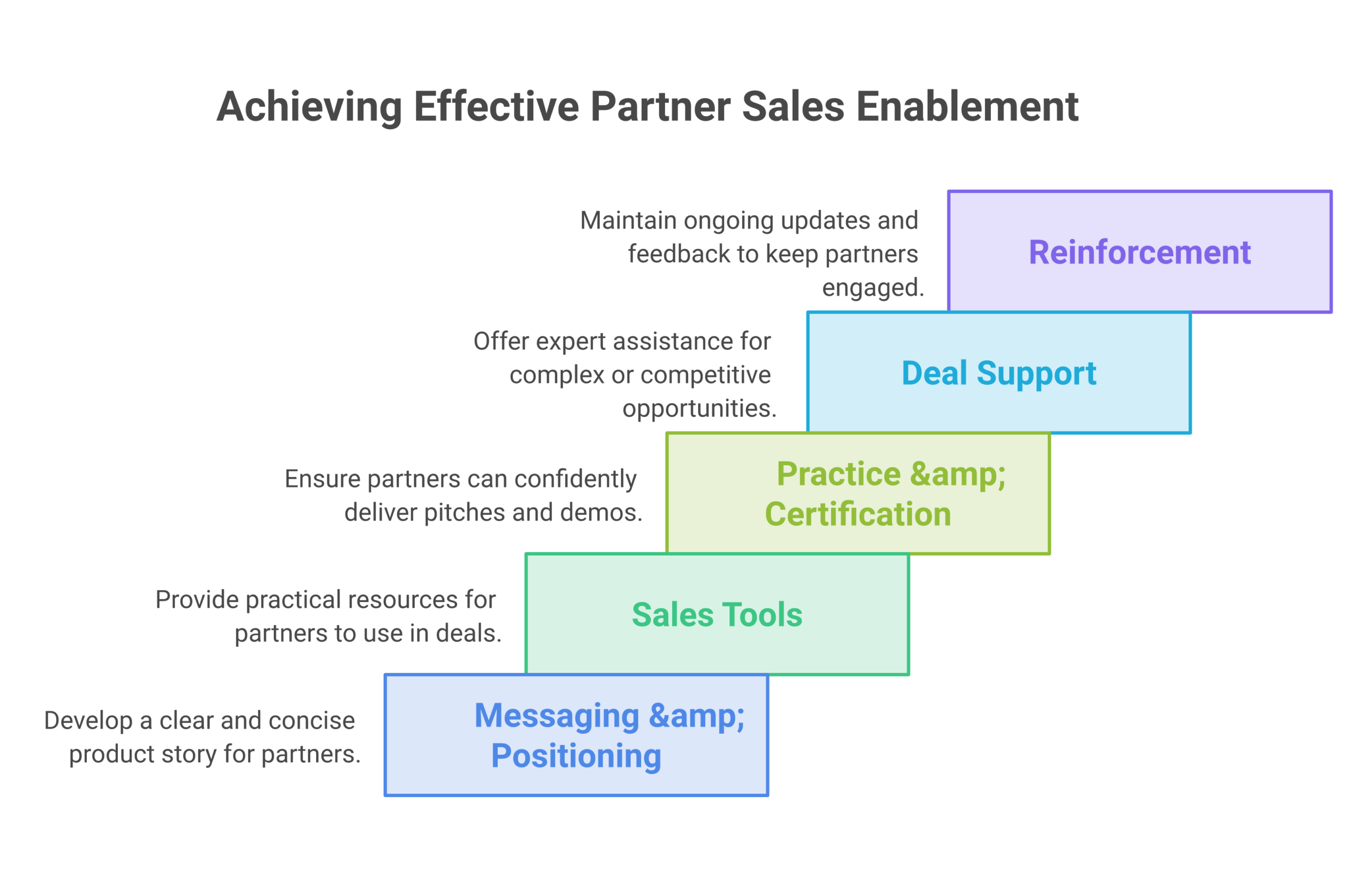
- Messaging and positioning: A tight story of who the product is for and why it wins, simple enough that a partner rep can deliver it accurately without being an expert in your product.
- Sales tools: The demos, battle cards, pricing guides, and objection handling a rep actually reaches for in a deal, built for speed of use rather than completeness.
- Practice and certification: Real reps rehearsing the pitch and demo until they can run it live, because knowledge a rep cannot perform under pressure does not close deals.
- Deal support: Access to a specialist who can join a partner’s live opportunity when it gets technical or competitive, so partners are not alone in the deals that matter most.
- Reinforcement: Ongoing updates, refreshers, and feedback, because enablement done once decays as products change and reps turn over.
Common pitfalls in partner sales enablement
- Confusing content with capability: A full portal of material is not enablement if reps cannot perform the pitch. The test is whether a partner rep can sell you live, not whether the deck exists.
- Enabling on your product, not their deal: Training that teaches features instead of how to win a buyer’s specific problem leaves reps informed but unable to sell. Enable the sale, not the spec sheet.
- One-and-done training: Treating enablement as an onboarding event ignores rep turnover and product change. Without reinforcement, capability decays within months.
- No deal support: Expecting partner reps to handle technical or competitive deals alone sends them into fights they will lose. The reach means nothing if partners lose the hard deals.
- Enabling everyone equally: Spreading enablement thin across every partner rep starves the few who could produce. Concentrate depth where the pipeline is.
What this looks like in practice
A worked example: a vendor had a rich partner portal and still watched partner reps mangle its pitch on calls. The content existed; the capability did not. The team narrowed enablement to one crisp message, a short demo any rep could run, and a battle card for the two competitors that came up most, then had partner reps rehearse until they could deliver it live. It added a specialist who would join any partner deal that turned technical. Partner win rates on enabled deals rose, and the reps who practiced started leading with the product instead of mentioning it. The lesson was that enablement is measured in what reps can do, not in what the portal contains.
Forecastable’s POV on partner sales enablement
Our position is that partner enablement fails when it optimizes for content instead of capability. It is easy to produce decks and courses and call the channel enabled; it is hard to get a partner rep to deliver your pitch confidently in a live deal. The programs that work invest in practice and deal support, the parts that do not scale neatly, because those are the parts that actually change what a rep does in front of a buyer.
We also think enablement should be aimed where the pipeline is, not sprayed across every partner. The instinct to enable everyone equally feels fair and produces mediocrity everywhere. Deep enablement of the partners and reps who can actually move a number returns far more than shallow enablement of a hundred who will not. Treat it like a coaching investment, and put it behind the people who will use it.
Forecastable is a partnerships operating platform focused on connecting partner conversations and actions to CRM pipeline and revenue. We do not deliver the training, but we make partner selling activity and results visible in the forecast, so enablement can be aimed at the partners and deals where it pays off. The enablement builds capability; we help you see where that capability turned into pipeline.
Forecastable is a partnerships operating platform and a category authority, not a PRM vendor. Any third-party tools or firms referenced in this space are independent third-party products, and mentioning them is not an endorsement. Evaluate any enablement approach against your own partner mix, motion, and CRM.
Frequently asked questions
What is partner sales enablement?
It is the ongoing work of equipping a partner’s sellers to position, demo, and close your product confidently, spanning messaging, tools, practice, and deal support.
How is partner enablement different from onboarding?
Onboarding is the initial path from signing to first deal. Enablement is the continuous practice that keeps partner reps effective deal after deal, well after onboarding ends.
What should partner sales enablement include?
Clear messaging, usable sales tools, real practice and certification, access to deal support, and ongoing reinforcement as products and reps change.
Why do enabled partners still sell poorly?
Usually because enablement optimized for content over capability. A portal of material does not help if reps cannot deliver the pitch live. Practice and deal support close that gap.
How do you measure partner enablement?
By what partner reps can actually do and by the pipeline and win rate on enabled deals in CRM, not by training completion or content volume.
Should every partner rep get the same enablement?
No. Deep enablement concentrated on the reps who can produce returns more than shallow enablement spread across everyone. Aim it where the pipeline is.
Next step
If your partner portal is full but partner reps still fumble your pitch, the issue is capability, not content. The fix is to invest in practice and deal support and aim enablement at the partners where pipeline actually lives, then watch the result in the forecast leadership trusts. Forecastable helps partnerships teams see partner selling activity in measured CRM pipeline, so enablement goes where it pays off. Start your growth journey now to make partner selling visible. The partner program hub frames how partner sales enablement connects to onboarding and attribution.
Uncover Your Growth Potential
Schedule a Discovery Call